
• Review: Nixon in China – Scottish Opera – ****

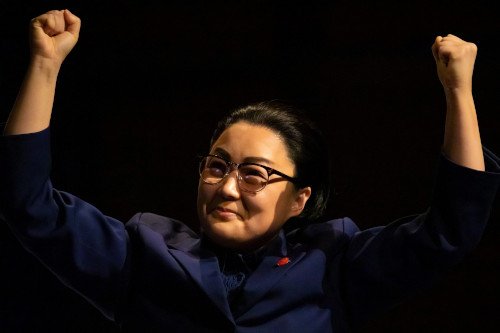
    Madame Mao
    Hye-Youn Lee as Madame Mao. Photograph: James Glossop

    Do we make history or does it make us?

    Scottish Opera’s co-production of Nixon in China is a timely and intelligent piece that asks questions about things that many in the audience will remember yet provides no easy answers. This is not a simple morality tale, nor a love story, nor a tragedy. It is an opportunity for every audience member to reflect on the swirling currents of modern political life. It is a piece that is at once about how strange the past seems to be and how even stranger, the present.

    The dominant theme in John Fulljames’s production is looking back. The whole story is told as a retrospective study of documents within an archive storage facility. Everything is either memory or historical record.

    This is an innovative staging making clever use of video throughout. Some of this is simply projected pictures. More interestingly though, much is seen in the form of layers of documents laid down under a digital vizualiser on a desk on the stage.

    The bold scoring of the arrival of the plane in China (Landing of the Spirit of ’76) is matched with a particularly fabulous kaleidoscope of projected images on stage.

    Joana Caneiro’s conducting shows some restraint throughout the evening. Both orchestra and singers seem a little underpowered. There was no trouble with balance between the pit and the stage but as the action and the theatre heated up, the sound of the fans on the large digital projector in the auditorium were more of a distraction than they should have been.

    None of this took away from the sheer excitement of the score. This is a phenomenal musical work. The retrospective mood on the stage perfectly matches the retrospective mood of much of the music, referencing, Wagner, Stravinsky, dance tunes and so forth. This is a production which also emphasises that though radical in some ways, the piece is fundamentally rooted in an operatic tradition. The various set pieces between the six characters, the three female secretaries singing in a semi-chorus, the quotes from other musical works and librettist Alice Goodman’s teasing playfulness with rhyming couplets all emphasise that this is a piece that refreshes a tradition that we already know well.

    The singing honours have to be awarded to the two female principals. The arrival of Hye-Youn Lee as Madame Mao in the second act was brilliantly exciting. The role demands an agile coloratura soprano and Hye-Youn Lee did not disappoint. Julia Sporsén’s portrayal of Pat Nixon was also astonishing and she completely dominated Act II. Indeed, there was the creeping realisation that there’s an ambiguity in the title of the work. Which Nixon are we celebrating coming to China – Richard or Pat? John Fulljames missed a trick in not bringing Ms Sporsén on last to receive the audience’s appreciation at the end of the evening to make the point that the piece is largely about Pat Nixon rather than her tricky husband. This was particularly seen throughout the revolutionary ballet when the action was entirely focused on Pat. Throughout everything her voice and hair were coiffed to perfection. She looked and sounded impeccable.

    Amongst the men, Eric Greene’s Richard Nixon was interesting and even vulnerable and Nicholas Lester’s final valediction as Chou En-lai the Premier of China moving, elegiac and world-weary.

    As the final archive box was put away with its characters in it, one felt thankful that this work had been brought out of storage by those intelligent enough to make it compelling and interesting. In a world still functionally unable to make sense of the relationship between power and the people this was a production that seemed necessary. I came out at the end of the evening feeling that I understood the world better than I did before. I also came out feeling that the world was also more perplexing than it seemed earlier in the evening.

    Both things can be true.


    Rating: ★★★★☆

    This review was published first by Scene Alba.

8 responses to “Synod Review – things you might have missed”

  1. kelvin Avatar

    COMMENTING POLICY

    Someone has tried to leave an anonymous comment making an allegation against someone in our church, that specific instances of bullying have been covered up.

    Whatever my sympathies are about the issue in general or what it being said in this case in particular, it is my view that dealing with this kind of thing through leaving an anonymous comment on a blog is neither an appropriate nor fruitful way forward. Indeed, my guess is that any anti-bullying policy worth its salt would argue that such a comment was itself an inappropriate behaviour in church circles.

    There is a grievance procedure in the church. If the person who left the comment would like to contact me by email or phone, I would be happy to point them towards the most appropriate way of dealing with the unfinished business which is causing them concern.

  2. chris Avatar

    Glad you had the energy to write this up so soon. I’d be interested in the further pursuit of the perceived irregularities with the Reserved Sacrament – but right now I have to get out to an entirely lay-led RS communion …

  3. Sarah Murray Avatar
    Sarah Murray

    It would be great to see the stats more widely available, they are quite difficult to get hold of- having written a paper on secularization and the SEC this year- stats were the first place to start to look at the trends and whether they matched the general trends etc. however I had to go around the houses to find them and then there were some considerable gaps. The census data unfortunately doesn’t include SEC as a separate category and therefore we have no picture from that data either. The patterns and the implications are hugely important picture for the future of the church.

  4. Suz Cate Avatar
    Suz Cate

    First, I offer thanks for the glimpse at a sister-church’s inner workings. Fascinating!

    I’m so sorry to hear that your preparation for ordained ministry included bullying. My personal experience here in TEC of the USA has been entirely supportive and not a bit confrontational (which isn’t to say it hasn’t been probing at times), but I’m aware of colleagues whose “process” has definitely included some bullying, and it is disgraceful.

    Your observation that “by such small mercies that great social change happens” is apt. I’ve seen that principle in action in our diocesan convention, in the pews of multiple parishes, and, more significantly for a native of the southern US, in the hundreds of daily situations in which persons of all different sorts have access to what were in former times the exclusive privileges of white upper class.

    The fact that there are still unspoken and unseen barriers to truly free access (here I’m thinking of my African American friends who feel the need to teach their sons to avoid encounters with the police, for instance) bears witness to the need to include as contributors and consultants the subjects of projects such as the Grosvenor Essay.

    Data matter. Even outliers are meaningless without the context of the data.

  5. Melissa Holloway Avatar
    Melissa Holloway

    I believe in small mercies – but the genesis of the small mercy mentioned here is a voice of leadership and power. In my southern USA diocese, as far as I can tell, the bishop’s voice goes in a different direction.

    Also, there is a ‘once upon a time’ that I think pertains not just to the Anglican Covenant, but also to the full inclusion of gay people in the church:

    “Once upon a time, I would have been on my feet encouraging, threatening, cajoling. I’d have been sowing fear, uncertainty and doubt. I would have been at work behind the scenes, bending people’s ears, twisting people’s arms – ”

    To risk being coy- as I was recently exhorted, we wait for the holy spirit here.

    I rejoice for this episode in the Scottish Episcopal Church, but it doesn’t make me feel so sanguine about my own life in the church. I hope for the day when a bishop I can claim says such a thing in a diocesan convention and then also for the day when everyone just wonders what the nibbles will be.

  6. revruth Avatar

    I wasn’t there nor did I manage to catch up on the talk about the deaconate online, but I wonder if anyone mentioned how this was going to be financed. Ordaining lots of deacons might be a very nice thing indeed, but I wonder if there is money for this. I reckon there are few churches who could afford both, so…?

  7. Christian Avatar
    Christian

    Fr Kelvin,

    It’s sad but not surprising to read your reporting on the SEC Synod debate about ministry. I am utterly perplexed to read that folks in this day and age think that someone coming straight from college knew nothing about the world. This is one of the reasons why I think that SEC will continue to struggle to attract younger members of our communities if they will not be accepeted (given the opportunity) and recognized for who they are and what they bring–Freshness, passion, zeal, strength, etc.

    However, I thank God for the grace and boldness given to our Primus to respond robustly to such ill-thought notions like: [There were calls for more non-stipendiaries working “not in the parish but in the world” and also for us to focus on those who have “life-experience” to be sought for ministry and not those coming “straight from college who know nothing about the world”.]

  8. Julie Avatar
    Julie

    Provost Kelvin

    It was refreshing to read the various reflections in the special edition of Inspires on-line post Synod 2012.
    Where there were any differences, when I compared the above with your Review, from my perspective, I felt your description was more measured & accurate.

Leave a Reply

Your email address will not be published. Required fields are marked *

Previous Posts

  • Prayers for Remembrance

    Last Sunday evening we had an extraordinary Choral Evensong. The idea was simple – to mark the start of the First World War by singing some of the music that the cathedral choir was singing 100 years ago. The idea came from Pam Barrowman, one of the members of the choir whose historical research includes…

  • Jericho, Berlin and what wall next?

    I remember going on a school trip to Germany when I was a young teenager. I don’t remember that much about the visit to be honest, but I do remember the wall. We were not in Berlin but we were staying near enough to the border between East Germany and West Germany to warrant a…

  • Somewhere over the rainbow

    I’ve just heard that I’ve been included in the Independent on Sunday’s Rainbow List. This is the new name for the Pink List – a list of gay, lesbian, bi and trans people whom the newspaper wants to celebrate as people who have made a difference in the past year. To be honest I’m surprised…

  • Becoming a Welcoming Cathedral

    Someone who is visiting Glasgow at the moment and who has been to St Mary’s a couple of times, said to me this week, “Well, whatever you are telling those people about Welcome, they are actually doing it.” It reminded me of someone in the congregation who said early on in my ministry here, “You…