
• For the cartoonists

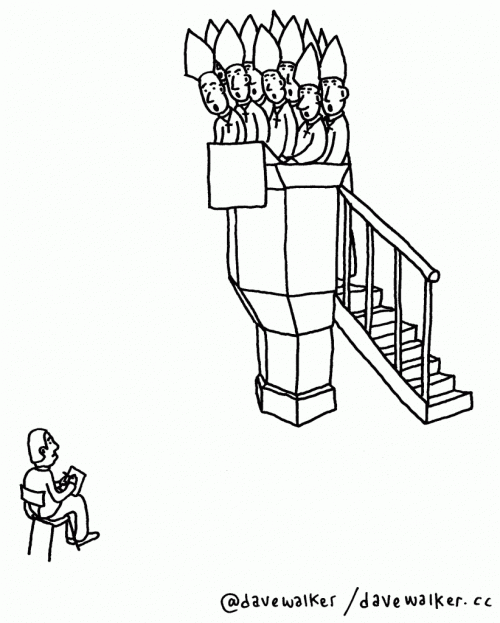
    I used a cartoon, and a religious cartoon at that, on, my blog yesterday and yet I live.

    I sometimes pray for satirists – those who come to occasional services in St Mary’s may occasionally have heard me do so. They don’t usually get enough prayers. Today, sadly, the thoughts of the world are with them.

    The killing of the journalists and cartoonists in Paris today made me think of a divinity class I was in long ago. We were talking about feminism and ethics, that being the stuff I was made on. We had discussed non-violence and non-violent protest. Inevitably we had made an excursion around Ghandi and Martin Luther King Jr and had probably had a go at whether Bonhoeffer was justified in getting involved in the plot against Hitler. We noted that these were all men, of course, and and talked about whether that was inevitably so.

    Eventually, someone said, “Yes, but what about real tyrants. What do we have to say to people facing real tyranny. Do we tell them to go floppy in the middle of the road as part of a protest when they will just get killed for it? What about tyrants – how do we deal with them?”

    There were no answers forthcoming from the class but there was from the person teaching it.

    “Make people laugh at them” she said.

    I’ve never forgotten that answer and I don’t forget it today, for all its problems.

    I realised then that words and ideas were always more potent, always more powerful than force. It was a moment when something significant made sense to me for the first time. Humour can be savage and sometimes needs to be.

    The killings in Paris do no honour to any god. They dishonour our common humanity.

    And so I turn back to my prayers.

    For satirists, humourists, cartoonists.
    For journalists. For bystanders.
    For those who take risks to disturb our peace of mind.
    For those who take risks to give the peace and security for them to do so.

    Lord in your mercy.
    Hear our prayer.


23 responses to “What if this is the end of the Eucharist?”

  1. Thomas Scott Avatar
    Thomas Scott

    Just noticing here that DGD (of happy memory) seems to have left out of his catalogue of joyous, sad, perilous, and solemn occasions any instance of celebrating during a plague or pestilence. I’m not worried about the mass. The eucharist need not be celebrated as though it were a car battery, as if not offering it now would somehow allow the power to run down. It is not at risk, we are, which I think is your point. The questions asked are worth asking, of course.

  2. Mo Nicholson Avatar
    Mo Nicholson

    Mo Nicholson. This is an intriguing discussion and what I would like to add to it is the observation that I have had to learn the hard way that participation in the Eucharist being made impossible in no way diminishes an individual’s ability to worship God or be in fellowship with other believers. I am barred from receiving Holy Communion in the Catholic church because allergies make this impossible for me. The pain induced by this has little to do with feeling separation from God, in fact nothing at all as I do not feel that. It comes from feeling excluded from the community, different sections if which regard it as desirable or tolerable that a member of the community should be excluded in this way. This experience has made me understand as never before that if we place prime value on liturgical celebrations, ir indeed anything else, above charity, compassion, welcome and inclusivity, in other words love, then we have become the sounding gong which St Paul warned against. If we truly believe that God is love, as I do, then it is obvious that it is love for one another which makes us true children of God our Father, and in light of this we could begin to look at these present challenging circumstances as simply an opportunity to love more, to reach out to one another in whatever way possible in the knowledge that this is what actually matters and always did. Only perhaps we were tempted to almost make a fetish of our rituals, sacraments and so on. And perhaps this can show us a better way more adapted to the world we are supposed to serve.

  3. Lynsay Downs Avatar

    You and your conversation with Dave Roberts prompted me to write this. Does it resonate for you?

    https://astonishing.community/2020/05/06/conversations-in-coronatide/

    1. Kelvin Avatar

      Thanks Lynsay – yes, it does resonate with me very much.

      I’ve shared it on facebook. I think it is really helpful.

  4. Fr Keith Avatar
    Fr Keith

    Thanks again for such a thoughtful piece. With the Eucharist central to much of, at least Anglican/Episcopalian, worship in recent generations, we perhaps forget that the Church in these islands was, between the Reformation and the liturgical revivals of the 19th and 20th centuries, sustained by Mattins and Evensong as the regular diet of worship on Sundays. I’m not advocating a return to such times, but there is, as you suggest, work to be done on non-Eucharistic worship (though not defining it as a negative). Thanks again.

  5. Fenland Boy Avatar
    Fenland Boy

    For the record, I’m not in favour of lay presidency at the Eucharist. I believe, for better or worse, in an ordered church.

    Why are you concerned about lay Presidency?

  6. Chuck Avatar
    Chuck

    May I say respectfully, lighten up. Many Anglicans/Episcopalians lived on the edges of civilization in the nascent U.S. and various elements of the British Empire. Priests to celebrate the Holy Eucharist and to baptize were seldom seen, at most twice a year in many areas. (Bishops, only every several years.) The Church carried on in this manner decade after decade. If circumstances require, the Church will carry on again despite our profound sense of loss.

    I should add, to those who grew up under threat or reality of war, persecution, oppression, famine, other disease, etc, the present difficulty is not unfamiliar in many respects.

  7. Miriam MacCarthy Avatar
    Miriam MacCarthy

    Thank you! It is wonderful to read these serious, personal thoughts about the Eucharist. My feeling is that it has become celebrated to the point of boredom. Church, and what we do in it, is in danger of becoming simply a habit. It could just as well be crackerjack for a fast-asleep congregation. My heresy is that the direction Jesus gave is to “do this in remembrance of me”, and that means everything we eat at any time, whether alone or with others, in thanksgiving. If that is seriously done, it has vastly more meaning. It really gets ones attention and requires preparation. Would not become popular or usual, I predict!

Leave a Reply

Your email address will not be published. Required fields are marked *

Previous Posts

  • +Katharine Jefferts Schori – interview

    One of the highlights for me of last week’s synod was the chance to grab a quick chat with Bishop Katharine Jefferts Schori, the Presiding Bishop of the US based Episcopal Church. We just had 10 minutes (and only 10 minutes!) to record a video interview between the afternoon session and the evening dinner last…

  • Back to base

    Coming back to St Mary’s was rather a shock yesterday. In the time that I had been away at General Synod every piece of equipment known to every broadcast engineer in Scotland appeared to have been put in the Cathedral. This is the weekend that a number of pieces of music are being recorded in…

  • Synod closes with a hymn and a blessing

    Thanks are offered by the Primus for the Synod Eucharist and worship Retiring Conveners are thanked Also chairs for sessions and those who have debriefed them Joe Morrow is thanked for being assessor to the Primus Kennedy Fraser is thanked for the IT Also Rob Warrent and yours truly for updates online Cursillo for tea…

  • Quota

    Synod debates the 3% quota figure for this year. The way of calculating the quota distribution has been questioned from the floor by Catherine Meikle. Prof Peatie says it is a complex thing to do. She also tells us how work she believes has been done to save money. The motion is to put set…