
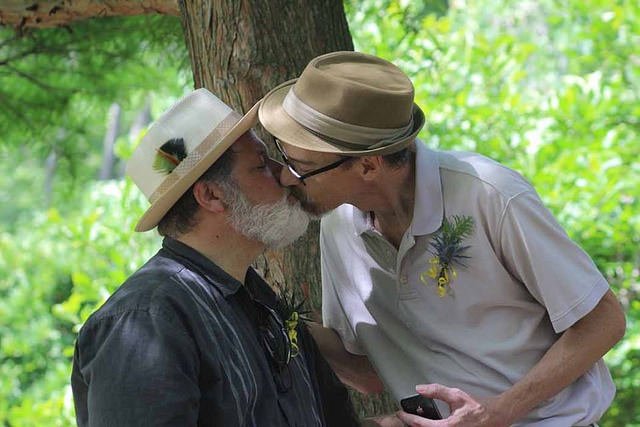
Can it really be that many are happier to see a gay couple marry than give one another a kiss?
Someone asked me recently whether the time had come to stop campaigning on LGBT issues. After all, he said, the gays have got everything they want now. They can get married and everything.
Well, leaving aside that the fact that “the gays” can’t get married in Scotland for another month or so and that when they can do so they will not be able to be married according to the same protocols as “the straights”, marriage in church not being an option for most same-sex couples initially, the truth is, the marriage debate is not the end of gay rights but the start of them moving into the mainstream.
The incredible thing about the campaign to open marriage to same-sex couples is that it wasn’t just same-sex couples who pressed for it to happen. It was a grand coalition of diverse folk – interested people like parents who have gay children, brothers and sisters, workmates and friends as well as gay folk, including gay folk who have no personal interest in marriage for themselves. But it was more than this too – it was a coalition of people who didn’t need to claim a direct interest in the debate. It was a coalition of those who thought that in a modern society the gender of the two people involved is of secondary significance to their love, their hopes for permanence, their promises of fidelity and so on.
In short, it was a coalition of the decent.
Now, that kind of statement gets me into trouble. “How can you say that those who were opposed to this are not decent people? Are they not good people, upright people, moral people too? They just didn’t think this was right – how dare you say they are not decent people?”
Well, the thing is, it isn’t me who is saying that – it represents the huge shift in public opinion that has happened. I’ve helped to shape those changes and am happy to continue to try to do so. Seeing the opinion polls shift so dramatically over the last 10 years is one of the most satisfying things that I’ve ever been involved in.
What happened is that we changed common perceptions about the kind of values that decent people could be expected to hold.
That’s why this is so hard for those who have not shifted much themselves. It must feel to them as thought they are on shifting sand. Moral judgements which once were those which good people could be expected to hold, became those which decent people were not expected to hold.
For some this has been a wonderful seemless recognition that the rights and responsibilities of being human apply to gay and lesbian people just as much as to anyone else. For those outside the big tent it must feel as though something dear has been shattered and broken. I don’t underestimate that, but it isn’t going to get any easier because we’re not done yet.
I was very struck this week in reading an opinion poll in the USA which indicated that there was strong support for changing the law to allow same-sex couples to get married. However, when the same people were asked what they thought of a gay couple kissing or holding hands in public the support somehow seemed to melt away. And there were different perceptions relating to gender too. It wasn’t so bad seeing women holding hands but gay men kissing in public was something that the decent still were not ready to see.
Can it really be that it is OK for a couple to get married, with all the support of the expectations of the institution of marriage, but that those who support them still feel squeamish about seeing such a couple display their affection.
I’ve a feeling this is an issue here.
When I’m conducting the nuptials of couples here in St Mary’s, I always have a rehearsal and quite often we address the question of whether the couple is going to kiss during the ceremony and at what point. (I think they should do what they feel comfortable with).
I’m aware that when I ask straight couples that question they can usually answer it easily. When I ask same-sex couples that question there is a big intake of breath as they think about giving their beloved a kiss in public.
I very occasionally see a same-sex couple coming to church on a Sunday hand in hand. (I see opposite sex couples doing so often enough not to notice). It is worth remembering that there are perhaps only a few hundred yards of the streets of Scotland where they would consider themselves safe to do so and only at particular times. And that’s just holding hands, never mind a wee gay kiss.
It would appear that we’ve a way to go yet before we get to the point where same-sex couples and opposite sex-couples are treated alike and can expect their affections to be regarded in the same way.
The campaigning will change in months to come but it is far from over yet.
I want a world where a kiss is just a kiss. And so much more too.
[Picture Credit – Ron Frazier Creative Commons attribution license]

Leave a Reply