
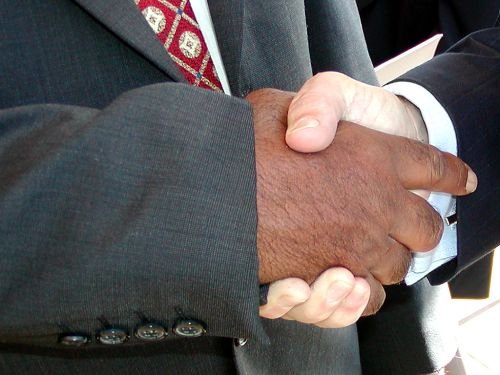
• On not shaking hands – Ugandan Anti-Homosexuality Law

    OLYMPUS DIGITAL CAMERA

    This morning, I heard that the President of Uganda has signed into law the anti-gay law that there has been such a huge amount of discussion about.

    The law itself has become iconic. It is almost the definitive answer to what draconian anti-gay legislation looks like. The Ugandan Anti-Homosexuality Law brings in terrible punishments for those who are gay in Uganda. It also criminalizes those who don’t report those who are gay to the authorities. This then has an obviously detrimental effect on those who are trying to work against HIV infection – those who know of men having sex with men are supposed to report them. The bill has exacerbated hatred of gay people in that land.

    Furthermore, the bill asserts that Uganda has jurisdiction on Ugandans abroad suggesting that they could seek extradition for punishment back in Uganda if they commit “homosexual offences” whilst abroad. Yes – that’s right – that could criminalize people who live in Scotland. It could criminalize people attending my congregation.

    There are a number of people in the Scottish Episcopal Church who have links with Uganda – the Primus, the Most Rev David Chillingworth is one. Gill Young in my own congregation is another. They are the most obvious people who need to be given all our support and encouragement to speak out against this bill whenever they are talking about overseas relations between the churches, international aid and homosexuality generally. The Primus in particular made a visit to Uganda recently which some of us in the church believed to be unwise and attended a service which was addressed by President Museveni himself. However, it was supported by the rest of our bishops so they each share some responsibility for his actions.

    The question for those who go to Uganda and meet with church leaders and politicians there which needs to be asked is whether they have met and greeted those who have blood on their hands. I know no-one involved in any aid agency, NGO, equality organisation nor in the wider gay communities who do not believe that this law will lead to further direct violence against gay people in the region.

    The hand that signed the bill this morning belongs to President Musoveni. The bill has terrible consequences for gay people in Uganda and stretches its reach to people here in the city of Glasgow.

    This summer, the eyes of the world will be on the city of Glasgow as we welcome sports people from around the world for the Commonwealth Games. It is very clear to me that politicians (and church people t00 – for the churches muscle in on these sports fixtures just like many organisations and businesses do) must not be seen to shake hands with any Ugandan official. In particular, it must be made clear in this city that President Musoveni and other officials of the Ugandan government are not welcome here. That must apply to local council leaders as well as Scottish and UK government ministers. It would be particularly sickening to see SNP leaders welcoming the official representatives of a foreign government which is attempting to criminalize Ugandans living in Scotland just weeks before the Independence Vote.

    Ugandan athletes should be warmly welcomed in Glasgow this summer. They should be greeted with welcoming banners in all the colours of the rainbow.

    Ugandan government officials should be met with a refusal on behalf of all people of goodwill to shake hands.

    That’s a language that is well understood internationally and particularly well understood in Africa.

9 responses to “Faith and Order Board Business – the Anglican Covenant process”

  1. kelvin Avatar

    Tim Daplyn – says that the Indaba process is not a normative process but something which means many things to many people. We have no rules of procedure. Asks if the feedback from Indaba will be incorporated into synod. is is canonical. Indaba was designed for African situation not our own.

  2. kelvin Avatar

    Chris Mayo – history is replete with turning points. We are at a turning point. Covenant process is laiden with emotion. People making up their minds at an early stage. Some see it as taking away our identity. Others see it as essential in a chaning environment. Question today is about moving on the journey. Thinks it would be abbrogation of responsibility to turn down this motion. We have a voice the punches far above our weight to communion.

    1. kelvin Avatar

      I speak and ask for material for dioceses to consider which puts a different position to that put by the Anglican Comminion Office.

  3. kelvin Avatar

    Grant Swain speaks in favour of the covenant and says that we would be left out in the cold by refusing to sign. Says that we must be there. But, our strength lies in being undecided. He supports the motion and says that we must sign the Covenant so we can mediate between extremists both in and outside our church. Talk is needed. But we need to be

  4. kelvin Avatar

    Lawrie Scrimgeour – asks since Independence is on the agenda, in this motion we are talking about Independence. Has the faith and order board considered a referendum on the question of the Covenant.

  5. kelvin Avatar

    Anne Pankhurst – notes that the Faith and Order Board say that there could be other processes. She says that we could end up with a Canon which was very difficult to change. She asks for further enlightenment.

  6. kelvin Avatar

    Bishop of Glasgow (Acting Convener) responds: Synod does seem to have the capacity to decide to adopt the process outlined. Responds to my suggestion by saying that he will take those views back to Faith and Order Board. He says that the Process itself takes no view on the Covenant. Synod is the only legally competent body to decided it. A referendum has not been considered and he believes it would not be canonical. Faith and Order Board has considered the posibility of remaining undecided.

  7. kelvin Avatar

    Bishop of Argyll says that Indaba process is a way of giving everyone a voice in a transparent way. We are trying to talk this year and explore the issues in depth. Next year a canonical process. Everyone will see everything that has been said in the Indaba process. The process is no in camera or in committee but a way of giving everyone a voice.

    1. kelvin Avatar

      Motion is carried – I think about 12 – 15 people voted against and 1 or 2 abstentions. So, we have a process for considering the Covenant.

Leave a Reply

Your email address will not be published. Required fields are marked *

Previous Posts

  • Car Stickers

    Hurrah! Scottish Episcopal Car Stickers. At last! We have cried in the wilderness (and in the Information and Communications Board), “How long, O Lord, how long?” Our prayers have been heard. Note that the sticker contains a subliminal message designed to make people believe that if that actually encounter the SEC then they will be…

  • Time for an Ascensiontide hymn

    [youtube:http://uk.youtube.com/watch?v=F83nC4H5koU] And whilst you are listening to it, you can have a ponder as to what on earth (or in heaven) is going on over at Kimberly’s blog.

  • Special Evensong

    Just to note that there is a bumper Evensong on Sunday 4 May 2008 [NB Corrected date!] at 6.30 pm in St Mary’s. You get two choirs for the price of one as St Mary’s Cathedral Choir are being joined by Glasgow University Chapel Choir. These are two of the most exciting liturgical choirs in…

  • The Listening Day

    To Stirling today for the Scottish Episcopal Church’s day of listening. Quite a lot of the day was food for thought though it would not be appropriate to blog about the people or the stories involved. In the end I was generally glad that I was there though sometimes still frustrated by the process. It…