
• Five Years Ago

    anniversary
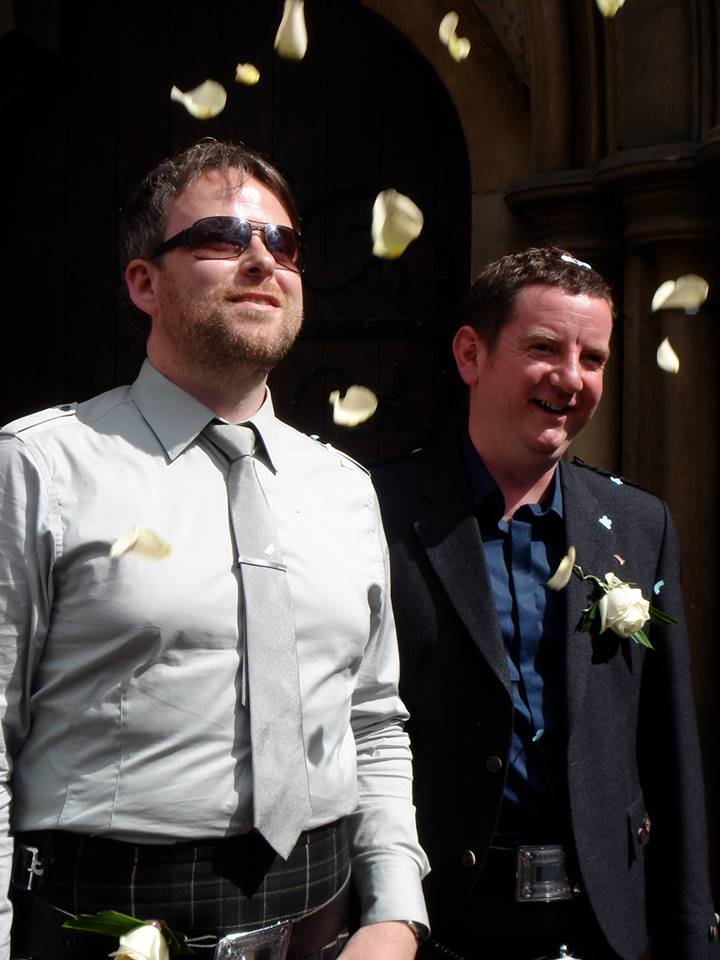
    I was reminded yesterday that it is five years since St Mary’s hosted its first Civil Partnership Blessing. So, congratulations to Colin and Robbie pictured above.

    Theirs was not the first such ceremony that I officiated at but it was the first in the building and the fifth anniversary of that is worth marking with a big alleluia.

    It is perhaps worth recording the process by which we decided to proceed with this ceremony. I had been approached some time before to discuss whether or not I would conduct such a ceremony. As I’d done one already, that was easy to answer – I agreed that I would do it. The question was whether St Mary’s was ready to host such a celebration.

    This is what I remember happening.

    It seemed to me that it was important to work out whether the Vestry were on board with this. It is the Vestry who share the responsibility of what happens in a Scottish Episcopal Church with the Rector. (I’m the Rector as well as being the Provost). Usually, I’ll just ask a Vestry what they think. Often we work towards consensus, sometimes we agree to vote about something if we need to make a decision with which some people disagree. In this case I went a bit further – in this case I outlined the question at a Vestry meeting and then asked them all to write to me to tell me whether they thought we should proceed. This allowed people to take some time and think about it. In the event, the Vestry members all wrote to me saying that they believed that St Mary’s should go ahead. I was thus able to say to Robbie and Colin that we would be delighted to welcome them and their families and friends to celebrate their special day.

    “Ah, but what about the bishop?!!!” I hear you splutter.

    Well, I told the bishop at the time telling him what I had been asked to do. He asked me what the Vestry thought and I produced the sheaf of letters from the Vestry spelling out what they thought and I told him that I was going to take the service. His response was “Very well then. I think you should do it.”

    It is worth also saying that when I reported to him that I was first going to take such a ceremony, his response was, “Well then, I’ll give you my permission to do it then.”

    “But Father, I didn’t ask your permission, I’m going to do it anyway” I said, to which his response was, “Well, you are getting my permission and you are getting it in writing – it is important that you have it”. (I still have the email).

    And thus, these things began and I’ve been happy to advertise that we do them since. Then it seemed remarkable. Now it seems special but in the same was that every wedding day is special. In the last five years there has been maybe one ceremony a year either in St Mary’s or elsewhere. (The first one I conducted was at the chapel of the University of Glasgow).

    In a few week’s time, I’ll be doing another one and this time there is something different. The innovation this time is that the couple can be pretty sure that by registering their civil partnership (which I’ll be blessing) they will end up being actually married as the new laws coming to Scotland should mean that they can convert their relationship to the status of a marriage by simply filling in a form in due course.

    The move towards marriage equality is a long drawn out journey of little steps. I’m proud to have shared that journey with those brave enoug to pledge their love to one another in public.

    Alleluia!

9 responses to “Faith and Order Board Business – the Anglican Covenant process”

  1. kelvin Avatar

    Tim Daplyn – says that the Indaba process is not a normative process but something which means many things to many people. We have no rules of procedure. Asks if the feedback from Indaba will be incorporated into synod. is is canonical. Indaba was designed for African situation not our own.

  2. kelvin Avatar

    Chris Mayo – history is replete with turning points. We are at a turning point. Covenant process is laiden with emotion. People making up their minds at an early stage. Some see it as taking away our identity. Others see it as essential in a chaning environment. Question today is about moving on the journey. Thinks it would be abbrogation of responsibility to turn down this motion. We have a voice the punches far above our weight to communion.

    1. kelvin Avatar

      I speak and ask for material for dioceses to consider which puts a different position to that put by the Anglican Comminion Office.

  3. kelvin Avatar

    Grant Swain speaks in favour of the covenant and says that we would be left out in the cold by refusing to sign. Says that we must be there. But, our strength lies in being undecided. He supports the motion and says that we must sign the Covenant so we can mediate between extremists both in and outside our church. Talk is needed. But we need to be

  4. kelvin Avatar

    Lawrie Scrimgeour – asks since Independence is on the agenda, in this motion we are talking about Independence. Has the faith and order board considered a referendum on the question of the Covenant.

  5. kelvin Avatar

    Anne Pankhurst – notes that the Faith and Order Board say that there could be other processes. She says that we could end up with a Canon which was very difficult to change. She asks for further enlightenment.

  6. kelvin Avatar

    Bishop of Glasgow (Acting Convener) responds: Synod does seem to have the capacity to decide to adopt the process outlined. Responds to my suggestion by saying that he will take those views back to Faith and Order Board. He says that the Process itself takes no view on the Covenant. Synod is the only legally competent body to decided it. A referendum has not been considered and he believes it would not be canonical. Faith and Order Board has considered the posibility of remaining undecided.

  7. kelvin Avatar

    Bishop of Argyll says that Indaba process is a way of giving everyone a voice in a transparent way. We are trying to talk this year and explore the issues in depth. Next year a canonical process. Everyone will see everything that has been said in the Indaba process. The process is no in camera or in committee but a way of giving everyone a voice.

    1. kelvin Avatar

      Motion is carried – I think about 12 – 15 people voted against and 1 or 2 abstentions. So, we have a process for considering the Covenant.

Leave a Reply

Your email address will not be published. Required fields are marked *

Previous Posts

  • Glasgow Rain

    It has started to rain in Glasgow in a way I’ve not seen since moving here. Will it go on until May?

  • The Quest for the Praeposital Flipflops

    It is a truth universally acknowledged, that a young provost who has taken up swimming once again must be in want of a pair of fine flipflops. But first, where does one buy flipflips at the end of the summer in Glasgow? I had to take advice from colleagues. The answer that was forthcoming was…

  • The Holy Father

    If I walk from home to work dressed in clerical attire, it is relatively common, especially when passing the outdoor smoking area of one of the pubs, for me to be assailed thus: “Hello Father! How are you Father? Nice to see you Father. Bye Father.” Today, the greeting was simply: “Salaam alaikum, Father. Salaam…