
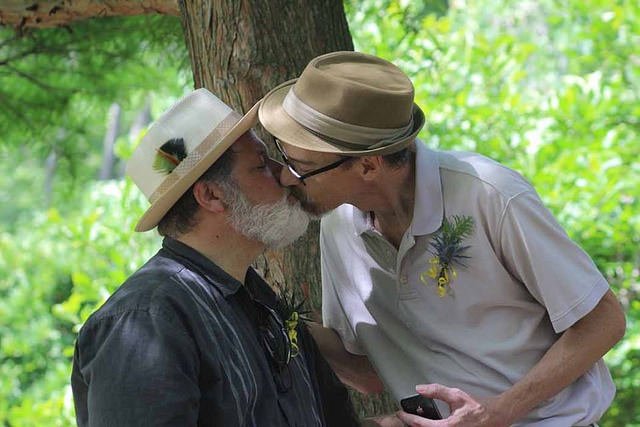
• A kiss is just a kiss

    14574900326_a18671621b_z

    Can it really be that many are happier to see a gay couple marry than give one another a kiss?

    Someone asked me recently whether the time had come to stop campaigning on LGBT issues. After all, he said, the gays have got everything they want now. They can get married and everything.

    Well, leaving aside that the fact that “the gays” can’t get married in Scotland for another month or so and that when they can do so they will not be able to be married according to the same protocols as “the straights”, marriage in church not being an option for most same-sex couples initially, the truth is, the marriage debate is not the end of gay rights but the start of them moving into the mainstream.

    The incredible thing about the campaign to open marriage to same-sex couples is that it wasn’t just same-sex couples who pressed for it to happen. It was a grand coalition of diverse folk – interested people like parents who have gay children, brothers and sisters, workmates and friends as well as gay folk, including gay folk who have no personal interest in marriage for themselves. But it was more than this too – it was a coalition of people who didn’t need to claim a direct interest in the debate. It was a coalition of those who thought that in a modern society the gender of the two people involved is of secondary significance to their love, their hopes for permanence, their promises of fidelity and so on.

    In short, it was a coalition of the decent.

    Now, that kind of statement gets me into trouble. “How can you say that those who were opposed to this are not decent people? Are they not good people, upright people, moral people too? They just didn’t think this was right – how dare you say they are not decent people?”

    Well, the thing is, it isn’t me who is saying that – it represents the huge shift in public opinion that has happened. I’ve helped to shape those changes and am happy to continue to try to do so. Seeing the opinion polls shift so dramatically over the last 10 years is one of the most satisfying things that I’ve ever been involved in.

    What happened is that we changed common perceptions about the kind of values that decent people could be expected to hold.

    That’s why this is so hard for those who have not shifted much themselves. It must feel to them as thought they are on shifting sand. Moral judgements which once were those which good people could be expected to hold, became those which decent people were not expected to hold.

    For some this has been a wonderful seemless recognition that the rights and responsibilities of being human apply to gay and lesbian people just as much as to anyone else. For those outside the big tent it must feel as though something dear has been shattered and broken. I don’t underestimate that, but it isn’t going to get any easier because we’re not done yet.

    I was very struck this week in reading an opinion poll in the USA which indicated that there was strong support for changing the law to allow same-sex couples to get married. However, when the same people were asked what they thought of a gay couple kissing or holding hands in public the support somehow seemed to melt away. And there were different perceptions relating to gender too. It wasn’t so bad seeing women holding hands but gay men kissing in public was something that the decent still were not ready to see.

    Can it really be that it is OK for a couple to get married, with all the support of the expectations of the institution of marriage, but that those who support them still feel squeamish about seeing such a couple display their affection.

    I’ve a feeling this is an issue here.

    When I’m conducting the nuptials of couples here in St Mary’s, I always have a rehearsal and quite often we address the question of whether the couple is going to kiss during the ceremony and at what point. (I think they should do what they feel comfortable with).

    I’m aware that when I ask straight couples that question they can usually answer it easily. When I ask same-sex couples that question there is a big intake of breath as they think about giving their beloved a kiss in public.

    I very occasionally see a same-sex couple coming to church on a Sunday hand in hand. (I see opposite sex couples doing so often enough not to notice). It is worth remembering that there are perhaps only a few hundred yards of the streets of Scotland where they would consider themselves safe to do so and only at particular times. And that’s just holding hands, never mind a wee gay kiss.

    It would appear that we’ve a way to go yet before we get to the point where same-sex couples and opposite sex-couples are treated alike and can expect their affections to be regarded in the same way.

    The campaigning will change in months to come but it is far from over yet.

    I want a world where a kiss is just a kiss. And so much more too.

    [Picture Credit – Ron Frazier Creative Commons attribution license]

52 responses to “Inclusive Language – again”

  1. ryan Avatar
    ryan

    Kelvin – that cracked me almost as much as your last tweet on the left of your blog ;-)!

  2. Jimmy Avatar

    Ryan, although you address your comment to Kelvin like I am not there. I assume you are referring to my poem, I can assure you that it does not crack me up watching you making any opinion you may have untenable.

    1. kelvin Avatar

      No Jimmy – I think Ryan was indeed referring to my last comment, above.

  3. Jimmy Avatar

    Thank you Kelvin and Sorry Ryan.

  4. ryan Avatar
    ryan

    No worries! Was indeed referring to the v.amusing coming out day tweets at the side.

    I’m not sure there’s ever existed anyone, anywhere,at any time, of whom it could be said that *all* their opinions are ‘untenable’, so such rhetoric is dehumanising at best. Apropos nothing, I was moved to google the poetic stylings of the great David Brent. Who needs Auden? 😉
    http://murfinsandburglars.com/2009/04/14/bad-poetry-for-tuesday-david-brent-edition/

  5. Peter Avatar
    Peter

    Kelvin; no, I think it distracts. It simp;ly reminds us that this is how your mind works: you make connections and delight in that sort of word-play. However, to sharpen up my point. Thank you for helping me to realise that, for some, ‘family’ is not a positive word in the way in which I experience it. For my part, this willl mean that I will be more careful about its use when others might feel excluded (and therefore hurt). Mutatis mutandi can you accept that I feel offended by what seems to be merely a casual linking between family and the f word? These are sensitive areas, but sensibilities are by no means confined to those who find family a painful or unhelpful concept.

  6. Simon Avatar
    Simon

    I am slightly nervous aboaut the alternatives to the 1982 Liturgy, not because I don’t share the inclusive sentiments expressed above (I do). I fear that, as so often in the history of the church, the steps we take to avoid one kind of mistake in the way we talk about God can lead us into another. The avoidance of pronouns as a measure to achieve inclusivity produces inelegant, strained and stilted English. How would it be if one were to use it in day-to-day speech? ‘I saw John this morning. I asked John’s how John’s health was. John said that John was over his flu, and hoped to be back at work on Monday’. This may not in itself seem to be a problem. But in fact, what very quickly happens when we adopt this idiom in addressing/expressing God, is that the very idea of a personal God begins to recede. My basic instinct is that the church’s language of pulbic prayer is properly anchored in that of the scriptures. There are dangers in departing from this. The perceived problem (rightly perceived) is perhaps better tackled by good teaching about the nature of God, than by linguistic contortions that produce stilted prayers, and possibly a less real and vivid idea of God.

  7. Melissa Avatar
    Melissa

    About the family imagery – another reason to drop it in church is for the sake ones who, like me, do actually have the signifying family relationships.

    There is too much pressure on day to day life with children when that life is forced to serve as some kind of example or testimony or witness to the world – or more likely one’s church friends – about the nature of God.

    I think it sours love because in that kind of scheme loving children is more fundamentally a means to an end.

Leave a Reply

Your email address will not be published. Required fields are marked *

Previous Posts

  • What’s the Scottish Episcopal Church is talking about?

    I did a wordle of the most recent issue of inspires, the Scottish Episcopal Church’s magazine to compare what we are talking about in the magazine with what we are talking about in synod. Quite interesting, no?

  • Want to know what General Synod is like?

    Well, here is a wordle made up from last year’s Synod Minutes. (Well, the draft copy, anyway). It is entirely unscientific, but it is interesting to look at how the words relate. Word size implies frequency of use. Now, what does this tell us about our church?

  • Extra, Extra!

    In addition to the extra Lent Devotions tonight (Eucharist at 6.30 pm followed by meditation and then Compline), there is also an extra Choral Evensong tomorrow (Saturday) in St Mary’s. There is a Royal School of Church Music singing day for Scottish Voices, which our own Frikki Walker directs. It will be splendid and as…

  • Ash Wednesday

    Services at St Mary’s at: 0930 – Morning Prayer 1230 – Eucharist with Ashes 1930 – Eucharist with Ashes, Byrd’s Four Part Mass and Allegri’s Miserere Prayers to do at home during the week – here Lentan Devotions, every Friday evening at 6.30 pm