
People who join St Mary’s from other kinds of churches or who are facing Easter for the first time since finding faith sometimes wonder how to keep Holy Week. Here’s a quick and easy guide to some of what to expect in Holy Week in a church like St Mary’s. Most of this text I’ve posted before on the blog but this time I’ve put it all together in one long post. Don’t forget the promise which I make every year – if you keep the Triduum, that’s the time from Maundy Thursday to Easter Day with me then it will change your life and you’ll see and understand Christianity in a way you never understood it before.
Palm Sunday
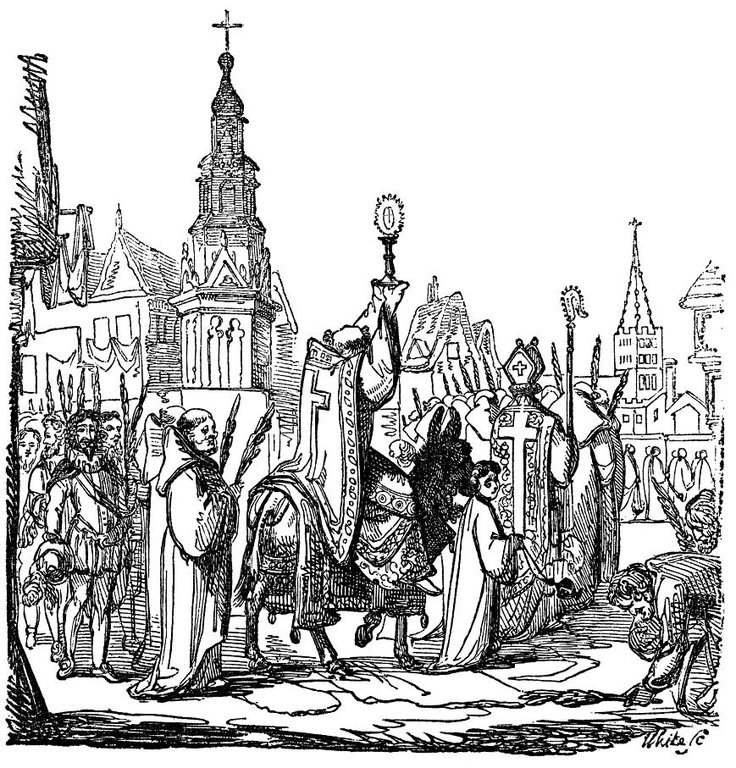
Palm Sunday is a great start to Holy Week for we begin with joy. What we are remembering is Jesus entering Jerusalem and being lauded by the people there as someone who represented their ideals and hopes. We will find soon enough that the crowd that cried hosanna will soon turn on him and shout something altogether different.
There are a couple of things that we do as part of the liturgy on Palm Sunday – starting with a procession. Oh yes, processing about is the order of the day and we have one huge procession of everyone who is present. First we get palm crosses in our hands which are blessed. And then off we go out of the church doors, into the glorious sunshine (hopefully) and process around the church as much as we can before coming back in by the south door and singing a hymn.
The key to the procession is that it should be joyful. British Christians sometimes don’t get this! Clergy like me tend to try to think up ruses to make it more joyful.
Jesus came into Jerusalem riding on a donkey and some churches have a procession with a real live donkey. (You know the tradition that donkeys are marked with a cross on their backs because a donkey carried Jesus, don’t you). I have to admit that I’ve never worked with a real live donkey. It seems to me to be asking for trouble. The Lord wants joy in his procession, not comedy, I think.
Instead of a sermon on Palm Sunday you get a very long gospel reading. We read the Passion Narrative – that means the whole story of Jesus’s arrest, trial and execution on a cross. It is a harrowing read. At St Mary’s the congregation (who are the body of Christ today) read the words of Jesus in the story.
The tradition of reading the Passion Narrative comes from a time when clergy found it difficult to persuade people to come to the rest of the services in Holy Week. (Who can believe this was ever true?!) The truth is, the services that we keep from Maundy Thursday onwards are, in most churches, a revival, a re-invention or indeed something really fairly new. However, no greater way has ever been devised to teach what Christianity is about then the triduum in my book and my promise, that it will change your life and change your faith, has always held good with everyone who has ever kept it with me.
The music that we use at Choral Evensong in St Mary’s always makes it one of the most beautiful evening services that we have in the year.
Maundy Thursday
 Every year I make the promise to people that if you keep the Triduum at St Mary’s (or any church that keeps it) then it will change your life and change your faith. Indeed, I usually say that it is like a lens through which we should see everything else that we do in church through the year. I can guarantee that Easter Day is radically different as an experience if you keep it as part of the Triuduum.
So, firstly, what’s a Triduum when its at home? Well, it just means three days and the three days we are talking about here are the Paschal Triduum which starts with the service in the evening of Maundy Thursday and ends with the Easter Day services. In some ways the services add up to a whole and are better thought of as one whole service than a series of bits that you opt in and out of. Its a rollercoaster of a journey, mind. Emotions all over the place.
So, what to expect. I’m not giving a line by line explanations here as I recognise the wisdom of someone who once said to me that once you explain liturgy it kind of disappears before your eyes. Some things just have to be experienced.
There are several distinctive features about the service on Maundy Thursday. In St Mary’s we have the joy of the Cathedral choir with us and the music on Maundy Thursday is always lush though there is darkness to be found in the music too.
Apart from the music, the first thing you might notice that’s out of the ordinary – there’s no spoken sermon. Instead you get an act – we wash feet instead of a sermon, remembering that Jesus washed the feet of his friends. Actually, I said that we wash feed instead of a sermon but that’s not quite right – the footwashing is the sermon. You don’t have to have your feet washed, but it does take you right into things in a very particular way. By the way, I have the ugliest feet in Christendom (apart from Mother Ruth’s of course, which are famous). Its not about having nice neat feet. Few of us like our feet. But that’s rather the point. If there’s a medical condition for not bearing your feet to the world, then washing hands is an option but its foot washing that really carries the symbolism of the day. (And as I’ve said before, its about intimacy and love much more than about power).
We then proceed with the Communion service as usual – bread and wine for all. (Instead of saying that we remember the night on which Jesus did these things, we say, “This, this is the night!”).
After communion, all is peaceful. All is as it should be. But not for long.
We recite Psalm 22, which Jesus quoted on the cross and whilst that is going on, the church is stripped of everything that is lovely. All the gold and tassels disappears. The whole church is stripped quite bare as we remember Jesus having everything stripped from him when he was arrested. The paschal candle which has burned for us at funerals and baptisms for the year past, connecting us with last Easter Day is broken. The font is closed – there will be no more sacraments now, Jesus is taken from us.
The last thing to leave the sanctuary is the bread from the reserved sacrament. This is taken in solemn procession to an altar of repose – a place where we remember Jesus in the Garden of Gethsemene. All is hushed as we hear him say to his disciples, “Can you not watch with me one more hour”. A quiet watch of prayer is kept until midnight. (Its an Open Silence – anyone can come for shared silence during this time). Some people creep away early on. Others stay until later either in prayer or doing some quiet reading. Some people like to read one of the gospels through from beginning to end through this time.
All is still in church. Its part of our tradition not to speak whilst leaving this part of the triduum and people are asked not to speak in the car park or anywhere around the building to preserve the silence for those who are watching and waiting and praying.
At the end of the Vigil, the remaining sacrament is consumed. He is gone.
Good Friday – the Veneration of the Cross
 At St Mary’s we have a service of Veneration of the Cross on Good Friday morning at 0930. Its a very simple service – a few prayers and an opportunity again to reflect on the Passion readings. Here we use the Passion from the gospel of the year on Palm Sunday and John’s Passion on Good Friday.
There are two distinctive things about this service. The first is that the church is bare and stripped after the Thursday night’s events. The second is that there is an opportunity to venerate the cross at the end of the service.
The bare, sparse feel of the church on Good Friday is like no other point in the year. The yawning space at the front seems to gape open. There is no sacrament reserved on the High Altar. The font will be closed. Jesus is taken from us and there will be no sacraments now until Easter Day, if such a Day should happen. It always feels unlikely to me on Good Friday that joy will ever come back. There is beauty to be found on Good Friday but it is stark beauty, harsh beauty, hard fought beauty.
The veneration of the cross is simply an opportunity to do something physical. There’s no sermon at this service (which takes just about half an hour) but rather, a chance to come close to a simple cross and say a prayer. Some people will kiss the cross, some will touch it and hold it whilst they pray, some will bow deeply before it. It is a physical act that connects us with the wood of the cross. (There’s a lot of physical touch involved in the triduum – feet, cross, even the cleaning that will come tomorrow – its far from cerebral religion).
The building always seems hushed and quiet at this time. The removal of so many things the night before somehow seems to make it feel achingly quiet. The prayers from the night before seem to linger and meld with the confusion of what it can mean for Christ to have been taken by civil authority and put to death. In some ways there is no sense to be made of today but there is no sense to be made out of most violence.
Sometime today whilst things are quiet, along with one of the servers I’ll wash down the High Altar with vinegar and bitter herbs. It is a gentle and calm act which few people see, symbolising the laying out of Jesus’s body for burial. The smell of the vingegar and the herbs lingers on through the day – a combination of strangeness, cleanliness and bitterness.
Good Friday – The Three Hours
 St Mary’s is actually the first church that I’ve worked in which has had the tradition of three hour devotions on Good Friday, so I know well enough that its not the only thing to do on Good Friday. However, its a very particular devotion and one that I’ve grown to love. Indeed, its hard to imagine not keeping it.
The idea is that the church marks the time between 12 and 3 pm on Good Friday – the time at which Jesus was on the cross.
Here in Glasgow, the time is usually spent with readings from the Passion, preaching, music for meditation and above all silence. I’m usually amazed at how the time passes and like quite a lot of people, I’m always there for the whole thing. However, some come and go. Its always a hard thing to judge how many people come to church for this part of the triduum because of the coming and going.
The music tends to be solemn and beautiful. I often don’t know until the last minute quite what it will be. The default position is organ music for meditation but usually there are other offerings from Cathedral musicians, some of them stepping forward in Holy Week itself to volunteer something for this service.
The preaching is thoughtful, calm and measured today. Sometimes one person preaches the whole thing and sometimes it is shared. I’ve done the whole thing a couple of times and its a marathon. Those who are more disciplined than I am write an address each week during Lent so that by the time Holy Week comes around all is more or less ready.
The tradition is seven sermons during the three hours. If its one voice, its a real test of a preacher to keep people focused and involved by the end. Sometimes people base it on the seven last words from the cross – the things that Jesus actually said on the cross that are recorded in the gospels. Sometimes its simply preaching on the Passion texts. (That’s what we’re doing today). I’ve known other schemes though too. I’ve heard a whole three hours devoted to the senses – including a wonderful sermon on the smell at the cross. I’ve also heard it done by preaching in the voice of the different participants – Peter, Mary, Pilate, the Centurian and so on.
The devotion ends with the singing of the Reproaches – a strange text which captures the bewilderment of the crucified one. “O My people, My people what have I done to you, how have I offended you answer me!” These are not words that Jesus said from the cross at all but an attempt to get inside his experience and to sing something from his perspective on what has happened. They describe the various ways in which God tried to save people in the Old Testament only to be rejected and spurned and see the cross as a continuation of that experience.
Its a long devotion. Its a worthy devotion. Its a holy devotion. And it is worth keeping well.
Good Friday Evening
 Generally in St Mary’s we have a Good Friday service or devotion of some kind in the evening, but it does differ in character from one year to the next.
Sometimes we have a performance of Stainer’s Crucifixion, sometimes something else, usually a service which is simply a meditation in words and music on the themes of Good Friday.
We’ll not be reading the Passion Reading again tonight – we’ve had that plenty and as we heard in the afternoon, “It is Finished”.
It’s worth noting in passing the the Deposition from the Cross is wonderfully depicted in one of the big paintings in St Anne’s Chapel. Jesus is taken down from the cross in a garden, but one that looks strangely familiar to anyone in this neck of the woods. It is all apparently taking place in Kelvingrove Park. A good reminder that the passion happens all around us all the time. It’s not just Jesus who is betrayed, captured, imprisoned, tortured and killed. The passion is all too familiar in some ways. So familiar that we block it out and don’t see the connections between the pain around us and God being in the world.
In some churches, the evening service is the main one of the day, particularly in places where people are prevented by work from attending in the morning or afternoon. Sometimes they walk the Stations of the Cross – a walking meditation looking at representations of the Passion Story. Sometimes it is Tenebrae – a musical service where lights are progressively put out until all is dark. Sometimes it’s a formal liturgy like the Veneration that we have here earlier in the day.
Tonight for us it’s music and words and then rest. All is done. Good Friday will be over.
And to end, a prayer from Compline the service of Night Prayer with which many people end their day:
Almighty God, whose most dear Son
lay at this hour in the sepulchre
in obedience to your will;
may we by your grace be so buried with him
that with him we may rise to life everlasting;
through the same Jesus Christ, our Lord. Amen
Holy Saturday
 Well Holy Saturday is an odd day and no mistake. Jesus is gone, he’s in the tomb and all the world waits. Well, all the world gets on with its own business generally.
There are no sacraments today. The font is empty of water, there is no Eucharist, there will be no weddings.
In St Mary’s it’s a day for getting things in order in case we have a resurrection on our hands on Sunday Morning. That means that it’s all hands on deck from 9.30 until about 1 pm to try to get things straight. The sacristy looks rather like a liturgical bomb hit it when everything was stripped out of the church. There are carpets and hassocks to bash free of dirt. There’s a large impressive looking eagle that is in want of a polish. Beeswax (or Mr Pledge) for the pews. There are sly buckets of flowers secreted somewhere in the church waiting to be brought forth in glory.
I like the clean and polish on Holy Saturday. It’s good community time. There really is a job for everyone. If you turn up, expect to be assigned a job. It might be dusting, it might be flower arranging (only for specialists with a PhD in Pew Ends) or it might simply be mopping the Provost’s fevered brow. And in all of this, he will keep his counsel about all that has gone before. No matter who makes him a cup of tea, he is unlikely to divulge who had the prettiest, ugliest or largest feet at the footwashing. What’s washed at the altar stays at the altar.
I like Holy Saturday. Its a great day to enjoy doing practical things today and sometimes to learn a name or have a chat with someone you’ve just not got to know yet on a Sunday. People always say how much they enjoy it and always say we should do that kind of community thing more often. It’s easy to join in with whether your a well kent face or just in town for the triduum.
All hands on deck. All hands needed!
The Easter Vigil
 Some churches celebrate the Easter Vigil on Holy Saturday in the evening. Some do it on Easter Day in the morning. Which is right? Well, if you think that the origins of the Easter Vigil lie in the practise of the early church then there’s some justification for either, or perhaps better, both.
The idea is that the early church used Lent to prepare people for entry into the church at Easter and the preparations for this would include an all night Vigil from Holy Saturday through until dawn on Easter Day. Liturgists will tell us that it has been the universal practise of the church to celebrate the resurrection with the lighting of a Easter fire, the renewal of baptismal vows for all the faithful and the first mass of Easter.
Liturgists, however, would be wrong. The Easter Vigil only really entered into the life of any normal congregations in modern times when these elements were added to the liturgy of the Roman Catholic Church in 1951. (Don’t believe me? Then show me the Easter Vigil in the Scottish Prayer Book 1929. You’ll look long and hard to find it). Much of the modern keeping of the Triduum and particularly the Vigil comes from the liturgical reforms of the late 1950s and 1960s. That doesn’t invalidate it but it does mean that we must not be too precious about keeping it in the way that it was ever so. It ever wasn’t.
If you begin on the Saturday evening the you begin when the day is done, according to Jewish timing. That means leaving it until after sundown or even better, until you can see three stars in the sky.
We do it on Sunday morning early. Well, relatively early. We start at 7.30 am. Some will start at dawn and I envy them their “vigilance”.
What I think I’d really like is an all nighter. Vigil of readings and baptisms late at night, sleepover in church and Easter Fire and Eucharist at dawn. I’ve never managed that, but that’s where I’d like to go with it.
The fire is the big excitement. We kindle it in the place of death. Here in St Mary’s that means the patch of ground formerly used as a memorial garden, where ashes were interred. From that fire, the large Paschal candle is lit and blessed by the Bishop. It will burn in church through the Easter season until the gospel of the Ascension on Ascension Day. At that point it is doused as we remember that Jesus is gone from this earth and remember instead that God is with us at all times and forever. The candle will then be lit every time there is a baptism or a funeral. The burning flame connects both events with the early light of Easter Day and the first hearing of the news that Christ is risen.
The service early on Easter Day begins in darkness. No electric light until the fire is lit and light is carried into the church and the Exsultet is sung. Each year, someone gets to sing that glorious hymn of praise. As he does so, he’ll sing the light back into existence. Dawn, even if its merely electrically induced, will come in song. In some places, you get the tradition of ringing bells or gongs at the start of the Gloria – greeting Christ’s resurrection with a great big noise.
After the service there’s breakfast. Churches which are pure and righteous will guard the sacred, holy fire and keep it unsullied. Churches however which remember the biblical stories will remember that Jesus cooked breakfast on early Easter mornings on a brazier. Do this in remembrance of me he said, often enough.
We’ll do our best.


Leave a Reply