
• Congratulations

    Craig and Calum

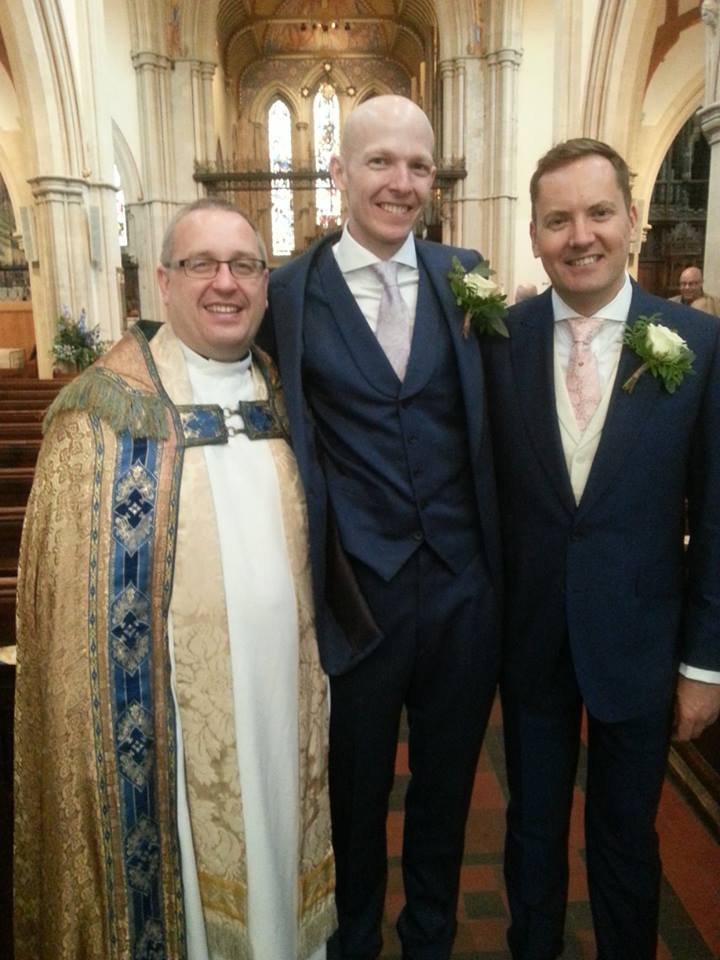
    Congratulations to Craig and Calum, two members of St Mary’s congregation whose Nuptial Mass I conducted yesterday afternoon.

    Very often, the struggle towards equality seems to some people to take on the air of a pitched battle with people shouting their positions over the heads of others. The truth is, it really is an unbottling exercise – opening up a situation to let God’s Spirit make merry with those around.

    Yesterday’s celebrations were like that. People from Anglican, Roman Catholic and Conservative Evangelical (and no doubt other) backgrounds gathered around a fine young couple because they love them and together we saw them make promises to one another that have at their essence all that is holy and all that it is true.

    It was a genuinely joyful day and a wonderful privilege to share it with them.

36 responses to “Inclusive Language and Politeness”

  1. John Prescott Avatar
    John Prescott

    I am loving the breath, depth, and civility of this conversation. At risk of muddying the waters, I would like to add another element to this discussion, namely language changes to choral works sung by a choir. As a progressive Episcopalian I want to do everything possible to make the liturgy inclusive. As a musicologist by profession, I also care about the integrity of musical works from other historical periods. Composers like Byrd and Purcell took exquisite care in the setting of particular words to music. Hymn tunes and texts, on the other hand, are often interchangeable and so, in my opinion we can be much freer in altering them. A solution may be for choirs to perform works from earlier times with their original words but also make a point of including new works with much more inclusive language. This is one possibility and I would welcome any other thoughts.

  2. Meg Rosenfeld Avatar
    Meg Rosenfeld

    John, your suggestion is eminently sensible and would enable us both to enjoy and appreciate the older musical works (whether as singers or listeners), and to rejoice in the inclusiveness of new or perhaps intelligently altered newer pieces (e.g. hymns and/or modern anthems.) Actually, I think that’s basically what we do, or strive to do at All Saints; would you agree?

  3. Ross E. Herman Avatar
    Ross E. Herman

    As an historian, much of this takes me back to the Puritanism of the seventeenth century that wreaked havoc on the traditional ways of worship and the beautiful art that so many held dear, things which our many of our Continental cousins still have and cherish. One of the three legs of Anglicanism is tradition and the respect we hold for those who came before from whom we inherited our faith and worship. Changing poems such as Bunyan’s impose our own values on an ancestor, debasing his genius and his faith, saying that he was somehow not enlightened enough to anticipate how mores would change. Part of the church’s mission is to celebrate the wonders of Creation, including the artistic contributions of the faithful.

    This issue is very similar to the argument in America over the censorship of Mark Twain’s seminal novel, Huckleberry Finn, which, as an honest reflection of his time, includes quite a number of instances of the use of the ‘n-word’. As it has been taught in American schools for decades, many have proposed, and even published versions which replace this with an alternative. This is wrongheaded on many counts, but it most importantly insults readers by presuming they are not intelligent enough to incorporate the historical context of the book into their comprehension of it; this also applies to the drive to puritanically whitewash any reference to gender, including the wholesale abandonment of traditions and practices that bring comfort to many.

    As an institution which holds teaching the Gospel as one of its fundamental missions, the church is perfectly well-equipped to remind or teach people of the context of things which may possibly offend, even using it as an opportunity to teach the importance of critically thinking about our world. The approach advocated here is an abdication of the church’s responsibility to preach the truth for the sake of making everyone, including itself, feel righteous and insulated from the iniquities of mankind. (NB: I seriously doubt Neil Armstrong was thinking that the many women at Playtex who worked to make his spacesuit were somehow excluded from the ‘big leap for mankind’; or maybe I’m wrong and he was actually a horrible bigot whose words should be scrubbed from history.)

    1. Kelvin Avatar

      And yet, I’m guessing you’d not be comfortable with a church using a hymn in public worship with the n-word in it. Am I right?

      1. Ross E. Herman Avatar
        Ross E. Herman

        Such an argument only begs the question of whether such a thing even exists; worship exists within reality, and hypotheticals can only go so far in addressing the needs of the faithful. Besides, it is an invocation of the fallacious warning against slippery slopes.

        1. Kelvin Avatar

          Not really. We tend to speak of Spirituals these days in our worship rather than the way in which people used to refer to them.

  4. Ross E. Herman Avatar
    Ross E. Herman

    Also, your decision to exclude critical commentary is incredibly hypocritical, blatantly going against the discursive nature of the Anglicanism that has enabled you as a priest to speak out in the first place. I understand the just desire to discourage hateful words, but criticism is not inherently hateful or derogatory. Please reconsider your policy.

    1. Kelvin Avatar

      er, I published your critical commentary, didn’t I?

      1. Meg Rosenfeld Avatar
        Meg Rosenfeld

        You did indeed! 😎

  5. Tony Wesley Avatar
    Tony Wesley

    At Trinity Cathedral in Cleveland, OH, USA, our beloved canon has recently introduced the term “kindred” to use instead of “brothers and sisters” precisely to address our non binary members and visitors. It seems to have taken hold more and more in our weekly newsletters, group emails, etc. I still pause when I use it and that is a valuable pause as it makes me aware again of the vastness of creation.

  6. Mikhail Ramendik Avatar
    Mikhail Ramendik

    Suggestion, good Reverend:

    ==
    Dear Lord and Father of our kind,
    Forgive our foolish ways!
    Reclothe us in our rightful mind,
    In purer lives Thy service find,
    In deeper reverence, praise.
    ==

    I see a possible problem here with “our kind” being read as Christians as opposed to humans, but not sure if it is a real danger.

  7. Ryan S. Avatar
    Ryan S.

    Dear Kelvin,

    Such a wonderful reflection on inclusive language in our worship.

    I have long cherished “Dear Lord and Father of mankind”—you could even say it’s my favorite hymn—and in my search for something to sing as a solo one day, I found several versions of it adapted for inclusive language. I ultimately decided I preferred “Dear God who loves all humankind,” though I also thought “Dear God, compassionate and kind” would’ve had a lovely sound to it. Someday, I hope that perhaps we shall all move away from referring to God with an implicit gender.

    Do keep up the good work. You’re doing fabulously.

    Joyfully,
    Ryan

Leave a Reply

Your email address will not be published. Required fields are marked *

Previous Posts

  • Shelly Marsh

    Just back from the delights of seeing Shelly Marsh installed as the Rector of St James the Less, Bishopbriggs. They are a lucky congregation indeed – she is very special. It was the first time I had been there. Someone said beforehand that it was like being in a Berni Inn. I know what they…

  • Daily Service

    Don’t forget that St Mary’s choir is on the Daily Service on Monday morning. You have from now until then to work out how to tune in on 198 Long Wave.

  • What are these tardises?

    [Is tardises the correct plural of tardis?] Anyone know what the strange tardis-like aluminium things are that are appearing on the streets of Glasgow? There is one not far from here and another on St George’s Road. I keep expecting the Doctor to appear from one of them. Mind, I’ve never been a Dr Who…

  • What am I reading?

    Oh, thank you for asking to be sure. I’ve just finished re-reading Wise Blood by Flannery O’Conner, one of her two novels, each so devastating. I started it yesterday when my weekend began. So very dark. She captures faith based mauvaise foi so very precisely.