
• Six things I have learned about anti-semitism and the church

    antisemitic stations

    1 Anti-semitism is a real thing in the life of the church

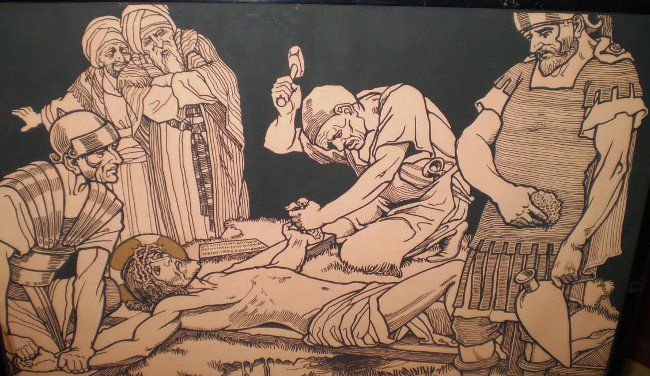
    A number of years ago I was visiting a church in the Diocese of St Andrews and happened to look up at a set of Stations of the Cross and remarked to the Rector that they were rather stylish. “Hmm,” she said, “look again – some of those images are not very nice. There’s a narrative of trying to implicate ‘The Jews’ in the way the pictures represent the story of the crucifixion.”

    And I looked and indeed saw that it was so. She was right and I hadn’t noticed. The picture that I’ve posted above is one of those stations and is based on stereotype and characterisation which is prejudicial to Jewish people.

    The question is, would I have noticed this if it had not been pointed out to me? I had been in that church plenty of times and never noticed. In that there’s something of a parable. Anti-semitism is something that people who think they are good simply don’t notice. How much of our art, our theology, our preaching, our discourse, our storytelling is anti-semitic?

    The answer has to be that I don’t know. I/we need to do our best to spot things that might make someone Jewish feel threatened, but the truth is, there may be things that I/we cannot see due to familiarity, uncovered prejudice or simple ignorance.

    I enquired about those Stations of the Cross a couple of years ago and was told that they’d been taken down and stored in a glory hole somewhere and there didn’t seem much appetite for putting them back up. I hope that they didn’t ever go back up though I do know that these were only copies and the originals still hang in a Church of England parish in the Diocese of Derby.

    2 So called “Christian Seder” meals are offensive and unhelpful

    It has become the custom in some parts of the church to celebrate something called a Christian Passover or Christian Seder. The idea seems to be to learn more about “exploring the Jewishness” of Jesus and the “Jewishness” of the Last Supper. NB – Jesus didn’t have a small element of Jewishness within him. Jesus was Jewish.

    It should not be a surprise to Christians that holding a parody of a key religious meal that people in another faith celebrate is offensive. However, that often seems to come as a surprise. Again, I will admit that it was only hearing a Jewish theologian talk about how offensive it is that I really thought about it for the first time. However, once I had done, the penny dropped.

    There are ample explanations on the internet for why Christians holding a parody of a Jewish Seder meal is offensive. When something is offensive, we shouldn’t do it.

    You want to know about the Seder? Then ask someone who is Jewish. They might even invite you to one and note well, you’ll be offered food there. Compare and contrast this to asking people from other faiths to a Christian Eucharist and telling them “no bread, no wine”. Not that anyone should expect someone from another faith to Christianity to take bread and wine in church but there’s something about hospitality that Christians have to learn from other faiths that is missing all too often in our own.

    3 Some Christian theological interpretations of texts are anti-semitic

    In particular – and this is really important, it is anti-semitic to teach Christian interpretations of the bible solely through the lens that Jesus was the answer to all the Jewish scriptures. Yes, you can find ample biblical evidence to support such a view. But you can find ample biblical evidence for slavery – so go figure.

    Look up supersessionist and understand what it means. (Quick version – the idea that the church has replaced the Jewish people as God’s chosen people). Look out for supersessionist interpretations of scripture in church and talk about them when you encounter them. For you will. Look for that kind of theology in hymnody as well as in sermons and readings.

    4 I have learned more about anti-semitism from Jewish people than from others

    I have learned some things about anti-semitism from people with a Jewish heritage who have subsequently embraced the Christian faith. I have also learned a great deal from people who are practising Jews themselves and this should not be surprising. It should not be surprising that it is Jewish people who know what anti-semitism is and have a more authentic voice in any of these debates than anyone who is not Jewish.

    In particular, I learned a lot from participating as a theological reflector at a conference organised by the Council of Christians and Jews. I also learned a lot about Judaism that I didn’t know (and quite a lot about Christianity that I didn’t know) from being invited recently to a synagogue to experience worship there on a Saturday morning. I learned about anti-semitism though the experience of having to take photo-ID with me and the experience of witnessing their having to have a security presence on the door. It is unacceptable to me that a religious group in Glasgow should need this. And I feel helpless in knowing what to do about it.

    I have learned about anti-semitism from reading things.

    Amongst the things I’ve read, I’ve learned in particular from the novels of Chaim Potok (though I am aware of criticism from within Judaism of his writing), from the theology of Amy-Jill Levine and from the novels of Howard Jacobson. (I read his novel “J” last week whilst on holiday in Milan and it was a fitting backdrop to the obscenity of anti-semitic speech from UK politicians that has recently been evident).

    5 Liberals are not exempt from anti-semitism and it is anti-semitic of them to presume that this is a problem for Evangelical Christians

    One of the curious prejudices that can be found in the Christian faith is that anti-semitism is something that right-wing evangelicals engage in whilst good liberals are all sufficiently conscious to make sure that they never engage in anything like that at all. The fact is, that just isn’t true.

    One thing to look out for in particular is the view that Jesus came to free us from the “tyranny” of the Law. The truth is, Jewish people have lived lives of great fulfilment whilst engaging in lifelong dialogues about what it means to live within God’s law. They have felt free, happy and full of life-giving energy. They have composed, written, prayed and told one another a million jokes about their experience. One is not oppressed by the fact that one is Jewish though one may obviously encounter prejudice and oppression. Jesus did not come to set Jewish people free from being Jewish. That idea is itself problematic as it contains the notion that Jewish people are not themselves free agents able to dialogue with God and possessed of free will.

    In particular we need to be aware of the dangers of creeping anti-semitism when reflecting on feminist theology, LGBT theology and other theologies of liberation.

    6 There will be more about anti-semitism I have yet to learn

    I have to acknowledge openly that I never learned that much about anti-semitism from within the Christian church. That in itself should give us pause for thought. I don’t think I learned anything at all about it in either of my theology degrees nor in my ordination training. I’ve learned what I know almost by happen-chance and meetings with people who have enriched my life but whom I might never have encountered.

    The fact that the things that I’ve learned about anti-semitism have surprised me when I have recognised them must mean that there is more to learn and that I will have prejudices that I do not know about deep within me.

7 responses to “Twitter and the Church”

  1. Justin Avatar

    First, congratulations Kelvin on your appointment as I&C Board convenor, and thanks to you and all who contributed to the SEC’s Synod Twitter coverage, which worked really well.

    Some thoughts:

    Next year, as was suggested by some of the Synod ‘Twitterarti’ we should have a proper Synod 2009 Twitter account, like that set up by the Church of Scotland for their Assembly. And it needs to be integrated into the Synod pages on the Provincial website from the outset.

    It would also be good to integrate the #pisky Twitter stream into the Provincial site on a permanent basis, or to set up an SEC account for that purpose. I would also suggest making the site’s SEC blogroll more prominent. And the SEC Flickr streams.

    I understand the concerns some have about the impossibility of monitoring what’s said on Twitter and the blogosphere, and its undeniable that sometimes people will say insensitive and daft things that will offend and hurt.

    But that is part of the very nature of online communication. The days when organisations could manage their channels of communication through press releases and a limited number of printed publications are gone. The web has democratised communications media, offering a low cost platform for all members of an organisation: the concept of gatekeepers at the top approving and filtering information is redundant.

    Like all organisations the SEC needs to embrace and engage with things like Twitter, blogs and other social networking tools, or people will simply bypass the ‘official’ channels and jump straight to where the real conversation is happening, like your blog.

    It’s not just Twitter we need to embrace, but the existing web platforms we’ve already got in place. I’ve been honoured to be asked to develop a number of websites for the SEC over the past couple of years, including the Provincial site and a few diocesan sites.

    Some good use has been made of these – Kennedy in particular has been doing some great stuff on the Glasgow site over the past few weeks. But my perception is that the web still plays a very muted second fiddle to print as a means of communication within our church.

    At Provincial level I don’t see why all the good news material should be kept for inspires magazine. I think it should go straight onto the website as soon as it becomes available. If it’s kept in inspires nobody outside the church can see what’s going on. I don’t think subscription rates to the magazine would be affected at all if inspires material also appeared online: most commercial magazines have found that putting selected material online serves to promote rather than threaten their presence on the newstands. There are now more printed magazines than ever, and they all have websites.

    I think we should allow the boards and committees to post their material direct to the SEC News section. That would, I think, encourage far more of them to contribute their material to the website.

    The same applies at diocesan level: nearly all the good news is kept back for the diocesan magazines, and almost none of it makes its way to the website (again, I know Kennedy is doing his best for the Glasgow site).

    News and events functionality, RSS feeds, photo galleries: they are all there on the diocesan websites waiting to be used. I have to be frank and say that communicating our diocesan news through rather poorly designed newsletters (where the Comic-Sans wars are still taking place) received only by insiders, makes us look very old-fashioned and insular.

    I realise that sounds rather harsh, and that people are volunteering their time to put together the magazines. But I don’t see why we are spending so much time and money doing it that way when the web is there waiting to be used. I love the church and want it to grow, not continue to decline. The web is our friend, offering so many exciting possibilities, and its importance as a means of communication will not be grasped unless we keep banging on about it!

    My tuppenceworth. Very interested to hear what others think. Congrats again and best wishes in the new post.

  2. gaielle Avatar
    gaielle

    Congrats and Best Wishes indeed, Kelvin. A most demanding role and requirement.

    Encouraged by Justin, I shall add a penny-ha’pennies-worth.

    Communication in the world of today is a serious and complex undertaking, isn’t it, not least because there are so many across-generation and accessibilty issues involved, leaving the ‘non-tech’ community disenfranchised if the ‘old fashioned’ hard copy approach is neglected – or perceived to be neglected. Hard copy will continue to be an essential medium for a while yet – and rightly so.

    But equally important, and especially for reaching, including and empowering the youngest generations in the SEC, is the recognition and inclusion of new and newest technologies. Perhaps the teenagers in our midst have some useful insights to offer us for Developing Mission Outreach. The Good News was given to us to share – with everyone.

    Good – effective – communication is a great thing when you encounter it. Rare Creature tho it be. Fully – and clearly intended to BE – fully inclusive, and therefore encompassing and using ALL practical and available methods of communication.

    Problems in achieving Good Communication so often seem to be due to omission, oversight and a lack of appreciation of The Need To Try.

    So, for instance, I Receive Information From Other, I process this internally with every intention that my Final Response will then be shared comprehensively – but I first neglected to Assure The Other that I had Actually Understood What They Were Saying. In consequence the Information I have Taken On Board may be incomplete or flawed – hence I have (inadvertently no doubt) neglected that very important step of Ensuring My Understanding Of Information Matched what Was Being Said…….

    “What Is Said”, what is “Intended To Be Heard”, “What Is Heard” and “What Is Understood” are frequently 4 different things. However, effective/”good” communication requires a thorough appreciation of such likely mis-match, and also requires enormous strategic endeavour (until the skill becomes second nature) to outwit the intervention of MisUnderstanding.

    As with anything in life, a little digging, hoeing, watering, general nurture and attention will reap a fine result. It takes time, and it takes effort. Such, however, are well worth investment.

    But you will know these things. There is no need for me to be teaching you to suck eggs. I was just mulling out loud.

    All Very Best Wishes for balancing the new hat. (I assume the new post includes a hat ?)

  3. gaielle Avatar
    gaielle

    PS. If there is currently no hat, maybe we could invent one…………..

  4. Kennedy Avatar
    Kennedy

    Perhaps one of our issues is that in the absence of any centrally provided forums for discussion – eg. we don’t normally have a letters page in Inspires – then the blogs and other social media just step in and provide the forum for the sort of discussion that people obviously seek.

    If staff at GSO aren’t involved then the discussion is the poorer for that.

  5. jaye richards Avatar

    Just a little point, and I’m curious as to your thoughts on this, but how would you feel about someone tweeting during , say, one of your sermons or during a particularly uplifting piece of music ? is there a time and a place for this kind of communication, and might this include a religious service

  6. Kelvin Avatar
    Kelvin

    I’d be bothered if someone was disturbing others with their tweeting. However, I was chastened a couple of years ago when I became a little distracted by someone near the front apparently unable to sit still and seeming to send lots of text messages.

    It turned out however that he had the whole bible on his mobile phone and was simply looking up the passages as they were being talked about.

    So, I’m not bothered about discreet twittering, I don’t think, though someone might well choose not to twitter in order to be able to concentrate more on what was going on. Part of a spiritual life in most traditions is about learning not to be distracted sometimes, and choosing not to be distracted during worship would be an admirable path to try to follow.

  7. jaye richards Avatar

    I have to admit to being disturbed sometimes during conference presentations by those around me twittering, although I do it myself so perhaps I shouldn’t complain ! I do think there’s a time and a place though, and for me, anyway, a sacred service is not the place to tweet from.

Leave a Reply

Your email address will not be published. Required fields are marked *

Previous Posts

  • No to the Covenant from the Church of Englandshire!

    I must admit to be rejoicing greatly at the news that a majority of dioceses in England have now voted against the Anglican Covenant. It cannot now return to the English Synod – well at least not for a few years. This vote kicks it into long grass until 2015 at least. I have to…

  • What to blog about

    I put out a call on Twitter and Facebook this morning asking for suggestions as to things that I might blog about. Here are the suggestions so far. How about how to know when to follow in obedience and when to listen to gut reactions? innovative liturgy? Use of social networking? Imaginative ways of communicating?…

  • Diocesan Pilgrimage Days

    Just to say that the last of the Diocesan Pilgrimage Days is on Saturday. I heard on Tuesday that there are a number of minibuses coming up from Galloway. It is just as well that I heard about it as we hadn’t been notified of anyone coming at all from down there and were wondering…

  • Chucks on Radio Scotland

    My curate, the Rev Chucks Iwuagwu was on Radio Scotland yesterday taking part in their Poetry 2012 series. You can hear him here for seven days: http://www.bbc.co.uk/programmes/b01dtvc5