
• Ariodante – Scottish Opera – review – ****

    This review appeared first at Opera Britannia

    Scottish Opera’s new production of Ariodante has a huge amount going for it. Performed by a solid cast, there’s a cracking trouser role, glittering sopranos and a pantomime baddie countertenor to boot. Only some dubious work in the pit and some slightly odd decisions from the director get in this way of this being a complete knockout. However, it is still a highly entertaining night out and would make a good first production for anyone wanting to give opera a go.
    ariodante-lead-large_trans++kG1sgSWw5LSQoolLf0IcOoW_JmRzpInTR3ZShkcrq7Y

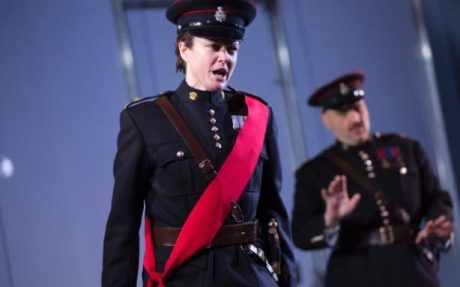
    This is an opera completely driven by brilliant singing. Caitlin Hulcup completely owns the title role. She looked dashing as the young Ariodante (a soldier, in this production) and took the audience deftly through a rollercoaster of emotions. Her “Scherza infida“, which came shortly before the interval in this production, was pure, heart wrenching sadness. Sung from an awkward crouching position, the sheer knots of grief that betrayal can engender were laid out before us. It was pure, it was sad and it was lovely. Later on, Miss Hulcup gave an astonishingly virtuoso performance of  “Dopo notte” – precise, joyful and exquisitely sung. It was all the more remarkable, coming towards the end of quite a long evening of singing.

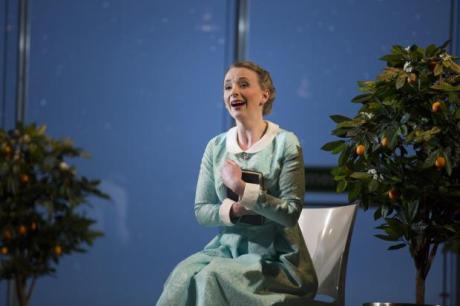
    However, Miss Hulcup was not the only star in the firmament. The parts of Ginevra and Dalinda were sung by two very fine sopranos indeed. Sarah Tynan’s voice brought a rich elegance to Ginevra, whilst Jennifer France, a Scottish Opera Emerging Artist, gave a fantastic show-stealing performance playing the maid Dalinda.
    imgID56301015.jpg-pwrt3

    The men were good too. Lurcanio was played by Ed Lyon whose acting was as precise and deft as his long vocal runs. Meanwhile, the villain of the piece Polinesso was played for laughs by Xavier Sabata, who somehow seemed to have acquired from somewhere Windsor Davies’s moustache. He was a crowd-pleasing villain – generous ironic boos being interspersed with his applause when all was done.

    The King was sung by a rich sonorous Neal Davies, who made particularly good work of “Voli colla sua tromba”. Unfortunately, this wasn’t matched in the pit, where there seemed to be a sudden and unfortunate outbreak of Fluffy Horn Syndrome. This was not the only time in the evening when there were some disappointing sounds from below. String intonation was a bit of a worry throughout and it sounded rather as though the orchestra were a little on the unprepared side. Maybe things will warm up through the run, but this wasn’t a great first night sound. Conductor Nicholas Kraemer kept things nicely balanced – no-one was overwhelmed by the orchestra. However, it was the singing that shone musically rather than the orchestra.

    But where were we and what was going on?

    The lyrics tell us that we were in Scotland. The set told us that we were mostly in a large atrium in a land of snow and ice. And the director seemed to be telling us that we were somewhere where the puritans were in power, putting adulterers to death for breaking biblical injunctions.

    A very striking non-singing opening scene was introduced during the overture – two unfortunate sinners were shown on the point of being hanged by their necks until they were dead. Indeed, they were each still trembling as they hang from the scaffold which we saw when the curtain went up. An Anglican bishop in modern dress seemed to be in charge of these proceedings, which were attended by an elegant crowd who seemed to have recently rediscovered something attractive about Edwardian clothing. This brief glimpse of the terrible fate of two individuals was then replaced with a curtain bearing the chilling words of Deuteronomy 22 about stoning adulterers to death.

    ariodante-new-lead_1-large_trans++pvhYCxZ1zyEMRa-WSVMKo2tT0gK_6EfZT336f62EI5U

    Now, I like a bit of religion but I was struggling a bit to get my head around all this. There was a big concept at work that I’m not entirely sure was ever entirely coherent. The trouble is, Ariodante is not a particularly religious opera. It is about virtue – doing good and being seen to do good. It isn’t particularly about anything more spiritual than that and certainly isn’t about Christianity. And yet we had the words “Trust in the Lord” emblazoned across the stage throughout the whole proceedings.

    It is perhaps simply a relief that the big concept didn’t particularly detract from the performance but it didn’t add that much either.

    For the outdoor scenes we were transported to a snowy wilderness where all the men who had either been wearing modern suits, clerical dress of very uncertain vintage or Edwardian military uniforms suddenly appeared sporting Russian-looking hats. I almost expected a walrus, polar bear or penguin to appear, which might have given us some geographical certainty about where we were but none came.

    Perhaps director Harry Fehr had simply given designer Yannis Thavoris the instruction to keep the audience wondering throughout the whole evening. Not that things were ever dull though. Although some of the changes of scene were a little clumsy with an ever falling dark curtain drop in danger of cutting off the action, the stage-work was interesting. The first scenes were set amongst fruit bushes which were doing rather well whilst love was in the air but as soon as betrayals and deception entered the scene, they died and rotted almost instantly.

    At various points, a couple of dancers appeared and danced their way through dream sequences. This was pretty but didn’t add that much to the storytelling and could easily have been cut without the evening losing terribly much.

    However, none of this should detract from what was a very enjoyable evening indeed. The first act particularly flew by and there was simply so much good singing that it seems almost churlish to be puzzled by whatever was going on in the director’s head.

    Notwithstanding some reservations, this remained enjoyable, entertaining and life-enhancing opera.

    Rating: ★★★★☆

7 responses to “Twitter and the Church”

  1. Justin Avatar

    First, congratulations Kelvin on your appointment as I&C Board convenor, and thanks to you and all who contributed to the SEC’s Synod Twitter coverage, which worked really well.

    Some thoughts:

    Next year, as was suggested by some of the Synod ‘Twitterarti’ we should have a proper Synod 2009 Twitter account, like that set up by the Church of Scotland for their Assembly. And it needs to be integrated into the Synod pages on the Provincial website from the outset.

    It would also be good to integrate the #pisky Twitter stream into the Provincial site on a permanent basis, or to set up an SEC account for that purpose. I would also suggest making the site’s SEC blogroll more prominent. And the SEC Flickr streams.

    I understand the concerns some have about the impossibility of monitoring what’s said on Twitter and the blogosphere, and its undeniable that sometimes people will say insensitive and daft things that will offend and hurt.

    But that is part of the very nature of online communication. The days when organisations could manage their channels of communication through press releases and a limited number of printed publications are gone. The web has democratised communications media, offering a low cost platform for all members of an organisation: the concept of gatekeepers at the top approving and filtering information is redundant.

    Like all organisations the SEC needs to embrace and engage with things like Twitter, blogs and other social networking tools, or people will simply bypass the ‘official’ channels and jump straight to where the real conversation is happening, like your blog.

    It’s not just Twitter we need to embrace, but the existing web platforms we’ve already got in place. I’ve been honoured to be asked to develop a number of websites for the SEC over the past couple of years, including the Provincial site and a few diocesan sites.

    Some good use has been made of these – Kennedy in particular has been doing some great stuff on the Glasgow site over the past few weeks. But my perception is that the web still plays a very muted second fiddle to print as a means of communication within our church.

    At Provincial level I don’t see why all the good news material should be kept for inspires magazine. I think it should go straight onto the website as soon as it becomes available. If it’s kept in inspires nobody outside the church can see what’s going on. I don’t think subscription rates to the magazine would be affected at all if inspires material also appeared online: most commercial magazines have found that putting selected material online serves to promote rather than threaten their presence on the newstands. There are now more printed magazines than ever, and they all have websites.

    I think we should allow the boards and committees to post their material direct to the SEC News section. That would, I think, encourage far more of them to contribute their material to the website.

    The same applies at diocesan level: nearly all the good news is kept back for the diocesan magazines, and almost none of it makes its way to the website (again, I know Kennedy is doing his best for the Glasgow site).

    News and events functionality, RSS feeds, photo galleries: they are all there on the diocesan websites waiting to be used. I have to be frank and say that communicating our diocesan news through rather poorly designed newsletters (where the Comic-Sans wars are still taking place) received only by insiders, makes us look very old-fashioned and insular.

    I realise that sounds rather harsh, and that people are volunteering their time to put together the magazines. But I don’t see why we are spending so much time and money doing it that way when the web is there waiting to be used. I love the church and want it to grow, not continue to decline. The web is our friend, offering so many exciting possibilities, and its importance as a means of communication will not be grasped unless we keep banging on about it!

    My tuppenceworth. Very interested to hear what others think. Congrats again and best wishes in the new post.

  2. gaielle Avatar
    gaielle

    Congrats and Best Wishes indeed, Kelvin. A most demanding role and requirement.

    Encouraged by Justin, I shall add a penny-ha’pennies-worth.

    Communication in the world of today is a serious and complex undertaking, isn’t it, not least because there are so many across-generation and accessibilty issues involved, leaving the ‘non-tech’ community disenfranchised if the ‘old fashioned’ hard copy approach is neglected – or perceived to be neglected. Hard copy will continue to be an essential medium for a while yet – and rightly so.

    But equally important, and especially for reaching, including and empowering the youngest generations in the SEC, is the recognition and inclusion of new and newest technologies. Perhaps the teenagers in our midst have some useful insights to offer us for Developing Mission Outreach. The Good News was given to us to share – with everyone.

    Good – effective – communication is a great thing when you encounter it. Rare Creature tho it be. Fully – and clearly intended to BE – fully inclusive, and therefore encompassing and using ALL practical and available methods of communication.

    Problems in achieving Good Communication so often seem to be due to omission, oversight and a lack of appreciation of The Need To Try.

    So, for instance, I Receive Information From Other, I process this internally with every intention that my Final Response will then be shared comprehensively – but I first neglected to Assure The Other that I had Actually Understood What They Were Saying. In consequence the Information I have Taken On Board may be incomplete or flawed – hence I have (inadvertently no doubt) neglected that very important step of Ensuring My Understanding Of Information Matched what Was Being Said…….

    “What Is Said”, what is “Intended To Be Heard”, “What Is Heard” and “What Is Understood” are frequently 4 different things. However, effective/”good” communication requires a thorough appreciation of such likely mis-match, and also requires enormous strategic endeavour (until the skill becomes second nature) to outwit the intervention of MisUnderstanding.

    As with anything in life, a little digging, hoeing, watering, general nurture and attention will reap a fine result. It takes time, and it takes effort. Such, however, are well worth investment.

    But you will know these things. There is no need for me to be teaching you to suck eggs. I was just mulling out loud.

    All Very Best Wishes for balancing the new hat. (I assume the new post includes a hat ?)

  3. gaielle Avatar
    gaielle

    PS. If there is currently no hat, maybe we could invent one…………..

  4. Kennedy Avatar
    Kennedy

    Perhaps one of our issues is that in the absence of any centrally provided forums for discussion – eg. we don’t normally have a letters page in Inspires – then the blogs and other social media just step in and provide the forum for the sort of discussion that people obviously seek.

    If staff at GSO aren’t involved then the discussion is the poorer for that.

  5. jaye richards Avatar

    Just a little point, and I’m curious as to your thoughts on this, but how would you feel about someone tweeting during , say, one of your sermons or during a particularly uplifting piece of music ? is there a time and a place for this kind of communication, and might this include a religious service

  6. Kelvin Avatar
    Kelvin

    I’d be bothered if someone was disturbing others with their tweeting. However, I was chastened a couple of years ago when I became a little distracted by someone near the front apparently unable to sit still and seeming to send lots of text messages.

    It turned out however that he had the whole bible on his mobile phone and was simply looking up the passages as they were being talked about.

    So, I’m not bothered about discreet twittering, I don’t think, though someone might well choose not to twitter in order to be able to concentrate more on what was going on. Part of a spiritual life in most traditions is about learning not to be distracted sometimes, and choosing not to be distracted during worship would be an admirable path to try to follow.

  7. jaye richards Avatar

    I have to admit to being disturbed sometimes during conference presentations by those around me twittering, although I do it myself so perhaps I shouldn’t complain ! I do think there’s a time and a place though, and for me, anyway, a sacred service is not the place to tweet from.

Leave a Reply

Your email address will not be published. Required fields are marked *

Previous Posts

  • Review: Betrothal in a Monastery

    Scottish Opera and the Royal Conservatoire of Scotland 20 January 2012 Rating: Prokofiev’s Betrothal in a Monastery is seldom staged in this country. This production by Scottish Opera in collaboration with the Royal Conservatoire of Scotland worked reasonably well as a showcase for the singing talents of those on stage. However, no persuasive case was…

  • Cedric’s Sermon – 22 January

    I have to confess to being rather amused by Cedric's sermon on Jesus trying to entice us into fishing for people. You can watch it here:

  • Online Evening Prayer

    I’ll be leading online evening prayer in a google+ hangout at 5 pm today. Check back here for the liturgy. The place to go on google+ is this and you need to add it to your circles in order to be invited to the hangout. More details here. UPDATE – liturgy now available here.

  • iBooks and all that

    I seem from the posting of several others (including Akma) that Apple have something new on offer. It is a new piece of software iBooks Author which allows people to construct what they are inevitably calling iBooks  very easily, that can be read on portable devices. I ought to be excited – it sounds like…