
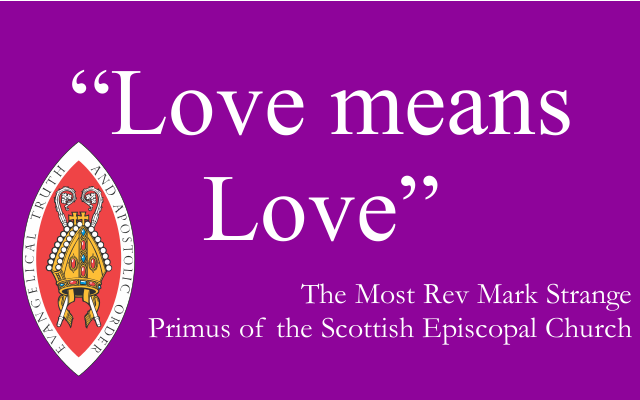
• Love means Love

    Members of the Scottish Episcopal Church voted earlier this year to allow the marriage of same-sex couples to be able to be conducted by those clergy who wish to conduct them. We voted on that after years of discussion. It was passed by the 2/3rds majority in the House of Bishops, the House of Clergy (just!) and the House of Laity (over 80% in favour). The bar to getting this vote through was set so high a few years ago that it seemed impossible to achieve to those who were wanting to nudge the church towards change. However, we carried on, because we believed that love means love. We believed, informed by the bible, by our own experience of God and by our contact with ecumenical and other Anglican friends from across the world, that the love that same-sex partners share has as much potential for the sacramental as the love the opposite-sex couples has.

    We voted knowing that there might be consequences to this in our relationship with the Anglican Communion, which we once helped to found. Our beloved friends in the US-based Episcopal Church were told in 2016 by the Anglican Primates that the Archbishop of Canterbury would, for three years, bar them from representing the Communion in ecumenical conversations and that they would be excluded from certain discussions about doctrine. It is important to note that the Primates themselves have no power to do anything other than listen to one another. It is the Archbishop who determines whom he will invite to take part in some discussions and the Primates asked the Archbishop to refrain from including American Episcopalians and he has, to some extent at least done so. Remember that these are the Archbishop’s Sanctions that the Primates have suggested not the other way round – that’s important. They are imposed by the Archbishop of Canterbury personally and by his authority. We do not have an international magesterium in Anglicanism. The Primates have no authority to impose anything.

    Being sanctioned in this way is a bitter pill to swallow – not because of the sanctions themselves – they probably affected a dozen US Episcopalians out of a church of hundreds of thousands. Bitter because it has the whiff of pettiness about it and of being branded as being slightly naughty by the Anglican Primates – the gathering of senior bishops from across the Communion. The sanctions are more symbolic than real. They have no teeth and everyone involved knows this far better than the media who persist in rather lurid headlines about punishment and even banishment. None of this is real. I’ve struggled to think of even half a dozen people in Scotland who might (and only might) be affected. For these tiny few, there is the frustration of being barred from something for which they have a passion and for which they have worked. We must bear witness that collective punishment is the ugliest form of bullying and that the Primates are wrong, quite wrong, even to impose a symbolic sanction for what we have done. For the rest of the church, the sanctions will have no effect whatsoever other than getting us a bit of welcome profile as an affirming and inclusive church in the media, and life will go on precisely as it did before.

    It fell to our new Primus, the Most Rev Mark Strange to articulate where the Scottish Episcopal Church is right now and he did so brilliantly.

    In June the General Synod of the Scottish Episcopal Church voted to change its Canon on Marriage.  This decision was ours to take as a self-governing province of the Anglican Communion.

    However, I recognise that this decision is one that has caused some hurt and anger in parts of the Anglican Communion and that the decision taken at the last Primates’ Meeting, which was to exclude our brothers and sisters in The Episcopal Church from debate on Doctrine and from Chairing Anglican Communion Committees, is a decision that now also pertains to us. We will continue to play our part in the Anglican Communion we helped to establish, and I will do all I can to rebuild relationships, but that will be done from the position our Church has now reached in accordance with its synodical processes and in the belief that Love means Love.

    This has clearly gone down very well with very many in Scotland. Remember, there were big majorities for what we decided and Mark is much loved and much prayed for by Scottish Episcopalians at the moment.

    It is perhaps worth thinking about what it means though.

    When I think of the phrase, “Love means Love” it takes me right back to the time when I started to bless same-sex couples who were entering Civil Partnerships. I remember them trying to devise ceremonies that reflected who they were and what they were saying to one another. They would say, “Of course it isn’t a marriage” and then when I asked them what they wanted they said, “Oh, we want to make vows to one another in front of our family and friends and exchange rings and have a blessing”. And I remember realising, perhaps even before some of the couples whom I was blessing realised, that what was going on was an altogether ancient archetype that I knew only too well. Whatever the law might have said at the time, what was clear to me was that they were married in the eyes of God and married in the eyes of their families and friends. In their ceremonies they were enacting the simple truth – Love means Love. It isn’t partial or biased or owned by anyone. Love is something that we can know by its absence and something that can overwhelm us by its presence. And as I conducted those ceremonies I was often overwhelmed by the love given and received right in front of my eyes. I learned that Love means Love from people who were bravely loving when there seemed to be no route map for their journey. The fact that they have ended up arriving at the same destination as couples who have been marrying for millennia still has an element of surprise about it. It is as though the full expression of Love was hidden for so long – occluded by law, prejudice, convention and expectation. Yet somehow, encouraged by activism, boldness, conviction and wanton cheek, that Love has managed to dawn in a new way upon this particular time in humanity’s story. And the warmth of love’s blessing is holy and powerful and true.

    Now, the truth is, no amount of purple prose and joy-filled tears of those of us who worked for this can change the fact that some are upset about this. As I sing the glory of Love meaning Love, I have to remember that some people within the Scottish Episcopal Church are probably having to love me through gritted teeth right now. Their generosity and love is costly and kind and that particular Love means Love too in a very real sense at the moment.

    I think that +Mark made it clear to the Anglican Primates that this matter is settled in this part of God’s church. We respect the consciences of all and increasingly I am sure that this will be seen within Anglicanism as the way in which this issue can be managed internationally. We bear witness that we have an answer to the troubles of the communion which we have wrestled fought and prayed for. Don’t be surprised when we seek to bear witness to what God has done for us. It is what Christians do.

    I recently presided over one of the first marriages of a same-sex couple in the Scottish Episcopal Church. It suddenly occurred to me during the service that though the rest of the Anglican Communion will believe that we have just started doing gay marriages, in fact, we have just stopped doing them. For Love is Love, and marriage is marriage. We don’t gay marry people, we just opened marriage to all couples. And God is blessing them and God is blessing us as we do so.

    Our message to the Communion is a familiar one – “O taste and see that the Lord is good.”

    And yes, the Love that we know have known through the ages, just means Love.


10 responses to “The Tim Farron Question and the Archbishop of Canterbury”

  1. Bro David Avatar
    Bro David

    This brings up an interesting memory with the long-time leader of Changing Attitude England (CA). This leader was taken in by Andrew Marin, founder of the Marin Foundation (MF) when he visited the UK in conjunction with some big outdoor Christian festival you lot hold anually. Marin and his followers were attending Pride Marches/Parades around the US and getting their photos taken hunging GLBTQ folks in the marches. His foundation claims to be attempting to build a bridge between the LGBTQ community and conservative Christian communities.
    Marin was invited to comment on the CA blog. He spouted his pablum message of love for LGBTQ folks. Then, in a comment, I point blank asked Marin if he believed that we LGBTQ folks were sinners and needed to repent and become straight. He refused to answer the question. He said that I was asking the “wrong” question. Then he gave this answer verbatim from the Marin Foundation website;
    “We call these the “Big 5.” They are:
    Do you think that gays and lesbians are born that way?
    Do you think homosexuality is a sin?
    Can a LGBTQ person “change?”
    Do you think that someone can be gay and Christian?
    Are LGBTQ people going to hell?
    “The one common theme of these “Big 5” is that they are all close-ended, yes-or-no questions. Each of them must be answered with one word and they are all meant to end conversation. Based solely on one’s close-ended answers, it is easy to label, judge and dismiss the other community entirely. Thus we dehumanize a community based off of a word rather than create a productive conversation. In essence, by close-ended answers either the conservative or the LGBTQ community judges who you are, what you believe, whose team you’re on and how you should be treated.
    “Rather than answering close-ended questions, The Marin Foundation seeks to elevate the conversation and continual fruitful dialogue, as tense as that may be. This is a model taken from Jesus throughout the Gospels. Of the 25 times Jesus was asked close-ended questions, only three times did he respond with a yes or no. These three times were only after he was arrested and admitting he was the Messiah. Prior to this, Jesus never answered close-ended questions with a yes or a no. Instead, he elevated the conversation.”
    I spent the next three days searching the MF website and reading through articles and white papers. I realized that it was a ministry to the LGBTQ of wolves in sheep’s clothing. These people were trying to love vulnerable LGBTQ folks into their embrace, to slowly chip away at them until they had brought them to realize that their sexual/gender orientation was false, acting upon it was a sin and they needed to seek the help of Jesus to beome heterosexual and accept their gender assigned by birth.
    I posted my findings on the CA blog and was promply chastized and barred from further posts. In a personal email from the leader of CA I was ripped a new arsehole and declared anathema. Sadly, even LGBTQ folks in prominent positions are taken in by these folks. I think that we need to continually ask the Big 5, of everyone, epsecially those non-LGBTQ folks who profess to be our allies and supporters, secular or religious.

  2. Peter Davison Avatar

    Good column.
    So who is entitled to express opinions on ethical issues? I’ve long understood it’s the duty of all of us to have INFORMED consciences and to obey them. We may wish to consult people we believe to be more informed than we are, such as our presumed leaders, but in the end, when asked, we should at least be ready to state, however firmly or tentatively, where we stand. As for our leaders, they may or may not be better informed than we are; but we also know that ‘experts’ may be people who know more and more about less and less – and that politics often intrude into our public morality. Much of ethics is situational. That said, Jesus seems to have had much more compassion for alleged ‘sinners’ than for those who chose to label them as such. And much of our present troubles seem to stem from our desire to label and scapegoat people who appear to be different. What would happen if we simply accepted people for who they are and learned to accept that love is indeed ‘a many splendoured thing’?

  3. Graham Evans Avatar
    Graham Evans

    A very interesting new perspective and certainly a question that should be put to all the Anglican bishops who sit in the house of Lords.

  4. The Rev Sr Helena Barrett, OSB Avatar
    The Rev Sr Helena Barrett, OSB

    Absolutely spot on, Kelvin. The ABC should be asked The Question until he is sufficiently exhausted to give a clear and honest answer (whatever it may turn out to be) instead of the usual yards of ecclesiastical flannel.

    1. June B Butler Avatar
      June B Butler

      “The ABC should be asked The Question until he is sufficiently exhausted to give a clear and honest answer…”

      Justin Welby wails piteously: “I’m not the pope.”

  5. the Rev. Grant Barber Avatar
    the Rev. Grant Barber

    I always wondered how the preachers in Pepys’ diary could preach such long sermons. I think I understand better now. So glad we’ve already settled the matter in the Episcopal Church. (Oh, the answer can be a succinct “no, not sin just by its nature).

  6. Bernard Silverman Avatar
    Bernard Silverman

    if I asked an archbishop whether deliberately stamping on someone’s toe is a sin they would give a direct answer. So they should be asked the Farron question over and over again until they do similarly. If the Prime Minister can do that so can they. Indeed the question should be “the PM thinks that gay sex is not a sin. Was she right?”

  7. Kate Odling Avatar
    Kate Odling

    Very interesting. I always think that if someone does not give a clear answer to a question that they have something to hide or that their true belief/thought would be unpopular. I think the ABC has looked very uncomfortable when any direct questioning about LGBT issues are raised. So someone should ask & not accept anything but a straightforward answer. My final thought is that we are all qualified to have an opinion – what’s wrong with that?

  8. Bruce Gulland Avatar

    Whatever I think about the answer to the question, I did rather enjoy the style of your post – you had me on the edge of my seat!

Leave a Reply

Your email address will not be published. Required fields are marked *

Previous Posts

  • Church of Scotland Debate

    I’ve spent much of today listening to the Church of Scotland’s General Assembly debating their Special Theological Commission that had been set up a couple of years ago to report on the way forward for that church with regard to the possibility of gay people to be ordained and inducted and to have their partnerships…

  • Church and Civil Partnerships

    As I awoke in a bleary haze this morning, (today is a post-Ceilidh morning) I heard someone one the radio talking about how the Church of Scotland might be the first church to allow people in Civil Partnerships to serve as ordained clergy. It won’t of course. The Scottish Episcopal Church already has plenty of…

  • Design Process for Discussing Same-Sex Relationships

    My General Synod papers arrived with a thud in the office today. Along with them is a briefing paper which is entitled “Briefing Note regarding design process for discussing same-sex relationships”. The short version is that the College of Bishops has invited the Mission and Ministry Board to establish a design group to create a…

  • A question of gender

    It seems to me that one rarely sees a priest who happens to be a woman happen to wear a maniple. Actually, one doesn’t see many people wear the maniple these days, for reasons that I’ve never quite understood. Why, when one does see such a thing, does it seem invariably to be sported on…