
• A Scottish Kalendar

    Once upon a time, many years ago, by which we mean up until the 1990s, the Scottish Episcopal Church used to publish an annual Kalendar which listed, for every day of the year, a set of bible readings for devotional reading, what saint’s day might happen to fall on that day and the liturgical colour for the day.

    It was immensely useful but was immensely difficult for someone to compile.

    At some point a decision was made to stop publishing it and instead to publish a comprehensive lectionary which listed all the possible combinations of bible readings that you could ever encounter along with a guide to the lectionary that was produced each year. The lectionary and guide are available on the Scottish Episcopal Church webpage here: http://www.scotland.anglican.org/who-we-are/publications/liturgies/calendar-and-lectionary/

    The trouble is, people find the lectionary very difficult to use. You can’t just open it up and see what bible readings you might read on any one day as you need to know which year you are in (1 or 2 for daily readings, A, B or C for the Sunday readings in church). You need to know whether you want readings for Daily Prayer or for a Eucharist. And you need to check in the guide which form of Daily Prayer you should be using that week if you are doing that and you need to check whether it is a feast day which might alter what you are doing and the way in which it might change what you are supposed to be doing.

    In short, checking the readings became something  that you needed to learn how to do rather than something you could just read from the Kalendar for every day of the year. And I think this has had quite an impact. It was much easier to give people copies of the Kalendar by way of supplying daily bible readings than it is to tell people to download the lectionary and guide and teach them how to use it.

    At the time that this change happened, I lamented somewhat.

    However, I also thought about it. For it seemed to me that this was a task that a half-decent computer programmer could get a computer to do.

    Reader, I am that computer programmer, albeit only one who is half-decent.

    Anyway, I started to write some routines to calculate the Kalendar about 19 years ago thinking it wouldn’t take me long to complete.

    Every year before Advent Sunday I’ve tinkered with it and had a go at producing a Kalendar. Each year I’ve failed dismally and got on with my life and muttered into my decaffeinated tea about why this is such a difficult task.

    In the mean time, other offerings have appeared, notably, that outstanding digital calendar that Gareth Saunders produces each year and distributes at no cost on http://www.seccalendar.co.uk/ Gareth’s offering gives you all you might want in a form that can be uploaded into a digital calendar, for example, a google calendar. It thus means that you have the readings at hand wherever you have a digital calendar.

    However, I’ve always hankered after something physical – something that you could leave lying around in the oratory in the cathedral where we gather for daily prayer that would have all the readings in a format that was easy to use. Something that you could leave by the bed or in the holy corner at home which gave you the same readings for use easily and practically when at home.

    I’ve always rather regretted the fact that the church didn’t produce this as it seems to me to be the most obvious way of getting people to read the bible every day. People love lists of daily bible readings. Many people just don’t know where to start with the bible without such suggestions.

    Anyway, this year was no different to any other year in that I had a tinker with the program I started to write 19 years ago. It was not particularly easy as I had chosen to write in an unpleasant computer language called Visual Basic for Applications simply because I had the lectionary tables available in Access. (Everything is a database problem as we know from our Computer Science degrees, right?). The trouble is, I’ve never learned Visual Basic and had to keep looking up the syntax just about every line I wrote.

    I reached the usual muttering into my tea stage early this year, about a week before Advent Sunday. I retired to bed in a very grumpy mood. And I slept. And as I slept, I must have dreamed. For on waking, I immediately went and found a piece of paper and wrote out an algorithm for solving the problem – for putting all the right readings and all the right saints’ days on all the right days of the year.

    And lo – I’ve managed to produce a new Kalendar in a similar format to that which was produced all those years ago.

    Thus, this week looks like this:
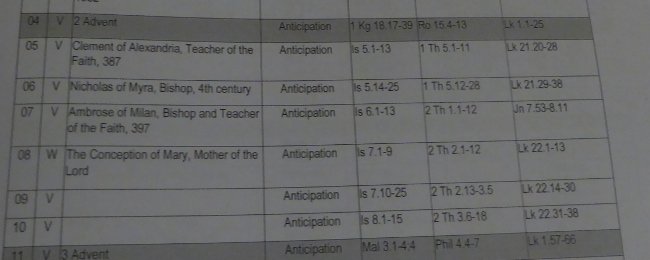
    And there’s even an easy explanation of how it works like this:

    Now, having produced it for myself, as an intellectual exercise if nothing else, it being the first time I’ve really used my programming skills since graduating in 1989, what to do with it?

    It seemed to me that this might be something that people in St Mary’s would like, not least those who have just completed the Vice Provost’s challenge to read the bible in a year.

    I printed some copies off and sold them on the Sunday morning and they went like hotcakes.

    Bishop Gregor has suggested that I should make them more widely available and, having checked with the chair of the Liturgy Committee that I wasn’t stepping on any toes by doing so, am now able to do so.

    Copies are available from me in church for the sum of £3 or are available to purchase on this website here:

    http://thurible.net/product/scottish-kalendar-2017/

    There’s a hefty discount for anyone wanting to buy in bulk for a bible study group maybe or for a church stall.

    For those wondering, the spelling Kalendar is a traditional spelling for a calendar kept by the church.

    This one runs from Advent Sunday 2016 until the end of 2017.

    I’d be happy to answer any other questions about this here. At this stage, I’m not going to be publishing a pdf – this is only available in physical form.

10 responses to “Advertise, advertise, advertise!”

  1. Matt Hanson Avatar

    Good writing. Keep up the good work. I just added your RSS feed my Google News Reader..

    Matt Hanson

  2. Eamonn Avatar
    Eamonn

    How naff can you get? It was worth listening to a professional advertiser’s comments on the Lichfield advert on the Sunday programme on Radio 4.

  3. Gavin Drake Avatar

    Adverts that make people in the church feel comfortable are likely to be completely irrelevant to people outside the church. As the instigator and creator of the Lichfield football adverts campaign I stand by them – they did what we wanted them to do. We had a target and we achieved that target. The professional advertising chap on Radio Four was anti the adverts; but he was also anti the entire Christian message as a self-proclaimed militant atheist. His best effort? “Life” – which is a campaign he created for the Billy Graham missions 20 years ago. Hardly creative (now, 20 years on) nor fresh. His message was that the church should get rid of Jesus, God and all the “after life” stuff and concentrate on making people feel good now.

    One final thought, in this blog entry aren’t you demonstrating the Christian Christmas grumpetyness which you appear to be criticising in others?

  4. kelvin Avatar

    Thanks for your comments Gavin.

    You are quite right about my grumpityness though I was not particularly being critical of it in others. Indeed, being able to rely on other people’s grumpityness is one of the things which has ensured a lot of exposure for the CAN ads, for example, the Bad Hair Day campaign and the Meek, Mild As If one. It was the (mock?) outrage of the christian community that got those ads talked about.

    I’m a fan of what the CAN do, which I perhaps did not make clear in the above blog entry.

    I’d be interested to know what the target was and how achieving it was measured.

    I have to confess to feeling embarrassed by the Lichfield ad but then of course, it was not aimed at me.

    I also commented about past CAN campaigns here and here.

  5. Kennedy Avatar
    Kennedy

    Having listened to the CAN adverts, I am left asking what the message was and who was the target audience? If the intention was to familiarise the audience with the characters and motifs from the Christmas story then OK, but there is more that could be said in the time.

    You’ll permit me a small plug for the stuff that GRF produce.

    Have a listen:

    http://smallvoice.org.uk/wp-content/uploads/2008/09/01-ms-christianity.mp3

    Yes, this uses the style of the M&S ads but I think that it communicates something about the Christian message and in a form that a non-church person could relate to.

    The judges at the Jerusalem Awards seemed to like it as they awarded it the premier award in the ‘Shorts’ category at their awards ceremony last week.

    If you are looking for creative audio to use in churches or schools then have a look at http://www.audiopot.org.

    Kennedy

  6. kelvin Avatar

    Thanks Kennedy. I like the M and S Ad. Very clever. I always like hearing Albatross (the music underneath) because it reminds me of someone I knew a long time ago who used to play it (on large pipe organs) during communion.

    One of the drawbacks of the ads that I was speaking about above is that they all depend on knowing the Christian story. That is perhaps legitimate in a Back to Church Sunday as it is presumably aimed at folk who have gone away knowing something or other.

    The line about the penalty does kind of imply that substitutionary atonement is what we believe though.

    The Lichfield ad certainly got a lot of coverage and if that was the intention, it succeeded.

  7. Elizabeth Avatar
    Elizabeth

    I must admit I found the racing advert amusing. The football ones leave me cold. Aside from issue about inclusivity and dubious theology, I think living in Glasgow has made me very wary of any connection between religion and football.

  8. Coxy Avatar

    I think that the football one is excellent, as does my wife (and she can’t tell the difference between Liverpool and Arsenal – I guess they do both play in red though!). How is it not inclusive of men and women? As I see it there is good build up play from Mary and Joseph before Jesus scores…

  9. kelvin Avatar

    Hi Nick

    I’ve just rescued your comment from a spam filter – don’t know why it got swallowed.

    At St Mary’s we tend to avoid language like “men” where what is really meant is men and women, “mankind” when what is meant really is humanity etc

    This affects things like the language we use for hymns.

    We’d never sing, “Brothers, this Lord Jesus, shall return again” for example. In a mixed crowd it just seems rude.

    There is an ongoing degate about how far to go with this policy but by and large, language inclusive of men and women is the norm at St Mary’s and exclusive language tends to jar and be distractive when you’ve got used to more inclusive language in church. Thus the ad is something we couldn’t use because of the use of the word “man” meaning something other than just men.

  10. ryan Avatar
    ryan

    The term “banter”, as featured in the ad, should also be used by no-one anyway (and only partly because of Chewing the Fat). O the amount of people that have endured abuse and had it expained away as “just banter”.

    Wondering if “male” ads like this are ok if one also does female-centered advertising, or if the whole idea is hoary sexism. St.Silas does a Women 4 Women thing which I believe is popular. No Men 4 Men though.

    Hope I’m immune from the st.silasite ensnaring spam filter
    ;-).

Leave a Reply

Your email address will not be published. Required fields are marked *

Previous Posts

  • Postcard to Rowan

    Dear Rowan, wondered whether it had occurred to you that if you give an interview in one country, these days, it will probably be picked up in another country. Take this interview that you’ve given to the Telegraph this weekend. Did you have any regrets? Oh yes, not going to the USA to deal with…

  • Deaconings and Priestings

    I’m sadly unable to be in St Mary’s this weekend for one of the most significant moments in the year – five people are being ordained at a special service on Saturday afternoon. These are moments that people remember for the whole of their lives. My exuberant good wishes to all those being ordained. Some…

  • Installation/Institution

    For the next three months, I’m on sabbatical from St Mary’s, enjoying the freedom that Bishop Gregor and the congregation have given me to think and reflect and grow. The last formal thing that I did as Provost of St Mary’s before sabbatical time started was to go to the start of a new ministry…