
• Why I’ll be Marching at Pride (2024)

    I slipped into an unknown pub in Middle England to get out of the rain and have a pub lunch. It was welcoming and cosy. Steak and ale pie, since you ask.

    The part of the pub I was sitting in was right next to the bar. A small snug. The kind of room where you can hear everyone else’s conversations though it wasn’t too busy. Just a group of fifty-something men in for their pies a table a few feet from me, right next to the bar. It wasn’t terribly busy and so our host behind the bar joined in with their conversation, which soon turned to the result of the General Election. Everyone was interested in what it might mean for them. (Bartenders round here want firm action on business rates, I can tell you.)

    After a while, one of the pie-eaters suddenly said for all to hear, “Did you know that 61% of the new MPs are gay?”  The others at his table and the host at the bar expressed surprise that it should be as high as that. “It just isn’t right – not that number, that’s far too many of them. How have we become a country where 61% of our MPs are gay?”.

    And I remained silent.

    I remained silent because I was in a strange place and didn’t want to risk any unpleasantness.

    Well no, I remained silent because homophobia stalks my world. I remained silent because I didn’t know how anything I might say might be taken. It probably wouldn’t have led to a punch in the face but the truth is, you never know.

    The person making the claim about the number of gay MPs was wrong. Spectacularly wrong. I suspect he’d been told that 61 MPs were gay and had heard it as 61% and accepted that as being true. It was true in his inner world, a world in which the gays were getting above themselves. It was also a believable fact for those around him. They were surprised it was 61% and yes, that did seem a bit high. And yes, the gays were getting a bit above themselves.

    I gather that a few more LGBT+ MPs exist than 61 – the number is about 66. That means that it is about 10% of the MPs in the House of Commons. LGBT+ people are sometimes estimated to account for about 10% of the population. So 60-odd members of parliament who fit that profile is something to be celebrated as a good example of representation. Once upon a time, every one of those MPs would have been subject to blackmail or worse. Once upon a time, every one of them would be silent.

    Me remaining silent in the pub for 10 minutes and then, after finishing the pie, going off without a word, is minor when compared with the violence that many gay people face on a daily basis in other parts of the world.

    Yet that incident played in my mind the rest of the day. I went over it again and again. Should I have spoken up and called out this nonsense? I can argue that both ways. But the thing that I care more about than putting someone right in a pub is that this nonsense claim inhabited my head for half a day. Not so much the absurdity of the suggestion that 61% of MPs were gay but the commonplace assumption, held by a group of apparently nice people in an agreeable country pub, that yes, the gays were getting above themselves. Too many in parliament. Too many in power.

    Power that should, apparently, be exercised by the dominant majority. By people who are not like me.

    How many gay MPs should we have anyway? And how many is too many?

    It is these thought patterns which form the framework in which homophobia thrives.
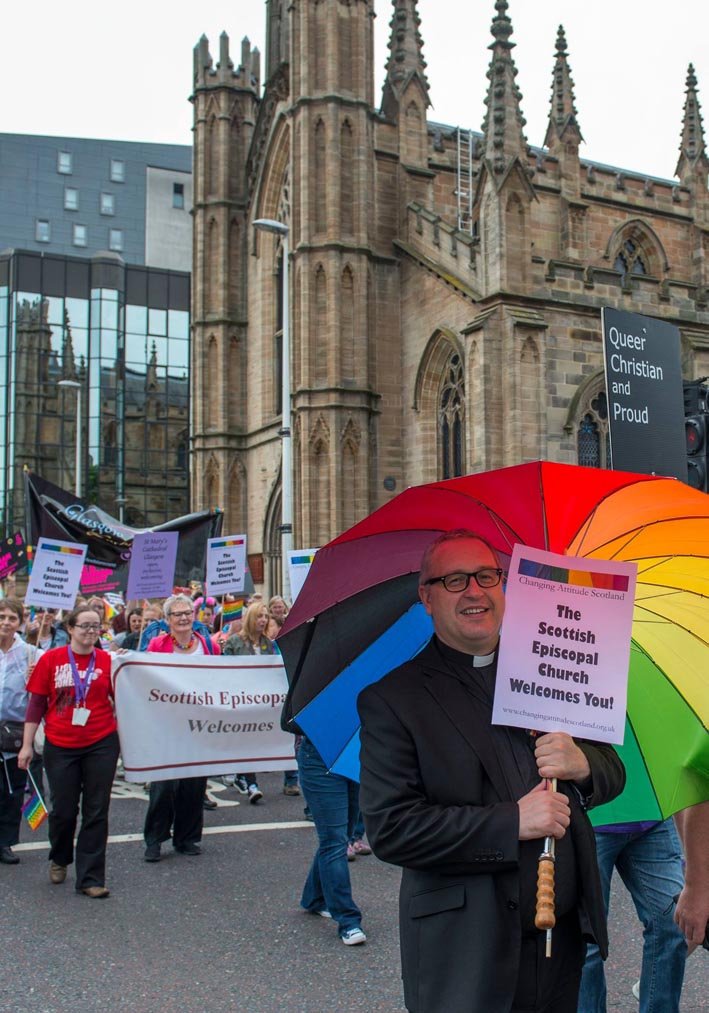
    Kelvin Holdsworth at Pride MarchI rejoice in the progress that we’ve made. But I’m impatient for more. I’ll carry my placard on Saturday at Pride and put a smile on my face. Blessed Are The Fabulous I’ll proclaim and I’ll mean it. But I’ll still be walking on streets in which it only feels safe for most same-sex couples to walk hand-in-hand for a couple of hours a year during Pride itself.

    I’ll also be marching wearing a black suit, clerical shirt and a white clerical collar because of the thousands who will be there for whom that will be an extraordinary thing to witness and something that they can scarcely believe possible.

    Yes, my own small corner of the world still has a lot of work to do. In my own diocese, the clergy asked clearly during the last Episcopal vacancy for intentional work to be done on racism, sexism and homophobia, recognising that these were all issues that were real in the diocese and that our attitudes to difference had played an ugly part in our attempts to try to choose a new bishop. A few years later, we are going into another Episcopal vacancy with none of that work done. And yes, what I experience as homophobia is deeply related to what my female colleagues experience and it is made out of the same basic material as the racist presumptions that black colleagues know well. And even since that time, anti-trans prejudice has grown and grown like an invasive new plant species. It poisons and diminishes all who taste its fruit.

    There’s nothing new about that poison either. Lots of us know it all too well.

    The easiest prejudice to counter is that which is most obvious. In-your-face discrimination is easy to point out if you are able to speak from a place of safety. Much harder is the bitter prejudice of the well meaning – that of those who couldn’t possibly be homophobic because they went to such a lovely wedding only last month, who can’t be sexist because isn’t it wonderful that we have lady vicars now and who couldn’t possibly be racist because that would be just unthinkable!

    Prejudice is part of the psychological air we breathe. It forms part of who each of us are.

    Think you don’t have any yourself?

    Think again.

    Think I don’t have it?

    I wish.

    How long will it be before it is unthinkable that women colleagues will ask whether another woman will ever be elected as a bishop due to accusations being made about the alleged behaviour of a bishop who happens to be a woman right now? How long before the qualifications of those who arrive in the church who happen to be black will be treated as being on a par with those who happen not to be? How long before I can simply sit and eat a pie?

    For all these reasons and 10000 other micro and macro aggressions, I’ll be marching at Glasgow Pride on Saturday.

    Anyone who shares the dream of a world where we are all treated equally and treated well is welcome to join me.

    Blessed are the fabulous.

    And blessed are the impatient too.

10 responses to “Advertise, advertise, advertise!”

  1. Matt Hanson Avatar

    Good writing. Keep up the good work. I just added your RSS feed my Google News Reader..

    Matt Hanson

  2. Eamonn Avatar
    Eamonn

    How naff can you get? It was worth listening to a professional advertiser’s comments on the Lichfield advert on the Sunday programme on Radio 4.

  3. Gavin Drake Avatar

    Adverts that make people in the church feel comfortable are likely to be completely irrelevant to people outside the church. As the instigator and creator of the Lichfield football adverts campaign I stand by them – they did what we wanted them to do. We had a target and we achieved that target. The professional advertising chap on Radio Four was anti the adverts; but he was also anti the entire Christian message as a self-proclaimed militant atheist. His best effort? “Life” – which is a campaign he created for the Billy Graham missions 20 years ago. Hardly creative (now, 20 years on) nor fresh. His message was that the church should get rid of Jesus, God and all the “after life” stuff and concentrate on making people feel good now.

    One final thought, in this blog entry aren’t you demonstrating the Christian Christmas grumpetyness which you appear to be criticising in others?

  4. kelvin Avatar

    Thanks for your comments Gavin.

    You are quite right about my grumpityness though I was not particularly being critical of it in others. Indeed, being able to rely on other people’s grumpityness is one of the things which has ensured a lot of exposure for the CAN ads, for example, the Bad Hair Day campaign and the Meek, Mild As If one. It was the (mock?) outrage of the christian community that got those ads talked about.

    I’m a fan of what the CAN do, which I perhaps did not make clear in the above blog entry.

    I’d be interested to know what the target was and how achieving it was measured.

    I have to confess to feeling embarrassed by the Lichfield ad but then of course, it was not aimed at me.

    I also commented about past CAN campaigns here and here.

  5. Kennedy Avatar
    Kennedy

    Having listened to the CAN adverts, I am left asking what the message was and who was the target audience? If the intention was to familiarise the audience with the characters and motifs from the Christmas story then OK, but there is more that could be said in the time.

    You’ll permit me a small plug for the stuff that GRF produce.

    Have a listen:

    http://smallvoice.org.uk/wp-content/uploads/2008/09/01-ms-christianity.mp3

    Yes, this uses the style of the M&S ads but I think that it communicates something about the Christian message and in a form that a non-church person could relate to.

    The judges at the Jerusalem Awards seemed to like it as they awarded it the premier award in the ‘Shorts’ category at their awards ceremony last week.

    If you are looking for creative audio to use in churches or schools then have a look at http://www.audiopot.org.

    Kennedy

  6. kelvin Avatar

    Thanks Kennedy. I like the M and S Ad. Very clever. I always like hearing Albatross (the music underneath) because it reminds me of someone I knew a long time ago who used to play it (on large pipe organs) during communion.

    One of the drawbacks of the ads that I was speaking about above is that they all depend on knowing the Christian story. That is perhaps legitimate in a Back to Church Sunday as it is presumably aimed at folk who have gone away knowing something or other.

    The line about the penalty does kind of imply that substitutionary atonement is what we believe though.

    The Lichfield ad certainly got a lot of coverage and if that was the intention, it succeeded.

  7. Elizabeth Avatar
    Elizabeth

    I must admit I found the racing advert amusing. The football ones leave me cold. Aside from issue about inclusivity and dubious theology, I think living in Glasgow has made me very wary of any connection between religion and football.

  8. Coxy Avatar

    I think that the football one is excellent, as does my wife (and she can’t tell the difference between Liverpool and Arsenal – I guess they do both play in red though!). How is it not inclusive of men and women? As I see it there is good build up play from Mary and Joseph before Jesus scores…

  9. kelvin Avatar

    Hi Nick

    I’ve just rescued your comment from a spam filter – don’t know why it got swallowed.

    At St Mary’s we tend to avoid language like “men” where what is really meant is men and women, “mankind” when what is meant really is humanity etc

    This affects things like the language we use for hymns.

    We’d never sing, “Brothers, this Lord Jesus, shall return again” for example. In a mixed crowd it just seems rude.

    There is an ongoing degate about how far to go with this policy but by and large, language inclusive of men and women is the norm at St Mary’s and exclusive language tends to jar and be distractive when you’ve got used to more inclusive language in church. Thus the ad is something we couldn’t use because of the use of the word “man” meaning something other than just men.

  10. ryan Avatar
    ryan

    The term “banter”, as featured in the ad, should also be used by no-one anyway (and only partly because of Chewing the Fat). O the amount of people that have endured abuse and had it expained away as “just banter”.

    Wondering if “male” ads like this are ok if one also does female-centered advertising, or if the whole idea is hoary sexism. St.Silas does a Women 4 Women thing which I believe is popular. No Men 4 Men though.

    Hope I’m immune from the st.silasite ensnaring spam filter
    ;-).

Leave a Reply

Your email address will not be published. Required fields are marked *

Previous Posts

  • Statement on the fire at Notre Dame

    The fire at Notre Dame Cathedral is a tragedy not only for Paris and the people of France but for the world. Those who know the building will be unable to see the pictures of the fire without feeling heartbroken. So many different things that make up the building are priceless – the medieval roof,…

  • If I had just one more sermon to preach…

    During Lent, members of the clergy at St Mary’s are giving addresses at Choral Evensong on the theme “If I had just one more sermon to preach…” Here’s mine: In the name of God, Father, Son and Holy Spirit. Amen. If I had just one more sermon to preach, I’d tell people that God loved…

  • Statement on the Christchurch Terror Attacks Against Muslims

    Glasgow in Scotland and Christchurch in New Zealand are linked by the fact that each contains a cathedral built to an identical design. Christ Church Cathedral and St Mary’s Cathedral, Glasgow were built to identical plans. Christian hearts and Muslim hearts are made to the same design as one another. Today we weep for all…

  • Teaching sermon on Confession and Absolution

    During Lent, I’m preaching giving simple teaching addresses focussing on different things that we do during the Eucharist. In the name of God, Father, Son and Holy Spirit. Amen. I don’t know whether you’ve given something up for Lent. These days I often tend to think of taking something up for Lent rather than giving…