
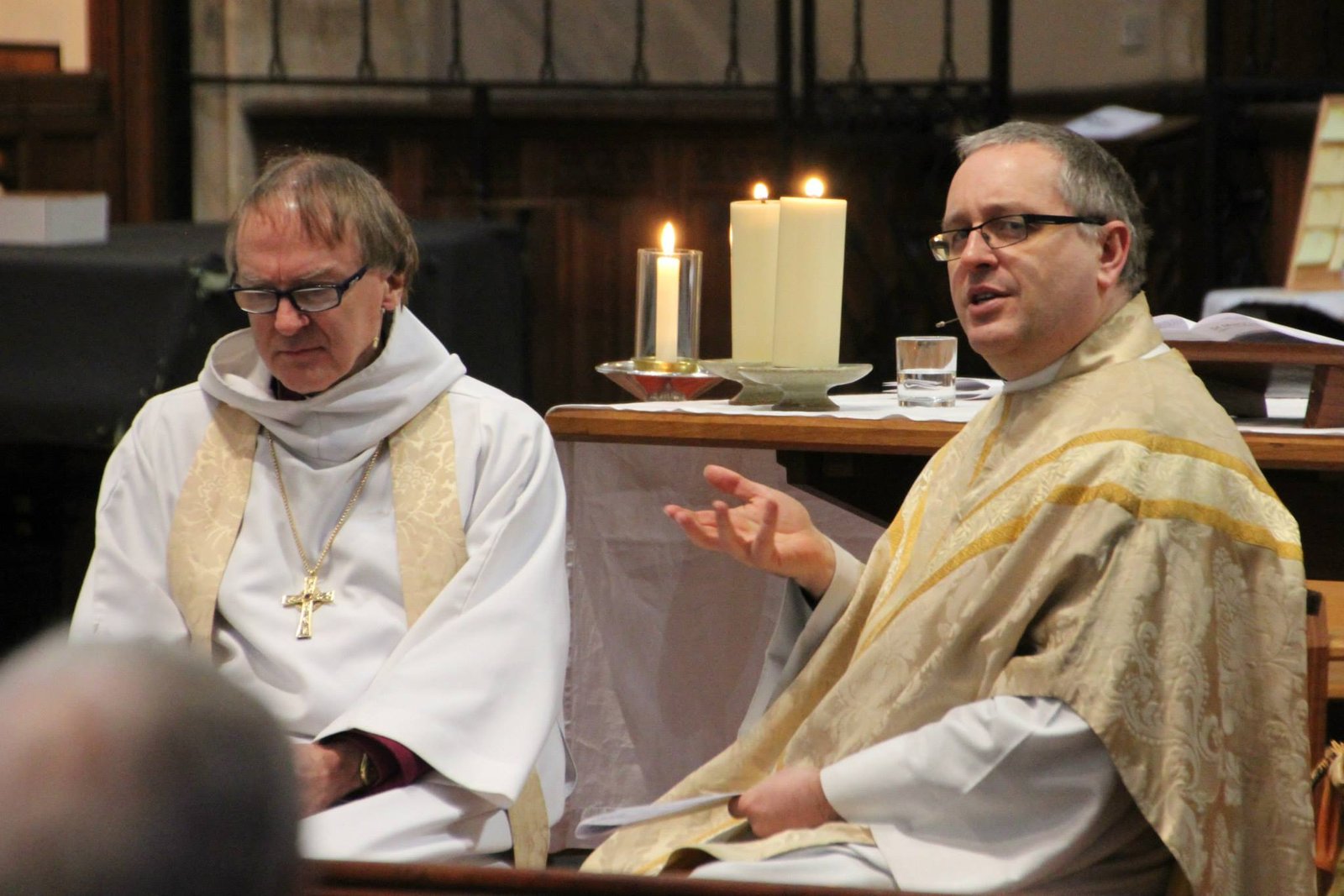
• Christmas Day 2014 – Sermon

    Come with me to Bethlehem. Come and see the babe in the manger. Come and worship and adore the Lord of Heaven and Earth with the shepherds at the manger.

    But don’t come with me to Bethlehem of Judea. Not yet anyway.

    Come with me instead in your mind to the city of Venice where I had part of my main holiday this year.

    I stepped off the train and walked out of the station and gasped at the scene in front of me. The grand canale, the vaporetto water busses. The astonishing modern Canalettoesque scene. A city completely without roads and cars.

    And I quickly got used to it and started to enjoy finding my way about down the little alleys and along the byways along the canals.

    Now, some of you will have been to Venice yourself. You’ll know that walking about can be a bit of a struggle.

    It is crowded and busy. The pathways are narrow and crowded. And it is insanely pretty so you just want to stop and gaze at everything.

    And everyone is feeling the heat and everyone needs to pause for breath sometimes.

    And one of the hazards are the bridges that you have to use to get over the canels. Every hundred and fifty yards or so you go up steps and over the bridge and down steps.

    And that adds to the weariness.

    And this year there is an added hazard on the bridges of Venice. Not just people sitting on their suitcases having an ice-cream and getting in everyone’s way. Not just people stopping to admire the view. No, there’s something new.

    Someone has come up with one of those bright ideas which seems like such a good idea until you see it in practise.

    Someone has come up with a pole a couple of feet long, upon which you can mount your phone or camera to allow you to take photographs of yourself with a background view behind you.

    And there’s nothing so pretty as the Venetian canals and so people stand on those bridges waving these dangerous sticks about trying to get the perfect picture of themselves, a canal and the whole of St Mark’s Basilica in the frame of a small smartphone.

    Yes – this is the year of the selfie and tourist spots like Venice are falling victim to the selfie pole menace. For sometimes you could barely get across a bridge without being poked or prodded by one of these infernal poles.

    Well, Venice is lovely. I completely fell in love with it. But oh, it can hard work.

    And so it was one day I found myself going along the alleyways in the heat, up and down the bridges and through the crowds. And I was hot and tired. And I needed a rest.

    Well the only thing to do in Venice when you need a rest is to slip into a church. Cool marble and shade from the sun was what I needed and so I pushed open the door of one of the many churches and found my way inside.

    And immediately I realised that I was in one of the churches that has significant pieces of art. I was hot and bothered so I don’t remember whether it was a San Maggiore or a San Benedissimus or what it was. And I’d seen so much art that I’d long since stopped being able to remember which was a Giotto and which was a Tintoretto.

    But I knew what was featured in the large painting in this particular church. It was at once completely familiar.

    The adoration of the shepherds in Bethlehem.

    Instantly recognisable. Somehow the image of the poor shepherds worshipping at the manger had appealed to some Venetian dignitary with enough money to commission art big enough to fill a wall.

    And in the picture were the holy family – Joseph, Mary and the babe.

    And in front of the picture, with their backs turned away, looking towards me was another family. Guiseppe, Maria and a rather hot and bothered babe.

    And the parents stood there in front of the great piece of art smiling.

    The family stood there grinning but with their backs to the great painting.

    For as they stood, the father was holding one of those selfie poles to ensure that they could get a picture of what mattered to them that day.

    There they were. This modern hot and bothered family putting themselves into the scene with the holy and beloved family. Putting themselves into Bethlehem.

    Come with me to Bethlehem.

    Come with me to Bethlehem and put yourself in the scene.

    For if the shepherds are invited then so are you.

    The invitation to the shepherds are a clue that God was setting up an open, inclusive and welcoming stable.

    For shepherds were not smart but scruffy. They were not respectable but rapscallions. They were not gentry but general riff raff.

    But the word came to the shepherds that something was going on. God had come into their neck of the woods and they had better pick themselves up and rush down and see what it was all about. The invitation to the shepherds implies that anyone is welcome.

    Come with me to Bethlehem and put yourself into the scene. For you are invited too.

    You are invited to know that God has come into your world.

    You are invited to know that God has come close to you.

    You are invited to know that God is near to you.

    And in Glasgow this week we need to know that God is near us, that God loves us and that God is right beside us – no matter what.

    All those selfie photographs in Venice and no doubt every other tourist spot speak of the desire to put ourselves into the picture.

    But we are already made in the image and likeness of God.

    A God who chose to put his own self into the picture; who opted to enter into our frame of reference.

    God came into the world long ago so that I could tell you right now that God is here in this city today.

    For the word of God in scripture, for the word of God in Glasgow, for the word of God within us.

    Thanks be to God.

8 responses to “What is a wiki?”

  1. Chris Avatar

    I wanted to comment on your wiki post, but there is a gremlin preventing me – no box to write in, so no writing!
    [Comment now moved]

    This is what I’d have said:
    Great clip! A really clear description – can we get it incorporated into an educational package for the church? See http://scotedublogs.wikispaces.com/ for a good example of a wiki in use for over a year.

  2. Tim Avatar

    Yeah. Wikis have huge potential. When I was setting up my church website I sat down and thought:
    a) lots of pages
    b) easy editing
    c) uniform appearance across pages
    d) ability to allow some people to (not) edit certain pages

    End result was dokuwiki.

    The real trouble is still persuading people that they’re capable of contributing…

  3. kelvin Avatar
    kelvin

    Yes, it is odd getting people to post on a wiki is very much harder than getting them to post a comment on a blog. Something about a fear of being the authorial voice.

    I think that it is fear of being contradicted and corrected, which is a shame, as whenever I post to a wiki, I’m hoping that someone can improve on what I’ve written.

  4. Kimberly Avatar

    Fabulous video. Thanks for linking it.

    I wonder if this is one of the ways we should be trying to respond to the Draft Anglican Covenant.

  5. Stewart Avatar

    Wikis are great – look forward to seeing the St Mary’s Wiki developing (and adding to it!)

  6. jimmux Avatar

    Thanks for a very clear explanation! Now that I understand how they work, I’ll be raising a discussion on how we might be able to use them on the National Postgraduate Committee of the United Kingdom. They seem a very useful tool for sub-committees which do a lot of work by e-mail.

  7. Kennedy Avatar
    Kennedy

    I had a look at Tim’s church website and looked at the bit with the contributions from the congregation and saw this statement:

    ‘Please note: the content in this section is contributed by members of the congregation and should not be considered official statements by the Church.’

    I am a great fan of wikis for collaborative work, but I think this indicates one of the issues with ‘public’ wikis. These problems tend not occur when wikis are being used for internal usage or for a closed group. Open editing is very attractive but you need some form of management to ensure that defacement doesn’t occur or statements which might be damaging are published.

    Also, how do I tell the difference between ‘the Church’ and ‘ members of the congregation’? Are they not the same thing?

    Kennedy

  8. […] First posted quite a while ago here. […]

Leave a Reply

Your email address will not be published. Required fields are marked *

Previous Posts

  • Child Protection

    Lexie Plumtree speaks. As usual, the synod is awed by her name. Committee on Child Protection will do some work on victims. Helping congregations to help those who are victims of abuse. New legislation is on course to come into place at end of this year. Vetting and barring scheme will come in. Will mean…

  • Amendment

    The Synod amends the motion to ask Diocesan Synods to consider the motion as well as the Standing Committee. It is the first division 73 in favour, 35 against. it doesn’t get more exciting

  • Patricia Peatie

    Says that Standing Committee is asked to consider the recommendations. Says next year’s General Synod will receive a progress report. Standing committee asked dioceses to think about skills on committees.

  • Elaine Cameron sums up

    Please that synod is interested in Gender language Purpose of Audit was partly to open up conversations and she is pleased it has done so.