
• Back from hols and quick theatre reviews

    beckettsmall
    I’m back to work at St Mary’s today after a post-Christmas (well, post-Epiphany) week off. I’m writing this at the point just before I go into work, say morning prayer and open up the emails that have come in to me whilst I was away.

    It has been a busy week. I managed to fit in a trip to Yorkshire to see family and a wee theatre trip to London.

    Here are a few quick theatre reviews of what I saw.

    • Matthew Bourne’s Swan Lake at Saddlers Wells – by some distance the most exciting thing I saw. I’ve come rather late to this one but loved it. (Except the ending which reminded me of Brokeback Mountain – how often gay couples only end up together when they are dead).
      Rating: ★★★★★
    • Ghosts at the Trafalgar Studios – A very good production of this Ibsen play though I was surprised when I got in that I’d already seen a strikingly similar production of the same play at the Citz a while ago. Outstanding question – why did the maid and her father sound as though they came from Govan when they were supposed to be rural Swedes?  Apart from that, all made sense and this was quite gripping.
      Rating: ★★★★☆
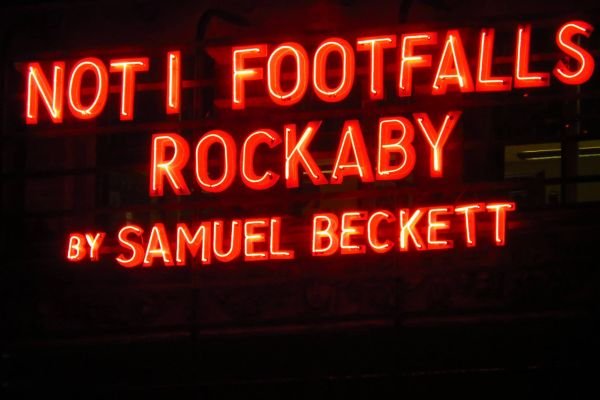
    • Not I, Footfalls and Rockaby – the Beckett trilogy at the Royal Court. This was the one I booked in advance and indeed the one that prompted me to book the trip. A rare chance to see Not I, not least because of how difficult it is – the actor hangs upside down on the stage and delivers a monologue “at the speed of thought” whilst the only illumination in the whole theatre is a tiny pencil spotlight on her lips. This was chilling, fascinating theatre that plays with your mind.
      Rating: ★★★★½
    • From Morning to Midnight – a German expressionist piece at the Royal National Theatre. Brilliantly done. But should it have been done? I was far from sure. Reminded me of that terrible production of the Seven Deadly Sins that Scottish Opera did a few years ago.
      Rating: ★★★☆☆
    • Mojo – a relatively new play at the Harold Pinter Theatre. This one didn’t work for me at all – far too shouty. Odd that the people in the stalls seemed to think it was hilarious and those in the Royal Circle didn’t. How does this happen?
      Rating: ★★☆☆☆

    Not a bad trawl. Add to that three big sung services in musical churches in London, a hour or so looking at favourite things in the National Gallery, some good food and good company and you’ve got a flavour of what I was up to.

    I was in London for three nights, by the way and managed to come back without blisters.

5 responses to ““Issues” is no more”

  1. Cedric Avatar
    Cedric

    Oh I well remember the day ‘Issues’ landed with a loud thud through the letter box. I had been ordained for over 10 years by then. And I reeled in reading it.
    Before then the general culture of conversation about sexuality in the Church was ‘don’t ask, don’t tell’. And most bishops acknowledged that among their most able and effective clergy many were gay men, some in relationships, and often deployable in parishes where others would not contemplate living and working.
    But remember the context. This was also a period when AIDS was an international emergency and in Britain the Thatcher government sought to outlaw the ‘promotion’ of homosexuality through section 28 of the Local Government Act. And for sure, ‘Issues’ was a direct consequence of the passing of the amended Tony Higton General Synod private members’ motion declaring all ‘homosexual acts’ as sinful. The consequent noise of the shutting of closet doors was deafening.
    In my diocese the bishop asked one of the archdeacons to convene regular confidential meetings with a few gay clergy to offer them an opportunity to talk about the effects of all this on their lives and ministry. Some would not trust the Church to participate in such enterprises. Understandably. And huge numbers of vocations were thwarted and lost. And are to this day, as the toxic debates continue in the C of E in a social context which has changed beyond imagining.
    So thank you Kelvin, as ever, for your insightful questions.

    1. Beth Avatar
      Beth

      Cedric, I recall you speaking to the LGBT Network at the Cathedral about Issues and that it was reaffirmed by the C of E around about that time too. I wasn’t so aware of it when it was published (being about eight years old at the time and also a Roman Catholic), but I remember so clearly from what you said how devastating it had obviously been and still was. I remember thinking at the time of that reaffirmation, “oh, I can never go home”. It became so clear to me that the Church of England wasn’t somewhere I could feel welcome as long as it was allowed to stand.

  2. Ian Paul Avatar

    Kelvin, I can understand why you are glad that the offensive language of Issues has gone. Ironically, it was actually a statement written by liberals of the day; the main author was Richard Harries.

    And conforming to Issues was never the real question. The real question is conforming to Canons B30 and C26, so that the pattern of life of clergy should reflect the doctrine of the Church ‘according to the teaching of Jesus’. All Issues did was make that clear and unambiguous (though in an unhelpful and obsessive way) with regard to sexual intimacy. Ironically, it was the liberal ‘don’t ask, don’t tell’ policy which cemented Issues in place as a response.

    And of course, with Issues gone, the Canons remain in place, and the demand is the same. The good thing about GPCC is that it sets this one issue in the context of many others, which is much healthier.

    But on the question in hand—nothing has changed. You seem to have missed that.

    1. Kelvin Avatar

      No Ian. It isn’t that I’ve missed that. It is that I don’t believe that.

      Issues was a massively offensive document that coloured absolutely everything the Church of England had to say about sexuality. Changes to Canons will look significantly different in the light of its removal.

      A great deal is changed by its removal.

  3. Mike Burnett Avatar
    Mike Burnett

    Jesus preached love, but he also forgave sins with the instruction ‘to sin no more’.
    Deciding not to sin when the sin in question is something that we enjoy so much that life may feel miserable without it, is a real sacrifice. It really is ‘bearing your cross’ to follow him. But that is what Christians are called to do.
    We may wish to question our translation of the Bible, or quibble over the exact meaning of a phrase we find challenging, but Christianity is not a ‘pick and mix’ faith where we just have to accept the bits we like and can ignore, or condemn, the bits we don’t like. We do not get to negotiate – we must take it or leave it.

Leave a Reply

Your email address will not be published. Required fields are marked *

Previous Posts

  • Lotions & potions, pills and powders

    Am living through a litany of lotions and potions, pills and powders. Thus far, the past few days have included: paracetamol lemsip (max strength) vicks vapour rub (v sticky) benylin strepsils tyrozets lightbox (first outing of the winter) multivitamins rhodiola rosea cod liver oil The remarkable thing is that I’ve had to buy none of…

  • Vestry Cancelled tonight

    Vestry members – please note that this evening’s vestry meeting is cancelled. (I had been hoping to be well enough, but am still afflicted and don’t want to be passing what I’ve got to the rest of you). Please deal with questions arising from this month’s reports by e-mail during the coming week. I will…

  • All heaven will break out

    Here is the sermon that I croaked this morning. Not having much voice, I’ve no idea whether people could hear it or not. The snuffling of the mancold which I’ve been afflicted with prompted me to dip into the file of “old sermons about the rich man and lazarus” and pull this one out. Last…