
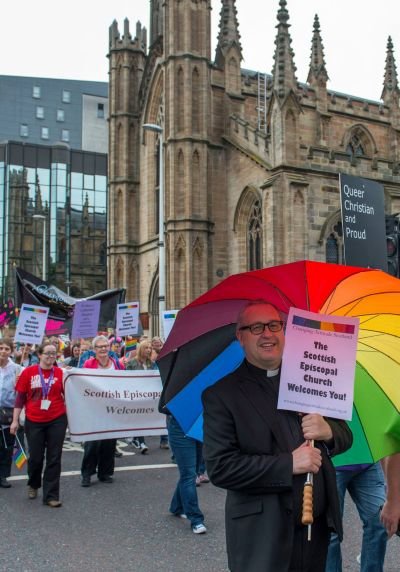
• 50 Years of Protest and Change

    As day turns to evening on the 28 June 2019, it is difficult not to think of a couple of relatively small-scale riots that took place 50 years ago and murmur a quiet prayer of thanksgiving for the rioters. I have little doubt that there was no way they could foresee the movement which was to spring from the events that took place in and around the Stonewall Inn in New York.

    Earlier this week I spent a lovely evening in the sun sitting outside the Royal Gourock Yacht Club eating a meal with friends. The sun was shining, the water was calm, boats were bobbing about and we were served good food. It could not have been further away from the rather downbeat drinking establishment that the Stonewall Inn had become all those years ago. However, as I sat eating my haddock and chips, one of the friends I was with said to me: “Do you know what I saw this week? I saw two young men walking down the street hand in hand. In Gourock! Imagine! How did that happen?”

    I looked at another friend who, like me, has been on a march or two in his time and said, “Well, it didn’t just happen. We made it happen”.

    But such is the luxury of being able to look back. No-one ever punched me in the nose, and I’d better remember that whilst thinking about what was started 50 years ago tonight.

    When the denizens of the Stonewall Inn were attacked by the police they seemed initially to simply have been fighting back rather than kick-starting a movement that would reach even down the Clyde on a balmy night in June 50 years later. They were not the A-Gays or the Power Lesbians of New York either. More the young, often homeless young people who had washed up in the big city for reasons with which gay people will instinctively be familiar. They were not welcome at home and they were not welcome most other places either. Lost LGBT youth still exist in major cities. The LGBT movement started by the Stonewall event hasn’t, sadly, stopped that completely.  But so very much has changed in those 50 years.

    There is so much to be thankful for. For those who, when set upon by a violent police force did high kicks and mocked the authorities mercilessly. For those who organised in the middle of chaos. For those who came up with slogans. For those who tended the wounded. For those who encouraged. For those who didn’t give in.

    Reading first hand accounts of the riots themselves, it is difficult for me not to hear echoes of the Magnificat, the riot itself a vesper prayer of those who knew that the world in which they were oppressed, needed to be toppled over. Reading of the corrupt world in which those who were attacked, I find myself cheering them on with a belated prayer that the mighty might be brought down from their seat with all the consequent glitter of the exaltation of the humble and meek.

    I celebrate and rejoice in all the activists then and since who have made this world a place where I can live in much more security than anything imaginable by the original rioters. And I am impatient for more.

    Thinking about the Stonewall Riots this particular week, it is impossible not to remember explicitly trans people and the current campaigns to change the law with regard to gender recognition. This process is going to take longer in Scotland than some had hoped for and there are many people directly affected who are feeling sad, cross and bereft right now. I’m someone who is sometimes puzzled by what trans rights to fight for – I’m very conscious that I don’t speak from that experience and the place of the church in those debates is very different from the discourse a few years ago over the marriage of same-sex couples. However I do see the most ghastly attacks (physical and in digital space) on trans people and recognise them as a kind of bullying and intimidation with which I am familiar.

    The conversation about how to reform the Gender Recognition Act will go on and it was clear from a gathering I was at within the Scottish Parliament building earlier this week that the genderqueer people who took leading roles in fighting back against oppression 50 years ago are still inspiring people today.

    The rights that have been won by the modern LGBT movement have been considerable. However, when those of us who have been active gather and talk at the moment, we often talk of the fragility we feel about those rights.

    And so much of what we have is partial anyway.

    I recently married a couple from Northern Ireland who were in a Civil Partnership. That meant that when they set off to come to get married they were in a Civil Partnership in Northern Ireland but at the moment I married them they became married in Scotland. Moreover, Scots Law says that at that moment, they became married from the date of their Civil Partnership. (As they travelled to come to Glasgow they were thus in one sense both married and not married simultaneously). And once they took the Easyjet flight home, as soon as they touched down they were in a part of the UK closer to here than Inverness, and all of a sudden they were no longer regarded as married in the jurisdiction in which they live.

    And I became aware this week of someone in the city too frightened to come to a Pride march as they could lose their job as a teacher in a state-funded Roman Catholic school in this city if they were seen to have done so and been reported to their bishop. (It happens to be the case that none of my friends in the Roman Catholic Church would think for a moment that such behaviour helps spread the good news of Jesus Christ – they seem as scandalised by it as I am). We won’t have inclusive education until such discrimination has been stopped in our local schools and it is a disgrace to the inclusive credentials of our local and Scottish governments that it hasn’t been tackled already.

    Such absurdities would never be tolerated by straight people. Nor should they be by us.

    The fight is far from over and there are plenty of us who are eager not only to secure the rights we have won but to fight for more.

    And notwithstanding the current fad for national populism, the borders of our countries will not ultimately inhibit or hold back the simple demand for equality that comes from those who don’t have it yet.

    The fight isn’t won yet.

    It won’t be over until the children of Kampala and Corstorphine grow up in institutions and households where prejudice against LGBT folk is unthinkable, never mind unrepeatable.

    It won’t be over until lesbians can take any bus in the world without being subject to the taunts and blows of putative patriarchs.

    It won’t be over until absurd aspersions cast against trans people are laughed at.

    It won’t be over until LGBT people are no longer running from home, from school or from life itself.

    It won’t be over until the boys holding hands in Gourock are unremarkable.

    But one day… one day it will be over.

    And until then, we march and work and dance and fight and laugh and pray.

    And I have no doubt, the whole company of heaven joins us.

10 responses to “Blogging”

  1. Lisa Avatar

    First, let me argue that Bishop Paul Marshall — who wrote that letter you cite — is not one of the great liberals of the Episcopal Church in the U.S. He is widely respected and regarded as a moderate. What he wrote in that letter is a frustration that many of us share: Why can the Archbishop meet privately with the most extreme conservatives of the Episcopal Church in the U.S., but consistently refuses to meet with our bishops assembled? I think that is a fair and valid question. I would urge folks to read Bishop Marshall’s whole letter and not just Ruth Gledhill’s biased “gloss” on it.

    I agree the overall tenor of dialogue on U.S. Episcopalians’ blogs is worrisome. But I do not believe it’s the “liberals” that have gone out of bounds. If you want to read true venom, go to Virtue Online or StandFirm.

  2. David Avatar

    It would be great to have a meet up and blether!

  3. kelvin Avatar
    kelvin

    Thanks for the comments

    Lisa – it was precisely standfirm and virtueonline that I had in mind.

    You’re presuming that I don’t have sympathy for Paul Marshall. I have a great deal of sympathy for his position. I think he is angry. And I think he is right to be angry. I deliberately linked directly to his piece rather than Ruth Gledhill’s stuff about it, which people can find for themselves.

    Perhaps if I had written “Those of us with strong liberal convictions…” my own position would have been clearer.

  4. Tim Avatar

    Sociability good. (And arguably good for online interactions too – there are several notable folks whose adventures I read, whom I could happily put in a room together with a football and lock the door 😉

  5. Frank Avatar
    Frank

    There comes a time to toss convention and start communicating. I have a tea party in mind.

    cheers

  6. Raspberry Rabbit Avatar

    Kelvin, I think the whole blogging machine on the right in the U.S. has been set up for a good long while now. They’ve become proficient at it – the ‘blog storm’ if you like which sees itself quite self consciously as ‘generating’ public opinion for particular ends. The amount of support which ‘social conservatives’ will lend to religious conservatives as ‘deserving cousins’ allows those involved in the present TEC dispute access to an immense network.

    I agree with the first comment about Bishop Marshall being middle of the road and not particularly liberal.

  7. Raspberry Rabbit Avatar

    Oh and with respect to SEC bloggers. A meeting might be a good idea

  8. Dennis Avatar
    Dennis

    Kevin: Just discovered your blog through MadPriest’s blog. I’ll add you to my regular visits.

    It is exciting for me, an American far away from the Episcopal Church of Scotland, since I was confirmed at St Mary’s Glasgow back on Pentecost Sunday in 1988 – your church is where I became an Episcopalian – Fr John Turner was the chaplain at GU. Fr Malcolm was provost.

    How exciting. Glad to find your blog.

    Dennis

    The world of political blogs in the US isn’t really that bad. The most important blog in the US for political progressives is DailyKos (www.dailykos.com) – I’m over there quite a lot – worth watching – it has a lot of voice and influence in the US Democratic party for supporting and raising money for underdog candidates last year who happened to win.

  9. Dennis Avatar
    Dennis

    make that Kelvin, not Kevin. sorry about that!

  10. Lisa Avatar

    I’ve corresponded privately with Kelvin about this, but let me make a few comments here in public.

    I usually have to do my reading and writing on “things Anglican” after a full day at work. I regret to say that means I am sometimes too tired, and I miss the nuances. Which clearly happened in my public reply here. I apologize for that, and I apologize for making unwarranted assumptions about Kelvin’s stance.

    One of the things I am realizing is that we in the Anglican Communion really do not understand enough about each other’s cultures and ethos. Over here in the U.S., we are very much hoping that the churches in the U.K. (and a few other provinces) will allow us to “work out our salvation with fear and trembling,” as St. Paul urged. I fear that our colonial past [of which most U.S. Episcopalians repent most sincerely] is working against us. We do not want to “export” our positions to others in the Communion; we don’t want to tell others they must do as we have done. We simply want the space in which to walk the path that seems right to us — and that path already has a 30-year history of prayerful discernment, both about the place of women in ordained ministry and about the place of gay men and lesbians in the Church and ordination.

    Unfortunately, in the larger U.S. culture now, both “liberal” and “moderate” are anathema. A very scary conservativism (verging on — dare I use the term? — fascism) is taking hold.

    When folks say the Episcopal Church is “bowing to popular culture,” they could not possibly be more wrong. “Popular culture” now in the U.S. is strongly capitalist, imperialist, nationalist, sexist, and anti-gay. Our church is “bucking” that tide, and we are paying a great price for what we truly believe to be a Spirit-led, prophetic witness.

    It remains to be seen whether others in the Anglican Communion will trust us to continue in this time of discernment.

    These are very, very hard times for all of us. And I hate how the positions are being polarized.

    At our church’s General Convention [Do you call it a synod?], several people spoke about how the “diverse center” had spoken. I hope and pray that the “diverse center” will find their voices in Tanzania.

Leave a Reply

Your email address will not be published. Required fields are marked *

Previous Posts

  • Madama Butterfly – Review

    Here’s a review of Madama Butterfly from Scottish Opera which I saw just before I was signed off sick. This also appears on the Opera Britannia blog. Rating: For their final show in an uncertain season, Scottish Opera return to form with an achingly beautiful revival of Sir David McVicar’s production of Madama Butterfly from…

  • Alternative Queen’s Speech

    Here is an Alternative Queen’s Speech – the things that I’d have liked to hear from the Queen in the House of Commons today and what I’d have asked Her Majesty to say if I were the Prime Minister. My Lords and Members of the House of Commons, my government will work in the year…

  • The Visitation and an Anniversary

    Today is the Feast of the Visitation. It also happens to be the anniversary of me coming to St Mary’s 8 years ago. Those who were around then will remember that my ministry started here with a hugely exciting service of induction and installation. I had to be made the Rector and I had to…

  • Off sick

    Have had an extraordinarily quiet time over the last couple of weeks, unable to really enjoy being on holiday as I was still trying to get over a bronchial infection which has gone on for weeks and weeks. Back to work for half a day yesterday showed me that I’m still a long way from…