
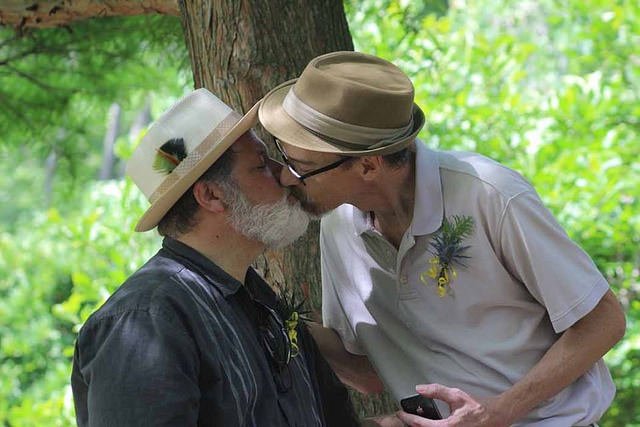
• A kiss is just a kiss

    14574900326_a18671621b_z

    Can it really be that many are happier to see a gay couple marry than give one another a kiss?

    Someone asked me recently whether the time had come to stop campaigning on LGBT issues. After all, he said, the gays have got everything they want now. They can get married and everything.

    Well, leaving aside that the fact that “the gays” can’t get married in Scotland for another month or so and that when they can do so they will not be able to be married according to the same protocols as “the straights”, marriage in church not being an option for most same-sex couples initially, the truth is, the marriage debate is not the end of gay rights but the start of them moving into the mainstream.

    The incredible thing about the campaign to open marriage to same-sex couples is that it wasn’t just same-sex couples who pressed for it to happen. It was a grand coalition of diverse folk – interested people like parents who have gay children, brothers and sisters, workmates and friends as well as gay folk, including gay folk who have no personal interest in marriage for themselves. But it was more than this too – it was a coalition of people who didn’t need to claim a direct interest in the debate. It was a coalition of those who thought that in a modern society the gender of the two people involved is of secondary significance to their love, their hopes for permanence, their promises of fidelity and so on.

    In short, it was a coalition of the decent.

    Now, that kind of statement gets me into trouble. “How can you say that those who were opposed to this are not decent people? Are they not good people, upright people, moral people too? They just didn’t think this was right – how dare you say they are not decent people?”

    Well, the thing is, it isn’t me who is saying that – it represents the huge shift in public opinion that has happened. I’ve helped to shape those changes and am happy to continue to try to do so. Seeing the opinion polls shift so dramatically over the last 10 years is one of the most satisfying things that I’ve ever been involved in.

    What happened is that we changed common perceptions about the kind of values that decent people could be expected to hold.

    That’s why this is so hard for those who have not shifted much themselves. It must feel to them as thought they are on shifting sand. Moral judgements which once were those which good people could be expected to hold, became those which decent people were not expected to hold.

    For some this has been a wonderful seemless recognition that the rights and responsibilities of being human apply to gay and lesbian people just as much as to anyone else. For those outside the big tent it must feel as though something dear has been shattered and broken. I don’t underestimate that, but it isn’t going to get any easier because we’re not done yet.

    I was very struck this week in reading an opinion poll in the USA which indicated that there was strong support for changing the law to allow same-sex couples to get married. However, when the same people were asked what they thought of a gay couple kissing or holding hands in public the support somehow seemed to melt away. And there were different perceptions relating to gender too. It wasn’t so bad seeing women holding hands but gay men kissing in public was something that the decent still were not ready to see.

    Can it really be that it is OK for a couple to get married, with all the support of the expectations of the institution of marriage, but that those who support them still feel squeamish about seeing such a couple display their affection.

    I’ve a feeling this is an issue here.

    When I’m conducting the nuptials of couples here in St Mary’s, I always have a rehearsal and quite often we address the question of whether the couple is going to kiss during the ceremony and at what point. (I think they should do what they feel comfortable with).

    I’m aware that when I ask straight couples that question they can usually answer it easily. When I ask same-sex couples that question there is a big intake of breath as they think about giving their beloved a kiss in public.

    I very occasionally see a same-sex couple coming to church on a Sunday hand in hand. (I see opposite sex couples doing so often enough not to notice). It is worth remembering that there are perhaps only a few hundred yards of the streets of Scotland where they would consider themselves safe to do so and only at particular times. And that’s just holding hands, never mind a wee gay kiss.

    It would appear that we’ve a way to go yet before we get to the point where same-sex couples and opposite sex-couples are treated alike and can expect their affections to be regarded in the same way.

    The campaigning will change in months to come but it is far from over yet.

    I want a world where a kiss is just a kiss. And so much more too.

    [Picture Credit – Ron Frazier Creative Commons attribution license]

5 responses to “The Primus’s Radio Interview about the Columba Declaration”

  1. Benj Avatar
    Benj

    I’m not sure Chillingworth gave a clear answer to Beattie’s question of what is wrong with the declaration beyond its discourtesy and rudeness. What does he mean when he says it is putting at risk the leadership of Christian faith communities at a critical moment in the ‘story of Scotland’?

    1. Kelvin Avatar

      I can’t speak for Bishop David but my view is that this debacle (the discourtesy and rudeness and the rest) has had a serious knock on effect on the ecumenical life of Scotland. To put it bluntly, trusts and friendships that have been built up over years have been very sorely tested. I think that this risks poisoning ecumenical life in Scotland for a generation and I’d say that does seriously compromise the way in which church communities and leaders will be able to speak to Scotland.

  2. Richard Avatar
    Richard

    It also speaks volumes for the contempt with which the Church of Englandshire holds for the Scottish Episcopal Church.

    You struggle to see the shining truth through his words because his words lack honesty and integrity. Not that anyone in Englandshire really cares- most probably haven’t even heard of the Scottish Episcopal Church and if they have, it will be as an unknown backwater entity. To sweep aside the Scottish Episcopal Church must have taken breathtaking arrogance.

  3. Iain McLarty Avatar
    Iain McLarty

    I can totally understand the SEC concern about the CofE barging into territory that isn’t theirs. However, there are perhaps a few things to bear in mind about why a relationship between the CofS and CofE is important where that isn’t really relevant.

    The first is that the CofS has a presence in England. Having spent a few years in a CofE congregation in Denmark I witnessed first hand how important the Porvoo agreement was in that context for enabling local worship and mission and similarly it could be hugely beneficial for the CofS congregations in England to be able to develop more formal relationships with their local Anglican partners.

    Secondly, there are a number of areas where the CofS and CofE are already working together and developing closer relationship such as on training and fresh expressions. These are areas where the relationships have developed naturally due to the two churches dealing with similar areas of concern and where there should again be no encroaching on SEC ground.

    Thirdly, the CofS and CofE work closely together in ecumenical circles through both CTBI and the WCC where both are significant players. It does seem strange that these two churches don’t recognise each other when their place in the wider ecumenical scene is so closely linked. That is not to deny the SEC’s ecumenical importance.

    Obviously no one is denying that the way this became public has been badly handled but I struggle to see what more can be down than the very sincere apologies and frank criticisms of what happened which have been offered. In terms of what real issues there are, I have yet to see anyone pin down specific parts of the Columba agreement which are concerning to the SEC, with all the comments either much more vague or else being fears about issues (such as interchangeability of ministry) which are not actually part of the agreement. In my experience (through ACTS, WCC etc.) the relationship between the CofS and SEC is one of the strongest ecumenical relationships and it would be very sad if this was jeopardised because of miscommunication rather than substance.

  4. Jeremy Bates Avatar
    Jeremy Bates

    It’s not just Scotland. A lot of people are struggling to see truth in the words of the Archbishop of Canterbury these days.

Leave a Reply

Your email address will not be published. Required fields are marked *

Previous Posts

  • What’s the Scottish Episcopal Church is talking about?

    I did a wordle of the most recent issue of inspires, the Scottish Episcopal Church’s magazine to compare what we are talking about in the magazine with what we are talking about in synod. Quite interesting, no?

  • Want to know what General Synod is like?

    Well, here is a wordle made up from last year’s Synod Minutes. (Well, the draft copy, anyway). It is entirely unscientific, but it is interesting to look at how the words relate. Word size implies frequency of use. Now, what does this tell us about our church?

  • Extra, Extra!

    In addition to the extra Lent Devotions tonight (Eucharist at 6.30 pm followed by meditation and then Compline), there is also an extra Choral Evensong tomorrow (Saturday) in St Mary’s. There is a Royal School of Church Music singing day for Scottish Voices, which our own Frikki Walker directs. It will be splendid and as…

  • Ash Wednesday

    Services at St Mary’s at: 0930 – Morning Prayer 1230 – Eucharist with Ashes 1930 – Eucharist with Ashes, Byrd’s Four Part Mass and Allegri’s Miserere Prayers to do at home during the week – here Lentan Devotions, every Friday evening at 6.30 pm