
• The Special Synod on Family Life

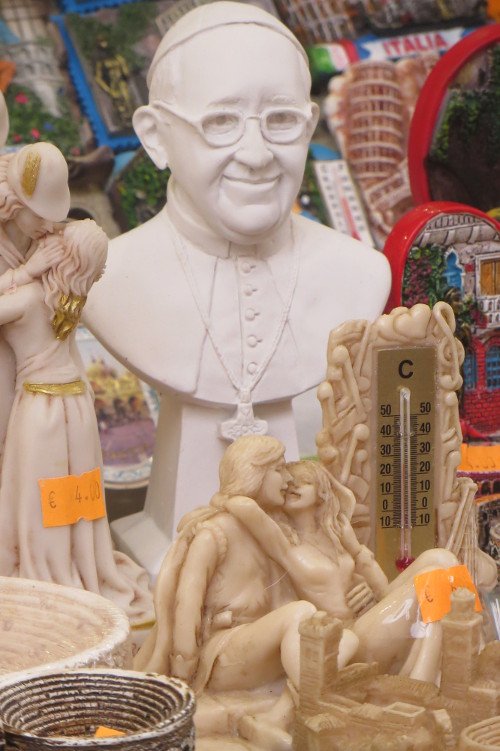
    pope and romeo and juliet

    Something significant is going on in the Vatican this week. A series of conversations has started about how the Roman Catholic Church deals with issues that arise in family life. It is hugely significant because such conversations simply don’t happen very often. Another interesting thing is that it started off with a questionnaire that was sent out to Roman Catholics allowing them the chance to respond to a set of questions with the idea that their responses would inform the bishops who have gone to Rome to have the conversation.

    There will always be people who say, “How can it be that a bunch of supposedly celibate men make decisions about family life?” and there’s no escaping from that question in this day and age. However, the idea of consulting the whole church through a questionnaire was revolutionary.

    The questionnaire itself was something of a mixed bag. It felt as though various tectonic plates within the Roman Catholic church were grinding together throughout its production. On the one hand it was an attempt to allow lay catholics to comment on their own situation but on the other, the dominant theme was that church teaching doesn’t change, so how can we present it in a better way to the world. It has been clear in the last week that there are enormous forces at work within the Roman Catholic church which are not all moving in the same direction. Some very highly placed leaders in the church have been disagreeing publicly about the way forward, particularly over whether divorced people should be able to receive communion in church.

    With these forces at work, what we don’t know is whether there will be an earthquake or not.

    This all has huge significance for non-Roman Catholics too. The reason for this is that the RC Church is such an incredible size in the world and the way it describes personal morality is very often a benchmark and indeed something which people presume all the churches sign up to.

    I see a lot of Roman Catholics in St Mary’s. Sometimes they are simply visiting out of interest, for example during Open Church times or Doors Open Day. This week, we had a large funeral and lots of Roman Catholics were present both when the coffin was brought into church and at the funeral itself. During these kinds of times lots of conversations open up about some of the areas which the synod in Rome may tackle.

    The reason that the Synod on the Family affects all Christians, not merely Roman Catholics is that we are related – marriages, baptisms, deaths all bring me into contact with Roman Catholics on a regular basis. We are in a sense, all family when it comes to the issues under discussion.

    A typical conversation goes like this:

    RC Visitor – “…but this looks just like a chapel.”

    Self – “Yes, and if you came on Sunday you would recognise the service immediately”.

    RC Visitor – “Yes, I know, I went to a requiem recently and it was just the same. It was exactly the same – well apart from the music which was much better. It was the same though and I couldn’t believe it.”

    Self – “Yes, I know.”

    RC Visitor – “So what are the differences then if there’s no difference in the worship?”

    Self – “Well there’s a few differences in how we teach people about social issues”

    RC Visitor – “Well what do you tell people about how they are to behave”.

    Self – “Well, I don’t think we do that. We give people the chance to make their own minds up about things.”

    RC Visitor – “Well do you give communion to people who are divorced?”

    Self – “Yes, of course we do.”

    RC Visitor – “Well that’s what took my sister away from the church, when the priest told her he would like to give her communion but he wasn’t allowed”

    Self – “Yes it is a hard discipline.”

    RC Visitor – “Can divorced people get married here?”

    Self – “Yes, so long as I get the permission of the Bishop. ”

    RC Visitor – “Oh, right. Can I give your number to my sister?

    Self – “Yes, here’s my card”.

    RC Visitor “And do you say abortion is OK too?”

    Self – “No, I don’t say abortion is OK but I do think that sometimes it can be the only option and I think women are best placed to make that decision for themselves”

    RC Visitor – “And I suppose you can have gays as priests too?”

    Self – “I am a gay priest”.

    RC Visitor – “We have gay priests too but they can’t say. It isn’t nice for them”.

    Self – “And we have priests who are women too.”

    RC Visitor “Oh we don’t have them, just nuns. You don’t have nuns.”

    Self – “We have nuns”.

    And so it goes.

    That isn’t particularly an exaggeration – it is common to discuss all those issues within the space of 10 minutes and I know from other clergy that when they get the chance to talk to Roman Catholic folk, these are some of the very first topics that come up in conversation and some of them at least are the topics coming up in Rome this week.

    Our prayers should be with the Roman Catholic bishops in Rome as they attend this special Synod on Family Life. The rules of their church cause some ordinary people great misery and heartache, notwithstanding the very best of intentions.

    The picture, by the way, is one I took the other week in Verona. I rather like the Pope looking down in benediction on Romeo and Juliet. Not a bad picture to prompt our prayers this week.


11 responses to “We should be wary of declaring martyrs”

  1. Eamonn Avatar

    Agree totally. I find myself in a comparable position vis-à-vis the mass canonisations of the ‘martyrs’ of the Spanish Civil War, which assume that all those worthy of commemoration were on the same side.

  2. Michael Russell Avatar

    Anyone killed for professing their faith is a martyr. ISIS is an equal opportunity martyring machine. The various faith communities targeted, including Islamic ones, should build common ground to dismember ISIS. I simply fail to see the point in quibbling about who is a real martyr and who is not.

    1. Kelvin Avatar

      Is it your view that someone is a martyr for Christianity because they cannot recite a verse from the Qur’an?

      It seems to me that whilst some men and women of violence are being claimed to be martyrs if they should be shot by law enforcement agencies whilst pursuing paths of terror that there’s a huge amount to be gained by determining who is a martyr and who isn’t.

      1. Bro David Avatar
        Bro David

        Not being able to explain a quranic verse was merely a way of discerning if someone was not Muslim. However, is it not just as great a presumption to think they weren’t martyrs, as to think that they were.

        The early church seemed to accept that all who were crucified or sent to the lions for their Christianity were martyrs. Perhaps not all did so as a statement of faith, but were nominal Christians caught up with the rest. But the church didn’t seem obliged to footnote who didn’t qualify.

        I’m not sure that I understand why your are hesitant. It seems a quibble. I don’t think anyone is leaning toward canonization here, just speaking of them as a whole.

  3. Jo Avatar
    Jo

    The SEC still keeps the feast of Charles, King and Martyr. I don’t think we get to be too narrow in defining who is or isn’t a martyr.

    1. Kelvin Avatar

      Actually, Jo – that’s not quite right. The SEC keeps the commemoration of “Charles I, King, 1649”

      There’s no mention of him being a martyr in the calendar (and the current calendar superseded and replaced the one in the prayer book). There are plenty of people who are named as martyrs such as Agnes the week before Charles or indeed “Charles Mackenzie of Central Africa, Bishop, Missionary, Martyr, 1862” the very day after Charles.

      It would appear that rather careful thought was given to whether to describe Charles as a martyr and though he is included in the calendar (not least for founding one of our dioceses) any notion of martyrdom is absent.

      1. Jo Avatar
        Jo

        Thanks for the correction, I hadn’t realised there was that detail of difference between the SEC and CofE.

  4. Father David Avatar
    Father David

    Of course, King Charles was a Martyr and is commemorated as such on January 31st each year. The trouble is that Anglicans have no real mechanism for declaring people to be saints or martyrs. Having referred to two recent horrific incidents on the African continent where Christians were slaughtered simply for being Christians, I wonder what the Provost of Glasgow thinks about the Ugandan Martyrs of the 19th century and would you personally regard them to be martyrs? As you know 23 Anglicans and 22 Roman Catholics were killed by the Kabaka for refusing to submit to King Mwanga’s corporal intimacies. The Roman Catholics were beatified in 1920 and canonised in 1964 but what of our Anglican Ugandan brothers – where they equally to be regarded as martyrs, or would you deny them that honorific title?

    1. Kelvin Avatar

      The Scottish Episcopal Calendar is again very clear: “Charles Lwanga and his companions, 1886, Janani Luwum, Bishop, 1977, Martyrs of Uganda”

      I have no idea why anyone would say that the SEC has no means of declaring someone to be a martyr. Not only do we have such a mechanism, we use it.

  5. Father David Avatar
    Father David

    It would be interesting to know how this mechanism works in the SEC in deciding who is eligible to join the noble army of martyrs? Bishop Edward King of Lincoln is widely regarded as a saint South of the Border. I think it was Archbishop Lang who was asked how it was decided that Bishop King had reached sainthood status and the answer was that he was given a Collect, Epistle and Gospel to commemorate his saint’s day – 8th March, the day of his Heavenly Birthday.

  6. Harry Campbell Avatar
    Harry Campbell

    “We strongly condemn such atrocities, whether they are Ethiopians are not,” the Ethiopian communications minister Redwan Hussein told AFP.
    http://www.theguardian.com/world/2015/apr/19/isis-video-purports-to-show-massacre-of-two-groups-of-ethiopian-christians

    What a shame the Archbishop couldn’t have said something similarly inclusive about the victims of the Kenyan massacre, and all such massacres, without caring about what their religion affiliation may or may not have been.

Leave a Reply

Your email address will not be published. Required fields are marked *

Previous Posts

  • NSM History?

    Can anyone point me to a concise summary, preferably online, of how and when and where Anglicans began ordaining people as Non-Stipendiary Ministers? [Note that I’m not interested in polemical publications arguing for one form of ministry or another. Its facts I want to mull over, and I don’t know them].

  • Sermon for 18 October 2009 – The Whirlwind

    Here is what I said in the pulpit this morning. Hearing that Gospel, I always think how real it is. If there are good seats, people always want them. And it seems very real that James and John were trying to secure for themselves the best seats in heaven. People are funny about seats, aren’t…

  • The Liberal Principle

    There is currently a campaign going on against a ghastly article published yesterday in the Daily Mail which was written by a woman called Jan Moir. Complaints have been made about it to the Press Complaints Commission and it seems to have been the fastest and most complained about article of all time. The PCC…

  • All Time Blog Post Popularity

    Here is the list of the most read bits of this website. Note that the 2 pancake articles when added together still beat the Advent Candle. Note also that on this blog, candles and pancakes are still each more than twice as interesting to my readers than the controversy over The Usual Topic. The Advent…