
Members of the Scottish Episcopal Church voted earlier this year to allow the marriage of same-sex couples to be able to be conducted by those clergy who wish to conduct them. We voted on that after years of discussion. It was passed by the 2/3rds majority in the House of Bishops, the House of Clergy (just!) and the House of Laity (over 80% in favour). The bar to getting this vote through was set so high a few years ago that it seemed impossible to achieve to those who were wanting to nudge the church towards change. However, we carried on, because we believed that love means love. We believed, informed by the bible, by our own experience of God and by our contact with ecumenical and other Anglican friends from across the world, that the love that same-sex partners share has as much potential for the sacramental as the love the opposite-sex couples has.
We voted knowing that there might be consequences to this in our relationship with the Anglican Communion, which we once helped to found. Our beloved friends in the US-based Episcopal Church were told in 2016 by the Anglican Primates that the Archbishop of Canterbury would, for three years, bar them from representing the Communion in ecumenical conversations and that they would be excluded from certain discussions about doctrine. It is important to note that the Primates themselves have no power to do anything other than listen to one another. It is the Archbishop who determines whom he will invite to take part in some discussions and the Primates asked the Archbishop to refrain from including American Episcopalians and he has, to some extent at least done so. Remember that these are the Archbishop’s Sanctions that the Primates have suggested not the other way round – that’s important. They are imposed by the Archbishop of Canterbury personally and by his authority. We do not have an international magesterium in Anglicanism. The Primates have no authority to impose anything.
Being sanctioned in this way is a bitter pill to swallow – not because of the sanctions themselves – they probably affected a dozen US Episcopalians out of a church of hundreds of thousands. Bitter because it has the whiff of pettiness about it and of being branded as being slightly naughty by the Anglican Primates – the gathering of senior bishops from across the Communion. The sanctions are more symbolic than real. They have no teeth and everyone involved knows this far better than the media who persist in rather lurid headlines about punishment and even banishment. None of this is real. I’ve struggled to think of even half a dozen people in Scotland who might (and only might) be affected. For these tiny few, there is the frustration of being barred from something for which they have a passion and for which they have worked. We must bear witness that collective punishment is the ugliest form of bullying and that the Primates are wrong, quite wrong, even to impose a symbolic sanction for what we have done. For the rest of the church, the sanctions will have no effect whatsoever other than getting us a bit of welcome profile as an affirming and inclusive church in the media, and life will go on precisely as it did before.
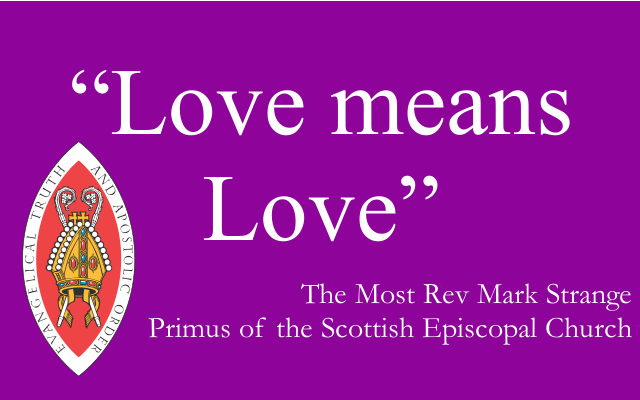
It fell to our new Primus, the Most Rev Mark Strange to articulate where the Scottish Episcopal Church is right now and he did so brilliantly.
In June the General Synod of the Scottish Episcopal Church voted to change its Canon on Marriage. This decision was ours to take as a self-governing province of the Anglican Communion.
However, I recognise that this decision is one that has caused some hurt and anger in parts of the Anglican Communion and that the decision taken at the last Primates’ Meeting, which was to exclude our brothers and sisters in The Episcopal Church from debate on Doctrine and from Chairing Anglican Communion Committees, is a decision that now also pertains to us. We will continue to play our part in the Anglican Communion we helped to establish, and I will do all I can to rebuild relationships, but that will be done from the position our Church has now reached in accordance with its synodical processes and in the belief that Love means Love.
This has clearly gone down very well with very many in Scotland. Remember, there were big majorities for what we decided and Mark is much loved and much prayed for by Scottish Episcopalians at the moment.
It is perhaps worth thinking about what it means though.
When I think of the phrase, “Love means Love” it takes me right back to the time when I started to bless same-sex couples who were entering Civil Partnerships. I remember them trying to devise ceremonies that reflected who they were and what they were saying to one another. They would say, “Of course it isn’t a marriage” and then when I asked them what they wanted they said, “Oh, we want to make vows to one another in front of our family and friends and exchange rings and have a blessing”. And I remember realising, perhaps even before some of the couples whom I was blessing realised, that what was going on was an altogether ancient archetype that I knew only too well. Whatever the law might have said at the time, what was clear to me was that they were married in the eyes of God and married in the eyes of their families and friends. In their ceremonies they were enacting the simple truth – Love means Love. It isn’t partial or biased or owned by anyone. Love is something that we can know by its absence and something that can overwhelm us by its presence. And as I conducted those ceremonies I was often overwhelmed by the love given and received right in front of my eyes. I learned that Love means Love from people who were bravely loving when there seemed to be no route map for their journey. The fact that they have ended up arriving at the same destination as couples who have been marrying for millennia still has an element of surprise about it. It is as though the full expression of Love was hidden for so long – occluded by law, prejudice, convention and expectation. Yet somehow, encouraged by activism, boldness, conviction and wanton cheek, that Love has managed to dawn in a new way upon this particular time in humanity’s story. And the warmth of love’s blessing is holy and powerful and true.
Now, the truth is, no amount of purple prose and joy-filled tears of those of us who worked for this can change the fact that some are upset about this. As I sing the glory of Love meaning Love, I have to remember that some people within the Scottish Episcopal Church are probably having to love me through gritted teeth right now. Their generosity and love is costly and kind and that particular Love means Love too in a very real sense at the moment.
I think that +Mark made it clear to the Anglican Primates that this matter is settled in this part of God’s church. We respect the consciences of all and increasingly I am sure that this will be seen within Anglicanism as the way in which this issue can be managed internationally. We bear witness that we have an answer to the troubles of the communion which we have wrestled fought and prayed for. Don’t be surprised when we seek to bear witness to what God has done for us. It is what Christians do.
I recently presided over one of the first marriages of a same-sex couple in the Scottish Episcopal Church. It suddenly occurred to me during the service that though the rest of the Anglican Communion will believe that we have just started doing gay marriages, in fact, we have just stopped doing them. For Love is Love, and marriage is marriage. We don’t gay marry people, we just opened marriage to all couples. And God is blessing them and God is blessing us as we do so.
Our message to the Communion is a familiar one – “O taste and see that the Lord is good.”
And yes, the Love that we know have known through the ages, just means Love.


Leave a Reply