
• Pilgrimage Days – Who on Earth Are You?

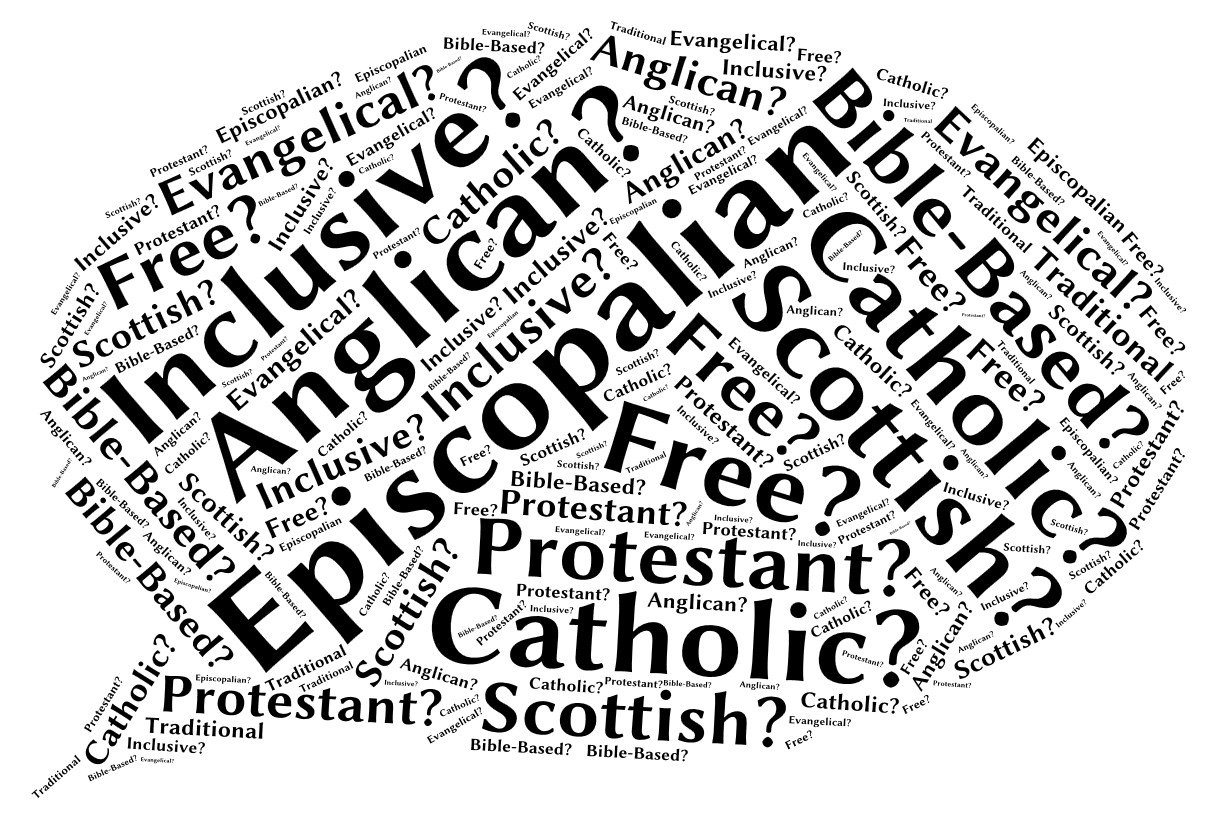
    Wordcloud graphic

    I’m looking forward to hosting two Diocesan Pilgrimage Days at St Mary’s on 20 and 27 February 2016 exploring the theme “Who on earth are you?”

    It is difficult to think of a better week for exploring our identity as Episcopalians but it isn’t going to be all about the Columba Declaration. We’ll be focussing on the things that we enjoy about our faith and the things that make us cherish the Scottish Episcopal Church as our place to live out a Christian identity.

    The day will include conversation amongst the pilgrims about where they have come from and things that inspire them. There will be a forum conversation with me about why I am an Episcopalian and how I came to value belonging to this church. In the afternoon there will be an Any Questions panel. Throughout the day there will be gentle worship and a chance to enjoy being together in the cathedral.

    If anyone wants to join it, all they need to do is bring a packed lunch – tea and coffee will be provided.

    The days begin at 10.00 and will end by 16.00.

    If you are coming, it would be helpful for you to let us know – please fill in the form on the cathedral website – www.thecathedral.org.uk


10 responses to “Sermon for Christ the King 2014”

  1. Julie Mansfield Avatar
    Julie Mansfield

    Kelvin, I follow your blog and I often find your conversations on facebook a lot of fun. But often, too, I don’t really understand what you are saying – such as your last paragraph there; ‘Like love. Like compassion. Like truth. Like hope. Like justice. Like joy. Like peace. Like the Way. Like the very essence of life itself.’ It sounds wonderful but what does it actually mean? Are you saying that the word, ‘God’ is a synonym for other worthwhile words which already have meanings I do understand?

    1. Kelvin Avatar

      What a good question.

      No, I’m not saying that, or at least not quite. I would say that we can’t describe what God is like in language, but one of the closest ways we can come near to talking about God is to talk by analogy – to talk about what God is like.

      The bible is full of times when people use analogy and metaphor to describe the reality of God which we can never completely comprehend.

      In this sermon I’m saying that whilst God may be like a king, God is also like a lot of things that one doesn’t immediately associate with kingship and monarchy. That string of words that you picked out in the sermon are all ways that the bible uses to speak of God. I was using them to do the same.

      Does any metaphor contain or enclose or sum up what we can say or know of God. The answer is always no.

  2. Joy Jones Avatar
    Joy Jones

    I loved your sermon. And have subscribed to your blog.

    No, I have not met the Queen, but I have met the King! And continue to get to know Him more and more every day. His love, peace joy, truth, etc.

    Our priest in North Carolina, said on Sunday, that
    it was hard to tell the difference between sheep and goats.
    Since you live in Scotland, you see a lot of sheep and goats….why did Jesus picked those animals?

    1. Kelvin Avatar

      Thanks for your comments, Joy.

      Actually, I don’t see that many sheep and goats in Great Western Road in the middle of Glasgow. I do see sheep when I drive in the countryside but very rarely goats.

      I think that it is the case that in the Middle East, sheep and goats are pastured together and do sometimes need sorting out. Here in Scotland, sheep and goats (especially wild goats) look very different. However I think in the Middle East, that’s less true.

  3. Julie Mansfield Avatar
    Julie Mansfield

    Kelvin, I’ve only just found your reply! Thanks so much for bothering. I really mean it. I thought you must have just ignored it. Yes, I see what you are saying but… I would say that all those meaningful words in the Bible about what God is like only make sense in the context of understanding who God is. ( i.e. that He came into being as the personification of the worldview of the marginalised Hebrew people, later taken up by Jesus, just as all of the other communities of the ancient Near East had gods representing their worldviews. I study with this bloke here http://www.bibleincartoons.co.uk. ) What I am trying – !! – to say is that God obviously cannot be everyone’s ‘truth’, ‘joy’, ‘justice’ etc because in society there are contradictory ideas about what these things are.

    1. Kelvin Avatar

      Are there contradictory ideas about truth, joy and justice?

      I’m not so sure. Surely we can still speak of these things as though they had some commonly understood meanings.

      1. Julie Mansfield Avatar
        Julie Mansfield

        oh absolutely there are, Kelvin. Just one of many examples: these immigrants in the Mediterranean Sea. Their truth and joy and justice is to be allowed to come and live here. Many folk here get their truth, joy and justice in seeking to put in controls. Whose truth, joy and justice is right? As I see it, the god of the marginalised Hebrews would side with the immigrants but I’m not sure about the Church…

        1. Kelvin Avatar

          I was speaking about God, not ethics. That’s not to say that there isn’t a lot that is interesting to say about the two, but they are quite different I think.

          The fact that people disagree about how to show love. does not, to me at least, negate the assertion that God is love.

      2. Julie Mansfield Avatar
        Julie Mansfield

        Oh absolutely there are contradictory ideas, Kelvin. Just one of many examples; these immigrants in the Mediterranean Sea. Their truth and joy and justice is to be allowed a place to live and thrive. For many folk here, their truth and joy and justice depends on keeping out as many immigrants as possible because they affect housing, medical care, schools etc. As I see it, the Biblical god of the marginalised Hebrews is on the side of the immigrants…

        1. Julie Mansfield Avatar
          Julie Mansfield

          sorry I didn’t see your reply! My difficulty is that you use words as if they have a universal meaning. E.g. love is not a neutral word. there are many different types of love such as conservative paternalistic love or socialist love or non-marginalising love. They are all love. How can God be them all?

Leave a Reply

Your email address will not be published. Required fields are marked *

Previous Posts

  • Newsletter

    I sent out a St Mary’s newsletter yesterday. If you got it, well and good. If you didn’t and want to read it, you’ll find it here. And if you want to make sure that such things are sent out to you in future, you can sign up here.

  • Equal Marriage Parliamentary Reception

    Had a great time at the Equal Marriage reception at the Scottish Parliament last night. A brilliant mixture of lots of good speakers, lots of great people and wedding cake. There was a great opening speech from Rae Cahill of the Scottish Youth Parliament. Then, very much enjoyed hearing Rabbi Mark Solomon of the Edinburgh…

  • Sermon preached on 29 January 2012

    Here’s Sunday’s sermon. Quite a tricky gospel reading all about casting out a demon. I do like being in a congregation where you can speak from the pulpit about exorcising the demons of the Bible and commanding them to be quiet, as Jesus did with demons. In some places, if you preached a sermon like…

  • Cedric’s Sermon – 22 January

    I have to confess to being rather amused by Cedric's sermon on Jesus trying to entice us into fishing for people. You can watch it here: