
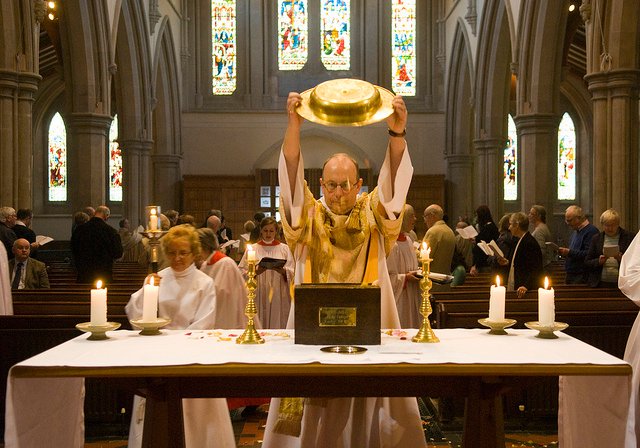
• We’ve a feast on our hands

    Corpus 7

    We’ve a feast on our hands today at St Mary’s. Today is a day set apart in the calendar of our church on which Christians may give especial thanks for the institution of Holy Communion. It is the very last of the festivals whose date changes according to Easter. Because Easter was early this year, so today, Corpus Christi is earlier than it often is too.

    Corpus Christi is related to Holy Week in another way too. The day on which Communion was instituted in the church is Maundy Thursday. That’s when we remember the Last Supper in the Upper Room. The Last Supper is perhaps confusingly the First Communion.  (Or at least it is if you discount the other eucharistic meals in the gospels where Jesus breaks bread and shares it, such as the feeding of the five thousand). Maundy Thursday though is a day when we’ve got so much to think about and so much going on that we tend not to think about the supper itself. We get so quickly caught up in the story of Jesus’s arrest in the garden, trial and crucifixion the next day that we don’t have much time to ponder, or indeed, celebrate, the meal itself.

    Hence, Corpus Christi. We get the chance today to rejoice in the meal.

    I used to go across to celebrate Corpus Christi in Edinburgh with Fr Kevin Pearson. Sometimes we would make it a trip for servers and other hangers on. Indeed, on one ocassion, Fr Kevin invited me to preach. When Fr Kevin became Bishop Kevin a couple of years ago, I decided to have a go a reviving the feast in the west and started to celebrate it in Glasgow. And today, I’ve asked Bishop Kevin to come and preach at it.

    It is a fairly complicated, wizz-bang kind of liturgy with much to think about. However, the essential ideas are easy to grasp. Firstly that God is really present when the Eucharist is celebrated. Secondly that God comes amongst God’s people and walks with them. Thirdly that it is OK to be joyful and happy. Indeed, joy is at the core of what we do.

    So, Corpus Christi.  A sermon from Bishop Kevin. Flower scattered (no, strewn!) before the Lord of Heaven and Earth. The glorious Vierne Messe Solonnelle from the choir. And joy for everyone.

    Kick off 7.30 pm. All welcome.

    [There’s a facebook event here: https://www.facebook.com/events/467625339986048/ if you want to invite facebook friends)

5 responses to “Heresy hunting”

  1. Nick Brindley Avatar

    It is probably helpful to be clear about the distinction between “dogma” (which is best understood as the definition of orthodoxy and of heresy, of the things it is mandatory to affirm and the things it is forbidden to affirm) and “church order” (the rules about how people are to conduct themselves). These are related but by no means the same thing.

    “Doctrine” is a third thing again, to my mind. It is the body of teaching that the church affirms but is much more extensive and changeable than dogma.

    Of particular relevance is who has the authority to pronounce on these things. Denominational authorities quite properly establish church law and discipline (this needs to be done and there’s nobody else to do it) but would go beyond their proper sphere (in my view) if they tried to establish new definitions in the field of dogma.

  2. Andrew Avatar
    Andrew

    I feel the need to separate praxis and doctrine, but I suppose that is probably a minor heresy in itself, in a church that hides its doctrine in its liturgy. Although I suppose the deftness of the ‘McCarthy Liturgy’ has maybe sidestepped that pitfall as deftly as an 18th century non-juring bishop side-stepping western orthodoxy and the rest…

  3. Rosemary Hannah Avatar
    Rosemary Hannah

    To a degree I think it is a matter of tradition. Anglican churches have tended (and it is only a tendency) to insist of orthopraxis. Church of Scotland churches have tended (same health warning) to emphasise orthodoxy of belief, call it doctrine or dogma. St Andrews is not of course a C or S institution, but it used to be, certainly in my day, and to a degree in yours, heavily steeped in C of S ethos. St Mary’s trained C of S ministers and that was ALL the training they got, because then they knew Orthodoxy.

  4. Jimmy Avatar

    The links on this post have led me to think of this –

    The Inner Party – The Outer Party – The Proles.

    The model demands tight control of the middle class, with ambitious Outer Party members neutralised via promotion to the Inner Party or “reintegration” by Miniluv, while proles can be allowed intellectual (and sexual) freedom because they lack intellect. Winston nonetheless believed that “the future belonged to the proles”. Wikipedia.

  5. Allan Ronald Avatar
    Allan Ronald

    There was most definitely a C of S ethos at St Andrews in my day [67-71]. Robin Buchanan-Smith was running a packed college chapel and one president of the SRC and one president of the Union were St Mary’s men who went on to ordination and, in one case, to be Moderator of the Kirk. Perhaps they got their orthodoxy from Matthew Black at St Mary’s and their skill in future clerical politics from their student posts…….

Leave a Reply

Your email address will not be published. Required fields are marked *

Previous Posts

  • What am I reading?

    Oh, thank you for asking once again.I’m about two thirds of the way through Robin Greenwood’s latest version of his book – The Ministry Team Handbook. This is for a clergy study day this week.Earlier this week I had a go at Iona Dawn – a book of spirituality for Holy Week from the Iona…

  • Listen again

    Here are a few listen again links from the BBC – things that were on the radio on Sunday that are worth catching this week before they disappear. (Most listen again links on the BBC disappear after 7 days).Firstly, there was Sunday Worship from St Mary’s Episcopal Cathedral in Glasgow. The words are all from…

  • Personal DNA

    Just tried the Personal DNA personality test.It says I am a Benevolent Creator. 

  • Sermon – 12 March 2006

    Sometimes it can be fun looking at someone else’s favourite books. You tend to be able to see what the most interesting (or juicy) bits are by the way the pages are marked. The gospels though did not have pages. How do you know where in a gospel the most significant (or the most juicy)…