
• Scottish Episcopalians at Pride Glasgow

    There’s going to be a group of Scottish Episcopalians walking (marching? processing?) together at Pride Glasgow on Saturday.

    This is being organised by one or two people from St Mary’s but anyone is welcome to join in. You don’t have to be gay, Scottish or Episcopalian either.

    All you have to do is want to be there.

    Here’s the invitation as it appears on facebook….
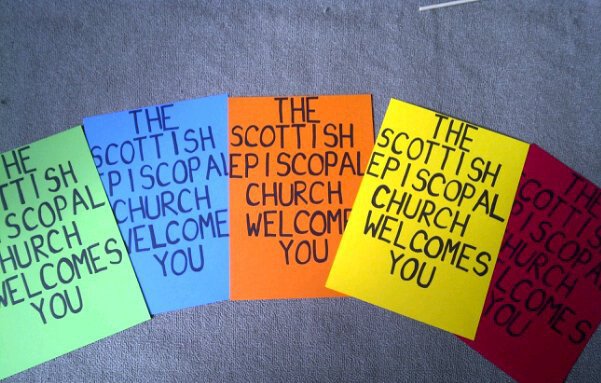
    The parade goes from Kelvin Way and ends up at George Square. We plan to meet on the steps to the Dumbarton Road entrance of the Kelvingrove Museum at 10.45am. All are welcome to come — LGBT folk, friends, family, allies, friends from other denominations, congregation, faith group etc. Anyone who would like to join in the procession in the company of a church group.

    If you want to join in, let either Beth or myself know you are coming and indicate interest via the Facebook Event if you are on FB.

    Dress code – colourful. Clergy – please wear a clerical collar if you can.

    Those who have reached mid…. er, mid-life, may wish to bring ear-plugs. It can get wonderfully noisy.

5 responses to “Heresy hunting”

  1. Nick Brindley Avatar

    It is probably helpful to be clear about the distinction between “dogma” (which is best understood as the definition of orthodoxy and of heresy, of the things it is mandatory to affirm and the things it is forbidden to affirm) and “church order” (the rules about how people are to conduct themselves). These are related but by no means the same thing.

    “Doctrine” is a third thing again, to my mind. It is the body of teaching that the church affirms but is much more extensive and changeable than dogma.

    Of particular relevance is who has the authority to pronounce on these things. Denominational authorities quite properly establish church law and discipline (this needs to be done and there’s nobody else to do it) but would go beyond their proper sphere (in my view) if they tried to establish new definitions in the field of dogma.

  2. Andrew Avatar
    Andrew

    I feel the need to separate praxis and doctrine, but I suppose that is probably a minor heresy in itself, in a church that hides its doctrine in its liturgy. Although I suppose the deftness of the ‘McCarthy Liturgy’ has maybe sidestepped that pitfall as deftly as an 18th century non-juring bishop side-stepping western orthodoxy and the rest…

  3. Rosemary Hannah Avatar
    Rosemary Hannah

    To a degree I think it is a matter of tradition. Anglican churches have tended (and it is only a tendency) to insist of orthopraxis. Church of Scotland churches have tended (same health warning) to emphasise orthodoxy of belief, call it doctrine or dogma. St Andrews is not of course a C or S institution, but it used to be, certainly in my day, and to a degree in yours, heavily steeped in C of S ethos. St Mary’s trained C of S ministers and that was ALL the training they got, because then they knew Orthodoxy.

  4. Jimmy Avatar

    The links on this post have led me to think of this –

    The Inner Party – The Outer Party – The Proles.

    The model demands tight control of the middle class, with ambitious Outer Party members neutralised via promotion to the Inner Party or “reintegration” by Miniluv, while proles can be allowed intellectual (and sexual) freedom because they lack intellect. Winston nonetheless believed that “the future belonged to the proles”. Wikipedia.

  5. Allan Ronald Avatar
    Allan Ronald

    There was most definitely a C of S ethos at St Andrews in my day [67-71]. Robin Buchanan-Smith was running a packed college chapel and one president of the SRC and one president of the Union were St Mary’s men who went on to ordination and, in one case, to be Moderator of the Kirk. Perhaps they got their orthodoxy from Matthew Black at St Mary’s and their skill in future clerical politics from their student posts…….

Leave a Reply

Your email address will not be published. Required fields are marked *

Previous Posts

  • Sermon – Holy Innocents

    The gospel reading this morning is one of those parts of the Christmas story which can take us by surprise. Indeed, it can be very tempting to miss it out. I had planned to use the Gospel readings for the first Sunday after Christmas instead, because I felt not a little squeamish about reading the…

  • Working Time

    I think that I might, just about, have recovered from Christmas. Having three services each 12 hours apart over Christmas Eve and Christmas Day is hard work. The European Working Time Directive would suggest that o­ne should not be encouraged (or allowed) to do this. It is o­nly a matter of time before the churches…

  • Christmas Day – Light that can never be extinguished

    There is one image that comes back over and over again at Christmastime ? the image of Christ as the Light. When Jesus comes at Christmas it is as though a blindfold is being lifted or a light-switch flicked on. Suddenly, things become comprehensible which once made no sense. Suddenly, there is the possibility for…

  • Listen to the Angel

    The angel said to them: ?Do not be afraid; for see, I am bringing you good news of great joy for all the people.: to you is born this day in the city of David a Saviour, who is the Messiah, the Lord.? Let us listen to the angel this night.