
• Willkommen! Bienvenue! Welcome!

    There have been quite a lot of new hits on the blog over the last few days, not least because of the Rudolphus post, which is currently receiving comments about the quality of the Latin. The comments are in Latin too.

    Seeing all these new hits come in, I decided it was time to update the About page on this blog. It now says a little more about what I do than the two line one that was there before which just had my job title and links to twitter and facebook.

    If you are reading this as a new blog subscriber a particular shout out to you. Willkommen! Bienvenue! Welcome! Thank you for signing up to receive updates by email. I hope you enjoy reading all this. Do join in the comments. This is a lively community which I learn from and which often makes me laugh.

    This is what I’ve said on the new About page. (Many thanks, as usual to Gordon Smith who took most of the photographs).



    head and shouldersHi, I’m Kelvin Holdsworth. Welcome to my blog. I’ve been writing here since August 2003. I’m the Provost of St Mary’s Cathedral in Glasgow – a busy church with a progressive ethos in the inner West End of the city. Glasgow is a place that I love and have a strong connections with both through my family and my childhood – I went to school just a few miles outside of the city.
    After school, which I finished back in Yorkshire where I was born, I studied Mathematics and Computing at Manchester Polytechnic before going on to study theology at the University of St Andrews and the University of Edinburgh.
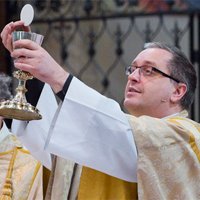
    elevating hostI enjoy my work – celebrating the Eucharist as I’m doing here, preaching and leading a busy, interestsing congregation which is gathered from all over the world. This blog is an extension of my preaching ministry sometimes – I tend to post my sermons here for all to see and I enjoy the debates that sometimes arise in the comments.

    Some of the themes of my ministry have been cathedral ministry (I worked in St Ninian’s Cathedral in Perth for my curacy), working with students (I’ve twice been involved in University Chaplaincy) and finding ways to make the liturgy of the church exciting and fun. I’m unashamed of having learned more about liturgy from the theatre than from the church. Human rights are important to me – I believe that everyone was made in the image and likeness of God and the consequence of that is an imperative to work for justice.
    pink list logoThe Independent of Sunday was kind enough to include me in their Pink List – their annual celebration of movers and shakers in the UK who come from the LGBT communities. I’m one of the more outspoken members of clergy who happen to be gay and I write quite a lot about that on the blog. For me, equality is indivisible – I think that people should be treated alike whether or not they happen to be gay or happen to be straight and that has led me to be one of the campaigners to Equal Marriage in Scotland. I look forward to the day when I’ll be able to marry such couples in church.
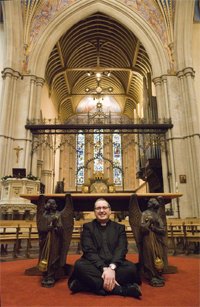
    with angelsAs well as finding me in church, you will find me in other places too. Social media seems to have been invented for me and I’m active on both facebook and twitter.
    When I’m not in church or online, I’m happiest in the theatre. Holidays quite often include a trip to London to catch up with what’s on there. A fascination with opera has led me into opera reviewing and my reviews of what’s happening on the opera stage in Scotland are regularly published by Opera Britannia.
    If you are wondering what a thurible is, well it is the thing that you use to swing incense around with in a church.

    If you want to keep up with the things that I write on this blog, you can subscribe using the box below. If you do, you’ll never miss a post.

    Enter your email address:Delivered by FeedBurner

24 responses to “Good Vicar, Bad Vicar”

  1. Josh Avatar

    Being a good vicar to stony, unreceptive hearts might require a pickaxe to reveal gemstones within. It must be tough to minister to jerks and meanies, no? We lose faith in people easily – I certainly do. But a good vicar – a loving parent – doesn’t give on up one’s children.

    A good vicar might depend on the eye of the beholder. Whether you believe vicars and congregations are intrinsically good or evil might get you called a Pelagian or an Augustinian depending on who you ask. Faith in the work of a vicar or the reception of the congregation depends on good faith and co-operation – what then do we place our faith in? Hardly Protestant thinking, when faith is dependent on work, manifestation, and epiphany. A bad vicar might be sent to good people. A good vicar might be sent to bad people. Whether a vicar or congregation is subjectively or objectively good is a difficult question to answer.

    It is then that I prefer to see both the vicar and congregation not as “good” or “bad” but rather as equally “beloved”. However large the congregation, or even the vicar’s skill shouldn’t matter then. But that raises the question: Who then do we love if we are so beloved by God? Perhaps love might be the answer. A vicar and congregation who sees and knows themselves as equally and lavishly beloved of God will love each other. Love makes congregations meaningful and precious, no matter how small they might be.

  2. Josh Avatar

    And if I might add to my previous comment – And love also makes vicars meaningful and precious, no matter how small the congregation might be.

  3. Rosemary Hannah Avatar
    Rosemary Hannah

    Yes – things which make the practicalities of small congregations include:
    the laity in most senior positions find it hard to see the inclusive love of God and to see the value of prayer and spiritual exercises, a shortage of laity with administrative abilities, a tiny handful of parishioners prepared to insist on unhelpful things all the time (the oldest liturgies every week, the kind of behaviour small children cannot sustain all service long, particular dress in those at church on Sunday to name but a tiny selection). In a larger church these things can be contained (one nasty comment for lady x outweighed by five or six lovely ones or simply finding somebody to be treasurer who can cope with the job). In a small church, however good the vicar, the nasty comment carries more weight, and the sorting out of the finances may take days of clergy effort. It is always hard to get from a tiny congregation to a large one.

    That said, I have sat through sermons so mind-numbingly boring and inappropriate that I have actually moved to another church.

  4. Paul Waddington Avatar
    Paul Waddington

    If one looks at the larger picture, the Archbishop’s optimism seems misplaced.

    According to the 1851 census, about five million people attended a Church of England service on the census day (a Sunday). The population of England and Wales at the time was about 17 million. These are round figures and I know that there were difficulties with the religious census, but they are good enough to demonstrate my point. Roughly speaking, about 30% of the population attended a CofE that Sunday.

    Recently published figures estimate average Sunday attendance at CofE churches at about 900,000. That is about 2% of the population of England. Wales is now excluded.

    So taking the long view, the trend is rather depressing for the CofE. Compared with 1851, fourteen out of fifteen no longer attend church regularly.

    As an aside, the 1851 census indicated a church attendance for Catholics of about 350,000. That is about 2% of the population. I understand that the current figure is very similar for Mass attendance is also around 900,000 or 2% of the population.

    Other recent research has indicated that the age range of CofE congregations is skewed towards the upper end. Certainly in my local parish, it is unusual to see anyone under the age of 60. I do wonder how many there will be in, say, 15 years time.

    1. Kelvin Avatar

      Thanks Paul – I find that bishops generally tend to accentuate the positive when it comes to thinking about numbers in church. Whether that is because they only go to events that are comparatively well attended or whether it is actually because it is their job to be upbeat about possibilities is not clear to me.

  5. Pam Avatar
    Pam

    It is complicated – ‘good’ and ‘bad’ – poor adjectives. The rector is the leader of the congregation and needs support and trust. But, I think, no longer is the vicar held in such esteem as not to have to earn that support and trust. A good thing, mostly. Churches grow for all sorts of reasons – the level of involvement with non-believers, a prominent noticeboard and outstanding bikke and slice-makers all help.

Leave a Reply

Your email address will not be published. Required fields are marked *

Previous Posts

  • Please don't take him just because you can

    Got back in late last night after the first meeting of the St Mary’s LGBT group. Well, it was the first meeting for a while to be truthful. Similar meetings have been going on in St M’s for years. I was learning last night that there used to be a gay clergy group which met…

  • What do clergy do?

    Here are some of the things that I am or have been doing this week: Two weddings Attending the formal opening of the new BBC building Being around St Mary’s for Doors Open Day LGBT Discussion Group (starts tonight at 8 pm in the Synod Hall) Trip to Aberdeen for Bob Gillies’s consecration as new…

  • Doors Open

    Before and after a wedding that I was taking at Glasgow University Chapel, I dropped in to St Mary’s to say hello to some of the people who were there for the Doors Open event. All across the city today and tomorrow lots of buildings are open to visitors and we are one of them.…

  • In a moment …

    How many times does wonder stop you in your tracks? How often do you find yourself stopping speaking in the middle of a sentence and gazing at something? It happened to me today. Someone showed me two pictures on a computer monitor. Perfect circles ablaze with colour and life. It was a pair of photos…