
1 Anti-semitism is a real thing in the life of the church
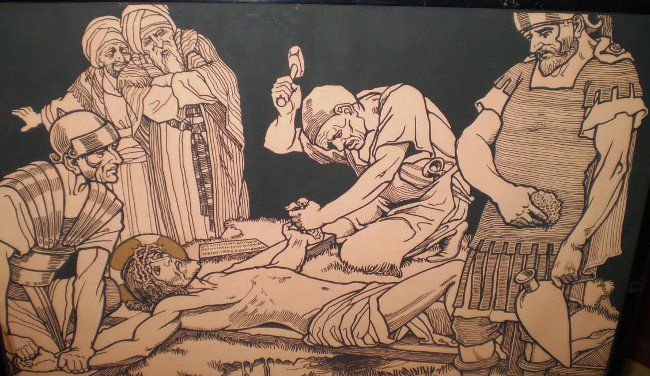
A number of years ago I was visiting a church in the Diocese of St Andrews and happened to look up at a set of Stations of the Cross and remarked to the Rector that they were rather stylish. “Hmm,” she said, “look again – some of those images are not very nice. There’s a narrative of trying to implicate ‘The Jews’ in the way the pictures represent the story of the crucifixion.”
And I looked and indeed saw that it was so. She was right and I hadn’t noticed. The picture that I’ve posted above is one of those stations and is based on stereotype and characterisation which is prejudicial to Jewish people.
The question is, would I have noticed this if it had not been pointed out to me? I had been in that church plenty of times and never noticed. In that there’s something of a parable. Anti-semitism is something that people who think they are good simply don’t notice. How much of our art, our theology, our preaching, our discourse, our storytelling is anti-semitic?
The answer has to be that I don’t know. I/we need to do our best to spot things that might make someone Jewish feel threatened, but the truth is, there may be things that I/we cannot see due to familiarity, uncovered prejudice or simple ignorance.
I enquired about those Stations of the Cross a couple of years ago and was told that they’d been taken down and stored in a glory hole somewhere and there didn’t seem much appetite for putting them back up. I hope that they didn’t ever go back up though I do know that these were only copies and the originals still hang in a Church of England parish in the Diocese of Derby.
2 So called “Christian Seder” meals are offensive and unhelpful
It has become the custom in some parts of the church to celebrate something called a Christian Passover or Christian Seder. The idea seems to be to learn more about “exploring the Jewishness” of Jesus and the “Jewishness” of the Last Supper. NB – Jesus didn’t have a small element of Jewishness within him. Jesus was Jewish.
It should not be a surprise to Christians that holding a parody of a key religious meal that people in another faith celebrate is offensive. However, that often seems to come as a surprise. Again, I will admit that it was only hearing a Jewish theologian talk about how offensive it is that I really thought about it for the first time. However, once I had done, the penny dropped.
There are ample explanations on the internet for why Christians holding a parody of a Jewish Seder meal is offensive. When something is offensive, we shouldn’t do it.
You want to know about the Seder? Then ask someone who is Jewish. They might even invite you to one and note well, you’ll be offered food there. Compare and contrast this to asking people from other faiths to a Christian Eucharist and telling them “no bread, no wine”. Not that anyone should expect someone from another faith to Christianity to take bread and wine in church but there’s something about hospitality that Christians have to learn from other faiths that is missing all too often in our own.
3 Some Christian theological interpretations of texts are anti-semitic
In particular – and this is really important, it is anti-semitic to teach Christian interpretations of the bible solely through the lens that Jesus was the answer to all the Jewish scriptures. Yes, you can find ample biblical evidence to support such a view. But you can find ample biblical evidence for slavery – so go figure.
Look up supersessionist and understand what it means. (Quick version – the idea that the church has replaced the Jewish people as God’s chosen people). Look out for supersessionist interpretations of scripture in church and talk about them when you encounter them. For you will. Look for that kind of theology in hymnody as well as in sermons and readings.
4 I have learned more about anti-semitism from Jewish people than from others
I have learned some things about anti-semitism from people with a Jewish heritage who have subsequently embraced the Christian faith. I have also learned a great deal from people who are practising Jews themselves and this should not be surprising. It should not be surprising that it is Jewish people who know what anti-semitism is and have a more authentic voice in any of these debates than anyone who is not Jewish.
In particular, I learned a lot from participating as a theological reflector at a conference organised by the Council of Christians and Jews. I also learned a lot about Judaism that I didn’t know (and quite a lot about Christianity that I didn’t know) from being invited recently to a synagogue to experience worship there on a Saturday morning. I learned about anti-semitism though the experience of having to take photo-ID with me and the experience of witnessing their having to have a security presence on the door. It is unacceptable to me that a religious group in Glasgow should need this. And I feel helpless in knowing what to do about it.
I have learned about anti-semitism from reading things.
Amongst the things I’ve read, I’ve learned in particular from the novels of Chaim Potok (though I am aware of criticism from within Judaism of his writing), from the theology of Amy-Jill Levine and from the novels of Howard Jacobson. (I read his novel “J” last week whilst on holiday in Milan and it was a fitting backdrop to the obscenity of anti-semitic speech from UK politicians that has recently been evident).
5 Liberals are not exempt from anti-semitism and it is anti-semitic of them to presume that this is a problem for Evangelical Christians
One of the curious prejudices that can be found in the Christian faith is that anti-semitism is something that right-wing evangelicals engage in whilst good liberals are all sufficiently conscious to make sure that they never engage in anything like that at all. The fact is, that just isn’t true.
One thing to look out for in particular is the view that Jesus came to free us from the “tyranny” of the Law. The truth is, Jewish people have lived lives of great fulfilment whilst engaging in lifelong dialogues about what it means to live within God’s law. They have felt free, happy and full of life-giving energy. They have composed, written, prayed and told one another a million jokes about their experience. One is not oppressed by the fact that one is Jewish though one may obviously encounter prejudice and oppression. Jesus did not come to set Jewish people free from being Jewish. That idea is itself problematic as it contains the notion that Jewish people are not themselves free agents able to dialogue with God and possessed of free will.
In particular we need to be aware of the dangers of creeping anti-semitism when reflecting on feminist theology, LGBT theology and other theologies of liberation.
6 There will be more about anti-semitism I have yet to learn
I have to acknowledge openly that I never learned that much about anti-semitism from within the Christian church. That in itself should give us pause for thought. I don’t think I learned anything at all about it in either of my theology degrees nor in my ordination training. I’ve learned what I know almost by happen-chance and meetings with people who have enriched my life but whom I might never have encountered.
The fact that the things that I’ve learned about anti-semitism have surprised me when I have recognised them must mean that there is more to learn and that I will have prejudices that I do not know about deep within me.


Leave a Reply