
• The Special Synod on Family Life

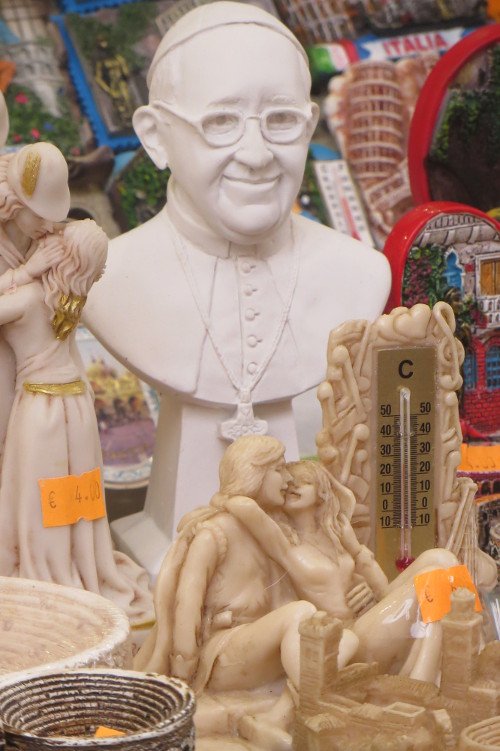
    pope and romeo and juliet

    Something significant is going on in the Vatican this week. A series of conversations has started about how the Roman Catholic Church deals with issues that arise in family life. It is hugely significant because such conversations simply don’t happen very often. Another interesting thing is that it started off with a questionnaire that was sent out to Roman Catholics allowing them the chance to respond to a set of questions with the idea that their responses would inform the bishops who have gone to Rome to have the conversation.

    There will always be people who say, “How can it be that a bunch of supposedly celibate men make decisions about family life?” and there’s no escaping from that question in this day and age. However, the idea of consulting the whole church through a questionnaire was revolutionary.

    The questionnaire itself was something of a mixed bag. It felt as though various tectonic plates within the Roman Catholic church were grinding together throughout its production. On the one hand it was an attempt to allow lay catholics to comment on their own situation but on the other, the dominant theme was that church teaching doesn’t change, so how can we present it in a better way to the world. It has been clear in the last week that there are enormous forces at work within the Roman Catholic church which are not all moving in the same direction. Some very highly placed leaders in the church have been disagreeing publicly about the way forward, particularly over whether divorced people should be able to receive communion in church.

    With these forces at work, what we don’t know is whether there will be an earthquake or not.

    This all has huge significance for non-Roman Catholics too. The reason for this is that the RC Church is such an incredible size in the world and the way it describes personal morality is very often a benchmark and indeed something which people presume all the churches sign up to.

    I see a lot of Roman Catholics in St Mary’s. Sometimes they are simply visiting out of interest, for example during Open Church times or Doors Open Day. This week, we had a large funeral and lots of Roman Catholics were present both when the coffin was brought into church and at the funeral itself. During these kinds of times lots of conversations open up about some of the areas which the synod in Rome may tackle.

    The reason that the Synod on the Family affects all Christians, not merely Roman Catholics is that we are related – marriages, baptisms, deaths all bring me into contact with Roman Catholics on a regular basis. We are in a sense, all family when it comes to the issues under discussion.

    A typical conversation goes like this:

    RC Visitor – “…but this looks just like a chapel.”

    Self – “Yes, and if you came on Sunday you would recognise the service immediately”.

    RC Visitor – “Yes, I know, I went to a requiem recently and it was just the same. It was exactly the same – well apart from the music which was much better. It was the same though and I couldn’t believe it.”

    Self – “Yes, I know.”

    RC Visitor – “So what are the differences then if there’s no difference in the worship?”

    Self – “Well there’s a few differences in how we teach people about social issues”

    RC Visitor – “Well what do you tell people about how they are to behave”.

    Self – “Well, I don’t think we do that. We give people the chance to make their own minds up about things.”

    RC Visitor – “Well do you give communion to people who are divorced?”

    Self – “Yes, of course we do.”

    RC Visitor – “Well that’s what took my sister away from the church, when the priest told her he would like to give her communion but he wasn’t allowed”

    Self – “Yes it is a hard discipline.”

    RC Visitor – “Can divorced people get married here?”

    Self – “Yes, so long as I get the permission of the Bishop. ”

    RC Visitor – “Oh, right. Can I give your number to my sister?

    Self – “Yes, here’s my card”.

    RC Visitor “And do you say abortion is OK too?”

    Self – “No, I don’t say abortion is OK but I do think that sometimes it can be the only option and I think women are best placed to make that decision for themselves”

    RC Visitor – “And I suppose you can have gays as priests too?”

    Self – “I am a gay priest”.

    RC Visitor – “We have gay priests too but they can’t say. It isn’t nice for them”.

    Self – “And we have priests who are women too.”

    RC Visitor “Oh we don’t have them, just nuns. You don’t have nuns.”

    Self – “We have nuns”.

    And so it goes.

    That isn’t particularly an exaggeration – it is common to discuss all those issues within the space of 10 minutes and I know from other clergy that when they get the chance to talk to Roman Catholic folk, these are some of the very first topics that come up in conversation and some of them at least are the topics coming up in Rome this week.

    Our prayers should be with the Roman Catholic bishops in Rome as they attend this special Synod on Family Life. The rules of their church cause some ordinary people great misery and heartache, notwithstanding the very best of intentions.

    The picture, by the way, is one I took the other week in Verona. I rather like the Pope looking down in benediction on Romeo and Juliet. Not a bad picture to prompt our prayers this week.


9 responses to “Turning Up and Being Counted”

  1. Lesley-Ann craddock Avatar
    Lesley-Ann craddock

    Thank you Kelvin
    What a read, I really enjoyed it, all of it. You have touched on the 3 things that I too have been wrestling with.
    Liturgy , turning up to be counted, and being open and real with our peers and counterparts.
    Hmmm I wonder if those aspects of being church in this post pandemic implosion of society will somehow be a catalyst to become braver clergy and have proper discussions about what matters to Gods church in its own context. Can we be diverse and not divided, can we lock into our heritage and yet be able to change too. Can Branson pickle save us. X

  2. Christine McIntosh Avatar
    Christine McIntosh

    Great stuff, Kelvin!

  3. Robert MacDonald Avatar
    Robert MacDonald

    Good points well made. We find some church members, who organise a community lunch on a Wednesday, then regularly say ‘we won’t make it on Sunday’. Seems the wrong way round – attendance on a Sunday should come first.

  4. Peggy Brewer Avatar
    Peggy Brewer

    Reading this made my day and contributes to my celebration of the season! Thank you!

  5. Calum Wyllie Avatar
    Calum Wyllie

    Reading this, I feel like it could have been written about me. I couldn’t have been more deeply involved with my church (felt deeply rooted in the weekly liturgy, sat on the PCC, led on diversity and inclusion, set up online streaming for the first time during lockdown), yet I haven’t been back in two years. There is definitely an element of that link of continuity having been broken, and it’s up to me to make the effort to reforge it again. But the anger is also real, and hard to pin down. When somewhere no longer feels like home, when you feel excluded (even when that person was responsible for leading on inclusion!), how do you find the courage to return? When the link with spirituality feels more present in other places (even when I used to absolutely value liturgy, the Eucharist, the community), how do you find a way forward? Too much thinking, and not enough getting on and doing, perhaps…

  6. Meg Rosenfeld Avatar
    Meg Rosenfeld

    Wow–this article is not only thought-provoking, and, to someone who’s a church-goer, extremely easy to identify with, but also entertaining and therefore all the more memorable. As one whose parish church (in San Francisco’s notorious Haight Ashbury neighborhood) nowadays gets about 15 people in the congregation on a “good” day, I do often wonder whether we’re ever going to bounce back from this expletive-deleted pandemic. Personally, I have no choice: I am, on the aforementioned good day, 50% of the alto section, and on other days, 100% thereof. All you folks out there don’t know what you’re missing–except, of course, those of you who are watching on your home computers.

  7. Father Ron Smith Avatar

    Well said, Kelvin Perhaps we clergy don’t stress enough the fact that the Host at our worship is not the clergy, but the Incarnate Son of God; who empowers us to the extent that we are willing to be empowered for daily life and work. I still think of that lovely phrase “Turn towards HIM and be radiant”. What a thrill!

  8. Kennedy fraser Avatar
    Kennedy fraser

    Yes,I still wonder if we have counted all those spiritual communions

  9. John Davies Avatar
    John Davies

    My church (suburban, evangelical Anglican in Birmingham, UK) took a long time to really recover from the lockdown and subsequent fears, but seems to be close to its pre-shutdown numbers again. What my wife and I noticed was that for quite some time the congregation was largely made up of its elderly members – ie those who are not perhaps so nifty with the electronic gadgetry of our age and, also, those who most wanted company. Younger families took a lot longer to return, but are now coming out of the woodwork again.
    One interesting point is that my old church reported a big increase in deaf people watching their zoom or youtube services, because one of the congregation provided signage at the front. Their new found audience felt greatly enabled to join in when they may otherwise never have done so. Is this something worth thinking more about?

Leave a Reply

Your email address will not be published. Required fields are marked *

Previous Posts

  • NSM History?

    Can anyone point me to a concise summary, preferably online, of how and when and where Anglicans began ordaining people as Non-Stipendiary Ministers? [Note that I’m not interested in polemical publications arguing for one form of ministry or another. Its facts I want to mull over, and I don’t know them].

  • Sermon for 18 October 2009 – The Whirlwind

    Here is what I said in the pulpit this morning. Hearing that Gospel, I always think how real it is. If there are good seats, people always want them. And it seems very real that James and John were trying to secure for themselves the best seats in heaven. People are funny about seats, aren’t…

  • The Liberal Principle

    There is currently a campaign going on against a ghastly article published yesterday in the Daily Mail which was written by a woman called Jan Moir. Complaints have been made about it to the Press Complaints Commission and it seems to have been the fastest and most complained about article of all time. The PCC…

  • All Time Blog Post Popularity

    Here is the list of the most read bits of this website. Note that the 2 pancake articles when added together still beat the Advent Candle. Note also that on this blog, candles and pancakes are still each more than twice as interesting to my readers than the controversy over The Usual Topic. The Advent…