
• Five Years Ago

    anniversary
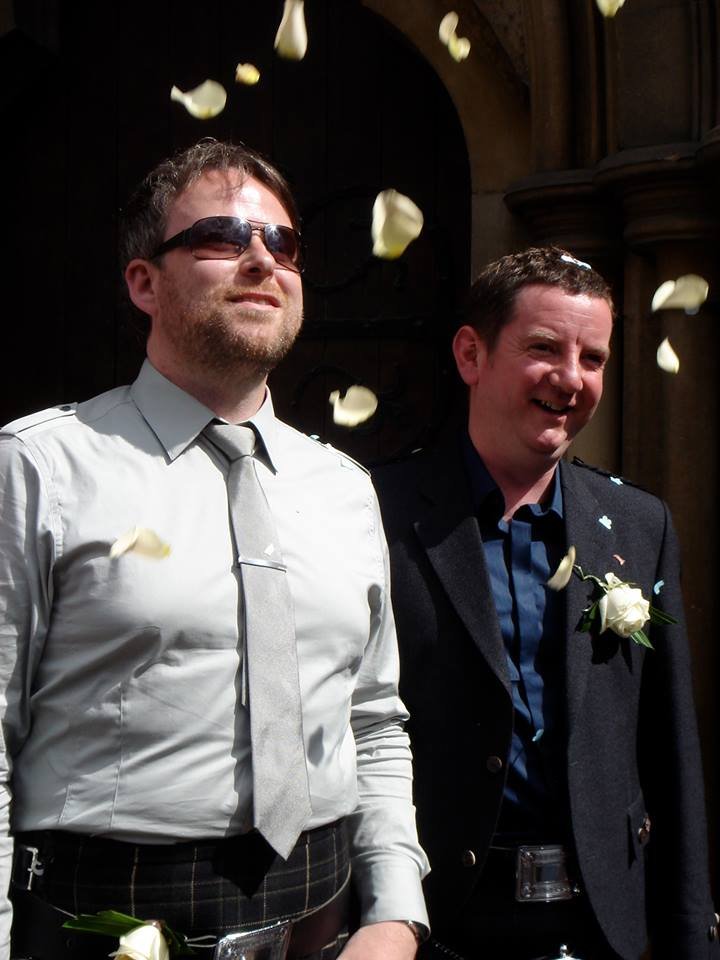
    I was reminded yesterday that it is five years since St Mary’s hosted its first Civil Partnership Blessing. So, congratulations to Colin and Robbie pictured above.

    Theirs was not the first such ceremony that I officiated at but it was the first in the building and the fifth anniversary of that is worth marking with a big alleluia.

    It is perhaps worth recording the process by which we decided to proceed with this ceremony. I had been approached some time before to discuss whether or not I would conduct such a ceremony. As I’d done one already, that was easy to answer – I agreed that I would do it. The question was whether St Mary’s was ready to host such a celebration.

    This is what I remember happening.

    It seemed to me that it was important to work out whether the Vestry were on board with this. It is the Vestry who share the responsibility of what happens in a Scottish Episcopal Church with the Rector. (I’m the Rector as well as being the Provost). Usually, I’ll just ask a Vestry what they think. Often we work towards consensus, sometimes we agree to vote about something if we need to make a decision with which some people disagree. In this case I went a bit further – in this case I outlined the question at a Vestry meeting and then asked them all to write to me to tell me whether they thought we should proceed. This allowed people to take some time and think about it. In the event, the Vestry members all wrote to me saying that they believed that St Mary’s should go ahead. I was thus able to say to Robbie and Colin that we would be delighted to welcome them and their families and friends to celebrate their special day.

    “Ah, but what about the bishop?!!!” I hear you splutter.

    Well, I told the bishop at the time telling him what I had been asked to do. He asked me what the Vestry thought and I produced the sheaf of letters from the Vestry spelling out what they thought and I told him that I was going to take the service. His response was “Very well then. I think you should do it.”

    It is worth also saying that when I reported to him that I was first going to take such a ceremony, his response was, “Well then, I’ll give you my permission to do it then.”

    “But Father, I didn’t ask your permission, I’m going to do it anyway” I said, to which his response was, “Well, you are getting my permission and you are getting it in writing – it is important that you have it”. (I still have the email).

    And thus, these things began and I’ve been happy to advertise that we do them since. Then it seemed remarkable. Now it seems special but in the same was that every wedding day is special. In the last five years there has been maybe one ceremony a year either in St Mary’s or elsewhere. (The first one I conducted was at the chapel of the University of Glasgow).

    In a few week’s time, I’ll be doing another one and this time there is something different. The innovation this time is that the couple can be pretty sure that by registering their civil partnership (which I’ll be blessing) they will end up being actually married as the new laws coming to Scotland should mean that they can convert their relationship to the status of a marriage by simply filling in a form in due course.

    The move towards marriage equality is a long drawn out journey of little steps. I’m proud to have shared that journey with those brave enoug to pledge their love to one another in public.

    Alleluia!

9 responses to “The Lament Question”

  1. kimberly Avatar

    ask it in the singular, and the answer is: because you’re a four.

    you’ll have me playing the funeral ikos next.

  2. kimberly Avatar

    the other answer is about possibility being revealed in limits.

  3. kelvin Avatar

    Its not just me though, and not just fours.

  4. Aaron Orear Avatar

    I think because sorrow touches the core of the human condition – we are mortal but can perceive immortality. “He has made everything suitable for its time; moreover he has put a sense of past and future into their minds, yet they cannot find out what God has done from the beginning to the end.” (Eccl. 3:11)

  5. Erp Avatar
    Erp

    I understand Aristotle talks about catharsis and various philosophers have followed up on that idea.

    Perhaps it arouses sadness both from the art itself but also from our own sources festering within and allows us to let go. We feel better for the letting go, the lessening of our own internal sadness, and so perceive the art as beautiful.

  6. RosemaryHannah Avatar
    RosemaryHannah

    Kimberly was there before me. However, even I, a nine, can sometimes see the beauty in sad things. For me they do two things (may be more but two are most obvious). The first is the catharsis thing. The second is to make me less lonely. Look, here am I weeping, but all around me people sit in the same sorrow. It is not just my sorrow – I am not alone.

    I have long thought there is another answer, one I do not properly understand but I have (I think – and who am I to think it). Deep in God there is a huge well of sorrow. Unless we experience sorrow we cannot understand God. When we sorrow we tap into that well, and become closer to him.

    And being a nice cheerful nine, I will now add that I live in hope that having sorrowed with him, we will share also and even more fully in the joy which swallows the sorrow. Delete this last paragraph from your mind on reading, it will only spoil the joy of the sorrow.

  7. Elizabeth Avatar
    Elizabeth

    Edgar Allan Poe said the most beautiful thing in the world is a beautiful, dead woman. Nice, eh?

  8. Ritualist Robert Avatar
    Ritualist Robert

    Surely it’s because the concept of beauty is independent from concepts such as ‘sadness’ and ‘happiness’ – just as a G major chord might be loud or soft, but that volume has no effect on its G major-ness.

  9. Steve Avatar
    Steve

    I remember Augustine saying (don’t ask me where) that for a picture to be beautiful it requires dark colours as well as bright.

    There is also a hint of an answer in this poem by Edwin Muir:

    Yet still from Eden springs the root
    As clean as on the starting day.
    Time takes the foliage and the fruit
    And burns the archetypal leaf
    To shapes of terror and of grief
    Scattered along the winter way.
    But famished field and blackened tree
    Bear flowers in Eden never known.

    Blossoms of grief and charity
    Bloom in these darkened fields alone.
    What had Eden ever to say
    Of hope and faith and pity and love
    Until was buried all its day
    And memory found its treasure trove?
    Strange blessings never in Paradise
    Fall from these beclouded skies.

Leave a Reply

Your email address will not be published. Required fields are marked *

Previous Posts

  • To Synod

    Just back from synod. Synod fatigue is like no other.I like the biz and the buzz, but come come feeling exhausted every time I go. This year I was there to watch what was going on as a member of the Scottish Episcopal Church’s Organizational Review Committee. (ie ORC – there will be a quiz…

  • To Seville

    To Seville last night – a performance of Carmen by Scottish Opera.It was hot – both in the theatre and on the stage. The production sizzled from beginning to end. The women on stage seemed to me to outclass the men. Carmen herself was fabulous and her two bar-room pals had a real edge to…

  • Liturgical moments

    Best liturgical moment yesterday was undoubtedly the singing of the word dragons in the linePraise the LORD from the earth, ye dragons, and all deepsat Evensong. Inspired.