
• Five Years Ago

    anniversary
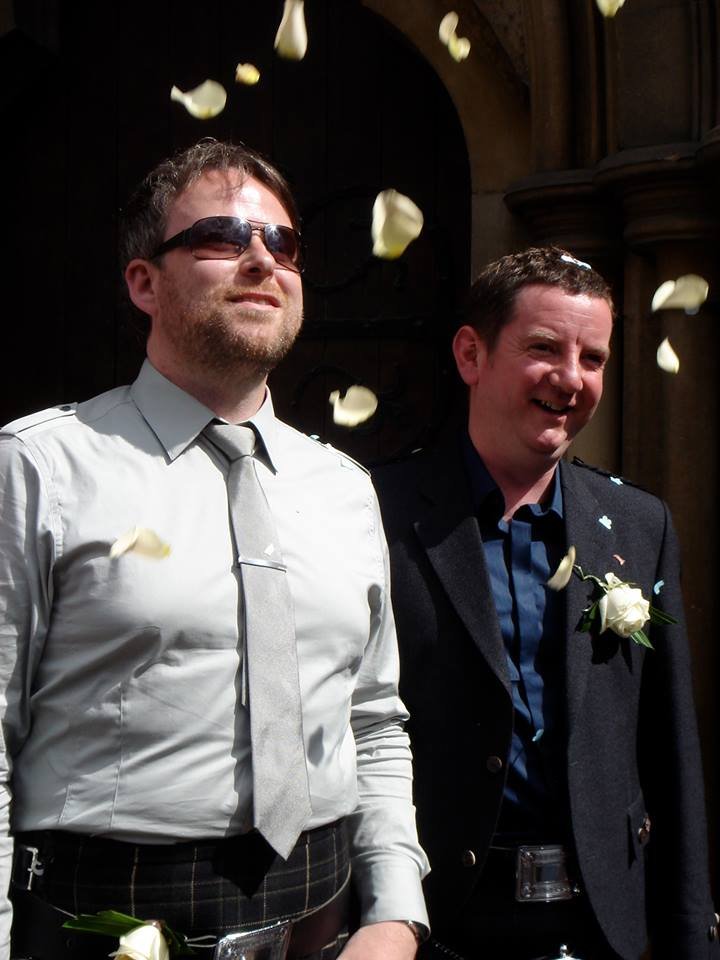
    I was reminded yesterday that it is five years since St Mary’s hosted its first Civil Partnership Blessing. So, congratulations to Colin and Robbie pictured above.

    Theirs was not the first such ceremony that I officiated at but it was the first in the building and the fifth anniversary of that is worth marking with a big alleluia.

    It is perhaps worth recording the process by which we decided to proceed with this ceremony. I had been approached some time before to discuss whether or not I would conduct such a ceremony. As I’d done one already, that was easy to answer – I agreed that I would do it. The question was whether St Mary’s was ready to host such a celebration.

    This is what I remember happening.

    It seemed to me that it was important to work out whether the Vestry were on board with this. It is the Vestry who share the responsibility of what happens in a Scottish Episcopal Church with the Rector. (I’m the Rector as well as being the Provost). Usually, I’ll just ask a Vestry what they think. Often we work towards consensus, sometimes we agree to vote about something if we need to make a decision with which some people disagree. In this case I went a bit further – in this case I outlined the question at a Vestry meeting and then asked them all to write to me to tell me whether they thought we should proceed. This allowed people to take some time and think about it. In the event, the Vestry members all wrote to me saying that they believed that St Mary’s should go ahead. I was thus able to say to Robbie and Colin that we would be delighted to welcome them and their families and friends to celebrate their special day.

    “Ah, but what about the bishop?!!!” I hear you splutter.

    Well, I told the bishop at the time telling him what I had been asked to do. He asked me what the Vestry thought and I produced the sheaf of letters from the Vestry spelling out what they thought and I told him that I was going to take the service. His response was “Very well then. I think you should do it.”

    It is worth also saying that when I reported to him that I was first going to take such a ceremony, his response was, “Well then, I’ll give you my permission to do it then.”

    “But Father, I didn’t ask your permission, I’m going to do it anyway” I said, to which his response was, “Well, you are getting my permission and you are getting it in writing – it is important that you have it”. (I still have the email).

    And thus, these things began and I’ve been happy to advertise that we do them since. Then it seemed remarkable. Now it seems special but in the same was that every wedding day is special. In the last five years there has been maybe one ceremony a year either in St Mary’s or elsewhere. (The first one I conducted was at the chapel of the University of Glasgow).

    In a few week’s time, I’ll be doing another one and this time there is something different. The innovation this time is that the couple can be pretty sure that by registering their civil partnership (which I’ll be blessing) they will end up being actually married as the new laws coming to Scotland should mean that they can convert their relationship to the status of a marriage by simply filling in a form in due course.

    The move towards marriage equality is a long drawn out journey of little steps. I’m proud to have shared that journey with those brave enoug to pledge their love to one another in public.

    Alleluia!

6 responses to “Here or there?”

  1. Gary Avatar

    Up there. High altar. No doubt.

  2. Tom Allen Avatar

    I am very much with Richard Giles on this one – there should liturgically only be one main altar – ideally this is achieved by romoving the former High altar and dedicating that space to some other purpose – where that is not possible as in historic cathedrals then it should be left dormant (covered in a simple cloth perhaps) and only the altar which is being used for worship should be dressed since this is in fact THE altar.

    Despite all the reservations about removing former altars in the end it solves long-term problems, and provides a single visual focus for Eucharistic worship. At times when a high altar is needed then the new altar can moved there.

    This kind of fuzziness illustrates that our liturgical practice has become dominated by hertiage criteria.

    I am about to replace our main altar with something moveable and aesthetically more appropriate, but am facing a Registrars ruling that the current altar (and former eastward facing number more recently provided with wheels and moved to the chancel!) must be burnt, and that the wood frontal cannot be used for a screen.

    Dont’ we get ourselves tied up in knots!
    Tom

  3. Stewart Avatar

    A thought came to my mind this afternoon. At the Creed we all face east. This results in the choir turning their back on the Nave Altar and in most cases put the High Altar in their sight.

    Considering Tom’s comments, another thought thinking about some English Cathedrals which have multiple altars around the building, it is not usually possible to see more than one at a time. Some have a chapel behind the High Altar – behind a screen.

    Turning back to St Mary’s – all the action at the 10:30 service is centred and focused around the Nave Altar. However there is still the High Altar, the Pheobe Traquair Reredos and Gwyneth Leach mural of Our Lady at the East End. To my mind their presence enhances the worship around the Nave Altar and does not detract from it.

  4. Andrew Avatar
    Andrew

    The Altar is a table, where we commemorate a meal together. Clearly (to my mind) we should all be sitting round it, as we do (more or less) at present. The table reminds me that Jesus instituted the Last Supper when he was among us (HERE), not somewhere else (THERE).

    I very much hope that the Altar in St. Mary’s can be left where it is.

  5. kelvin Avatar
    kelvin

    It seems to me curious that the practice that I inherited was to light and dress the high altar whilst using the nave altar. It makes no sense, except perhaps to highlight St Mary’s puzzling parallel worlds of deep conservatism mingled with radical liberalism.

    Whist tending to agree with Andrew’s sentiments, it is worth remembering that the nave altar could hardly be said to have stayed in one place these last 20 years.

  6. Elizabeth Avatar
    Elizabeth

    Here. Both. Loving the paradox.

    But maybe I only say that beccause the only church I’ve regularly worshiped in where there are clearly two visible altars is St Mary’s and that’s what I’m used to. I’ve never found it distracting that the high altar is dressed and lit, even though the nave altar is where the action is, so to speak. But then, would I notice if the high altar wasn’t dressed and lit? Probably not.

    I do love the nave altar, peripatetic as it is!

Leave a Reply

Your email address will not be published. Required fields are marked *

Previous Posts

  • To Synod

    Just back from synod. Synod fatigue is like no other.I like the biz and the buzz, but come come feeling exhausted every time I go. This year I was there to watch what was going on as a member of the Scottish Episcopal Church’s Organizational Review Committee. (ie ORC – there will be a quiz…

  • To Seville

    To Seville last night – a performance of Carmen by Scottish Opera.It was hot – both in the theatre and on the stage. The production sizzled from beginning to end. The women on stage seemed to me to outclass the men. Carmen herself was fabulous and her two bar-room pals had a real edge to…

  • Liturgical moments

    Best liturgical moment yesterday was undoubtedly the singing of the word dragons in the linePraise the LORD from the earth, ye dragons, and all deepsat Evensong. Inspired.