
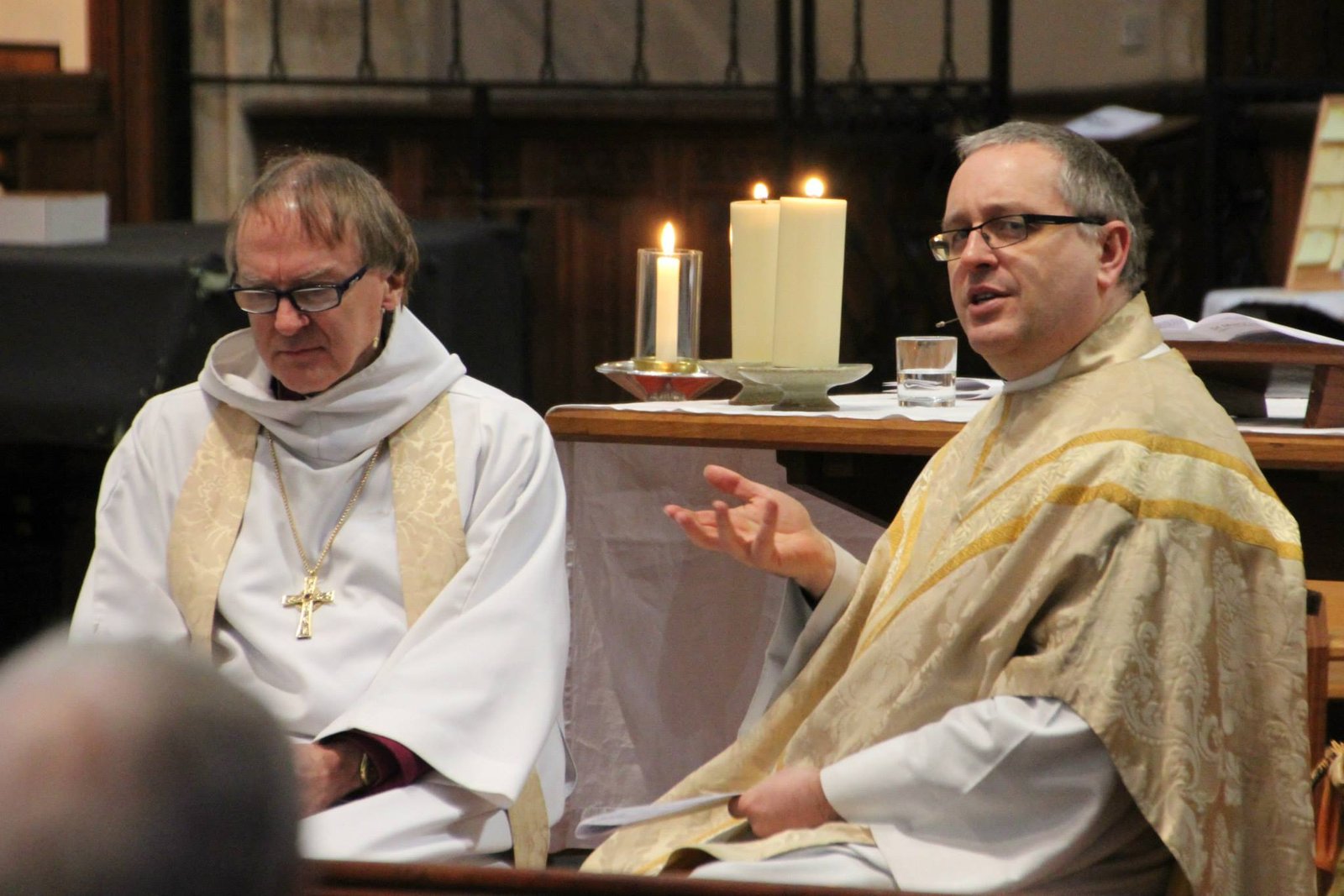
• Sermon for Epiphany 4

    If you look carefully at the video, you might spot the moment when I realised that I didn’t have all the pages of this sermon with me in the pulpit.

    Sermon preached on 1 February 2015 from Kelvin Holdsworth on Vimeo.

    Come out and shut up

    On Friday, we celebrated a commemoration in the Scottish Episcopal Church. Not one that matters to most people. Not one that is graded high enough to automatically merit a mass. Not indeed, one that most people will have thought much about at all.

    However, last Friday was the commemoration of Charles I – King and Martyr as some liturgical books in our tradition describe him.

    I don’t want particularly to preach a defence of Charles I here today. However, I do want to call him to mind as a jumping off point before we get into looking at the bible passages in the light of our own times. For those of you who don’t know the history of this country, Charles I was a King who ended up being beheaded. And all manner of trouble came to the Scottish Episcopal Church because it maintained its allegiance to the Stuart cause afterwards. Within 50 years various penal laws had been passed restricting the ability of Episcopalians in Scotland to worship freely. For a time, it was a crime for Episcopalians to baptise people or marry them. And for a time, it was illegal for a cleric to minister to more than 5 people at a time and the punishment, if you were caught doing so a couple of times, was transportation for life.

    We had a way round it in Glasgow – Episcopalians would gather in old rooming houses – primitive tenements if you like and groups of five would meet in each room and all leave the door open onto the stair. And the priest would stand on the landing and shout (or maybe yell) the service so that everyone in each of the rooms could hear it but he couldn’t be accused of speaking to anything more than 5 people.

    Occasionally I’ve thought of trying to recreate this scene in the tenement I now live in, particularly when I had downstairs neighbours who were fond of Saturday evening parties.

    There’s a certain romance about thinking about the people of the past getting around the penal laws in that way.

    However, the danger with looking back is that we see the past through rosy spectacles and forget reality. Episcopalians need to remember that we were capable of doling out persecution to others when we managed to get hold of the levers of power.

    In particular this year, we will be reminded of this as the Roman Catholic Church remembers the 400th anniversary of the martyrdom of St John Ogilvie. It is the case that the Episcopalian bishop of the time – one of Bishop Gregor’s predecessors in effect, had a direct part in Ogilvie’s capture, trial and death. Indeed John Ogilvie was keep imprisoned in the Bishop’s palace.

    Now, I’m remembering some of the religious conflicts of the past this morning not just because there’s an Old Firm game this afternoon but rather because I want to think about one of the big questions of the day in the light of our scripture readings. And in the light of the fact that our scripture readings this morning are not really much help.

    Over the last few weeks we’ve been forced into thinking about free speech. None of us saw it coming, but the murders of the cartoonists in Paris suddenly uncovered huge questions which I think we probably still have some way to go in trying to answer.

    Is free speech a right? Is it absolute? Are there limits?

    Cast your mind back to the first reading that we had this morning.

    Did it give you a sense of outrage to hear it read in church? Maybe it should do. Maybe that’s the point of reading it.

    The Lord your God will raise up for you a prophet – But any prophet who speaks in the name of other gods, or who presumes to speak in my name a word that I have not commanded the prophet to speak—that prophet shall die.

    Free speech does not come naturally to us.

    And that should give us pause for thought.

    I was also struck by the gospel reading this morning. It comes at the start of the Gospel of Mark that we are reading this year. Presumably that story comes in the first chapter because it was thought to be important. It comes right after the call of the disciples.

    And the first thing that Jesus is presented as doing after gathering the disciples is telling someone in the synagogue very firmly to shut up.

    It is one of those times where Jesus doesn’t seem to be terribly nice. Not terribly Christian, in the way that people often presume Christian to mean.

    God wants to kill dissenting prophets. Jesus tells the first person he encounters outside his close group to shut up.

    There’s no free speech there.

    I wanted to highlight this because I think it is important sometimes to remember that Scripture isn’t helpful to us and we need to know where to turn when that is the case.

    In particular I think we need to remember that the Anglican tradition, which we belong to here, looks to other sources of authority as well as scripture – in particular, tradition and reason.

    And perhaps they are more help when we are trying to think about the free speech controversies of our day.

    The conflicts of the past that I’ve spoken of this morning remind us that we’ve been on both ends of religious persecution and attempts to silence people because of their faith. And maybe that gives us permission to try to work out what appropriate ethics of freedom of expression for our own times. Our own tradition here has been silenced. And our own tradition has done some of the silencing.

    Our own tradition has been persecuted. Our own tradition has done the persecuting.

    People of our own traditions died. People of our own tradition caused others to die.

    And that experience should help us see modern controversies from both sides.

    And maybe that experience from our history can inform us in using reason as we try to work out what to say about free speech today.

    So I’ll tell you where I think the limits lie and you can tell me later or discuss online whether you think I’m anywhere near what’s reasonable. Because everything is a conversation these days. Or at least, everything should be.

    I think that freedom of speech is something that allows us to worship in this city, in this building, in this way, at this time.

    That experience makes me think that we’re onto something important in modern society in believing that free speech matters. And that should make us want to defend it strongly from our religious experience, if not from our scriptures and our history.

    However, as victims of hatred that led to persecution, we’ve also got something to say to those who would see themselves today as being victims of hate-speech.

    I think that freedom of speech is vital but has to be limited. And the line I would draw, and the line that I think the law tries to draw is, where speech becomes a weapon and is used to threaten others with harm.

    And because I’ve said that everything is a conversation these days, here are some questions that are worth thinking about this week.

    • Having heard today an argument from scripture against freedom of speech – can we think of things which would support it?
    • Having been both the persecuted and the persecutors in our own history, can we see things both from the point of view of those holding up their pencils and demanding a right to say anything and also from the point of view of those on the receiving end of a freedom being used to abuse and mock things others hold dear?
    • Lastly, as people who believe God to be good and loving, how can we convey that love to those whom we meet this week?

    For I think that the world needs that love right now.

    Can we commit ourselves in our minds this day to show forth God’s love wherever we go.

    Can you do that this week?

    I think that might be the gospel we are called to share this week.

    It might be worth remembering the saying purported to St Francis of Assisi. – “Preach the gospel. Use words… if you have to.”

25 responses to “New Statement from College of Bishops”

  1. Dennis Avatar
    Dennis

    If you want a good resource for changing things start with Moyer’s Movement Action Plan. It was the bible for social change training movements for twenty years in the US for local and organizational politics and informed some of the organizing.
    https://www.indybay.org/olduploads/movement_action_plan.pdf

    You might also look at the Midwest Academy’s Manual for Social Change
    http://www.midwestacademy.com/manual/

    And the granddaddy of them all: Saul Alinksy’s Rules for Radicals (1971) http://www.amazon.co.uk/dp/0679721134

    and while you are waiting for it to arrive, start an invitation only discussion list going for those in your church who support change and organize those training sessions in more than one diocese.

  2. Daniel Lamont Avatar
    Daniel Lamont

    Dennis makes helpful and pertinent suggestions. It may be inappropriate as an Anglican living in England (albeit hoping to move to Edinburgh when he sells his house) to ask if there is anything we can do anything now such as writing to bishops.

    1. Kelvin Avatar

      Writing letters can do much good.

  3. Steven Avatar
    Steven

    I am an outsider in two senses on this. Firstly, I don’t live in Scotland and am not Scottish. I am not a member of the SEC. Secondly, my faith (such as it is) varies between committed humanism to Quakerism (via Zen) to liberal Christian (all of which represent positions that I deeply admire). I am an honest doubter on the edges of Christianity (a noble calling I share with your own former Primus, Richard Holloway). However, I do love Scotland and visit Edinburgh and the Islands on a regular basis. When I visit I always try and go to church. I usually go to Old Saint Paul’s or St John’s in Edinburgh. I consider myself an Anglican in Scotland (much like the Queen becomes Presbyterian…). I do so because the Scottish Episcopal Church has always represented – to me at least – the most progressive, open minded Christian community on these islands and which retains, at the same time, the beauty and ritual of the Catholic tradition. I must have been mistaken. I would never have thought the Scottish Bishops (all intelligent and sensitive individuals as far as I can tell) could produce such a document – which completely misses the point. I know Bishop David a little bit because he used to be rector of Seagoe Parish in Northern Ireland and I went to school with his children. I served on the vestry in that Parish after his departure to Scotland. I have followed his blog since. While I have a huge amount of respect and admiration for Bishop David, I can’t help but wonder why he remains silent on this issue. Do Bishops ever reveal where they stand on any issue of controversy? The Bishops need to know that real people want change and that documents like the one released simply confound and mystify those of us who see that a prophetic church would be leading the way on inclusion rather than entrenching the old prejudices. Bishop David and all the Scottish Bishops, for the love of God, say what you mean and mean what you say! Do not be afraid.

    1. Fr John E Harris-White Avatar
      Fr John E Harris-White

      Steven,thank you for your comment. Exactly my thoughts. Together with sadness, and hurt.

  4. Craig Nelson Avatar
    Craig Nelson

    I wonder if the College of Bishops feel the need of a holding operation. In any case I hope change comes. It may come from the people rather than the Bishops. Still very disappointing.

  5. Ritualist Robert Avatar
    Ritualist Robert

    Though I agree that the tone of this isn’t particularly helpful (but then, has a communique from a group of bishops ever been particularly helpful?) I read it more as guidance on how clergy can (indeed must) avoid breaking the law.

    I don’t think it would do anybody a favour if a same-sex couple came an SEC priest, were purportedly ‘married’ by him/her when, in fact, that priest was unable to do so under the law.

    I think the bishops’ letter was in large part an attempt to protect both clergy and same-sex couples. But, as I say, I agree that the tone of the communique isn’t particularly helpful, especially when it comes to ordinands, for example.

    1. Kelvin Avatar

      I don’t think anyone at all has a problem with the bishops giving guidance on bit breaking the law. That really isn’t the issue at all. It is about the tone and the other aspects of the guidance and the fact that this was withheld until a week before the law changed. Oh, and making pronouncements about people without consultung them.

Leave a Reply

Your email address will not be published. Required fields are marked *

Previous Posts

  • To Moffat

    To Moffat today for the Diocesan Council. “What is the Diocesan Council?”, I hear you ask, your interest piqued and your excitement rising. Well, the Diocesan Council consists of elected people from the different Regions of the Diocese of Glasgow and Galloway who meet together several times a year to do the business that needs…

  • Whither the Kirk?

    I watched with interest the BBC documentary last night about the Church of Scotland. (A Church in Crisis on BBC 1 Scotland) I guess that those who were hoping for a celebration of 450 years since the Scottish Reformation were a little disappointed. The programme was something of a lament and really rather sad. They…

  • What’s in Kelvin’s Tooth

    If its Tuesday, it must be root canal treatment and another session of gazing into the eyes of Stylianos whilst he does things inside my mouth which feel like someone is twanging a rubber band behind my nose. Again. After some time poking and twanging, Stylianos shakes his head sadly and says, “No, the infection…

  • Glasgow Landmarks

    Oh, here’s something to do! If you like St Mary’s Cathedral, why not nominate it as one of Glasgow’s Landmarks on this page: http://www.glasgowlandmarks.org.uk/ Closing date for nominations is Wednesday at 5 pm.