
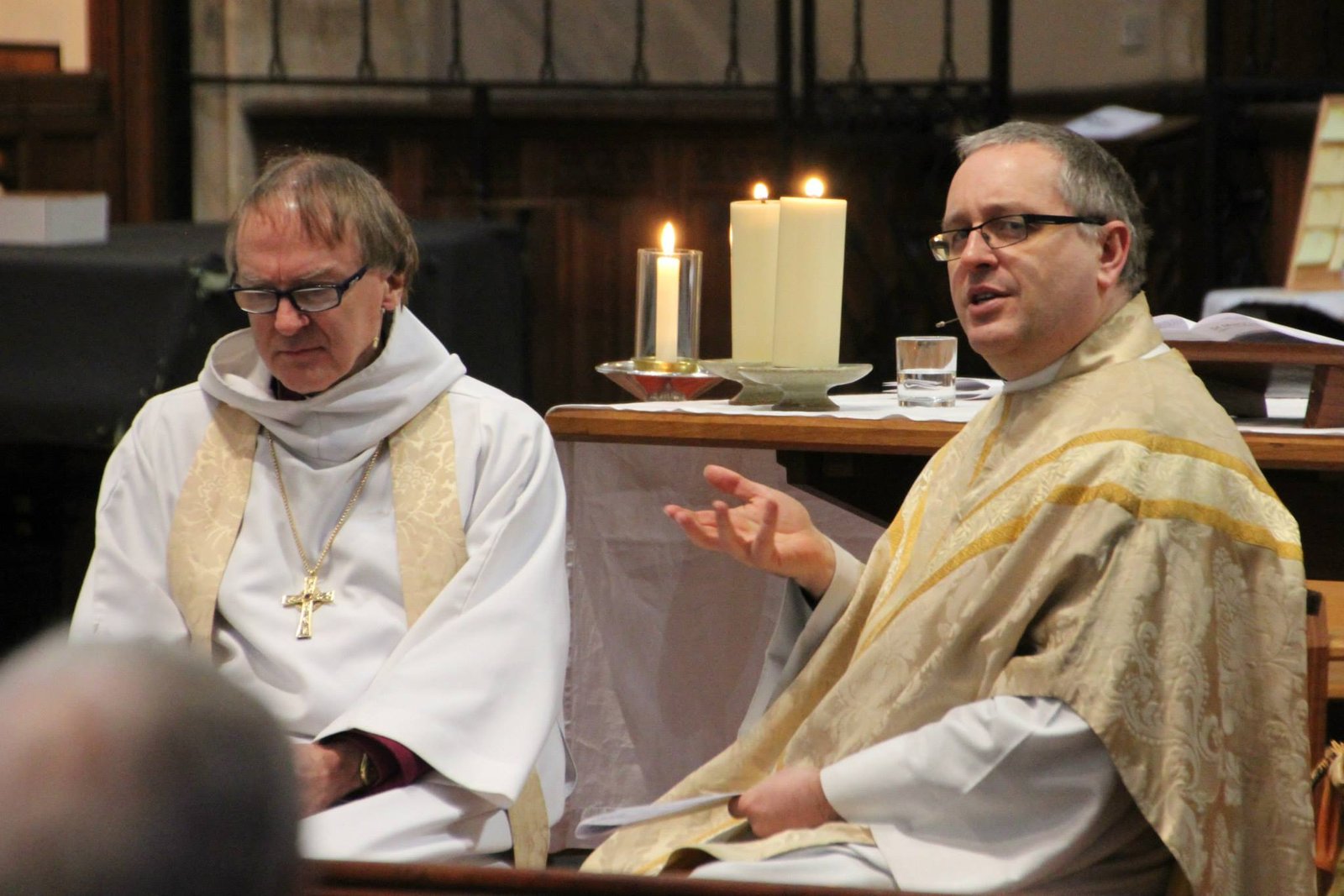
• Sermon for Epiphany 4

    If you look carefully at the video, you might spot the moment when I realised that I didn’t have all the pages of this sermon with me in the pulpit.

    Sermon preached on 1 February 2015 from Kelvin Holdsworth on Vimeo.

    Come out and shut up

    On Friday, we celebrated a commemoration in the Scottish Episcopal Church. Not one that matters to most people. Not one that is graded high enough to automatically merit a mass. Not indeed, one that most people will have thought much about at all.

    However, last Friday was the commemoration of Charles I – King and Martyr as some liturgical books in our tradition describe him.

    I don’t want particularly to preach a defence of Charles I here today. However, I do want to call him to mind as a jumping off point before we get into looking at the bible passages in the light of our own times. For those of you who don’t know the history of this country, Charles I was a King who ended up being beheaded. And all manner of trouble came to the Scottish Episcopal Church because it maintained its allegiance to the Stuart cause afterwards. Within 50 years various penal laws had been passed restricting the ability of Episcopalians in Scotland to worship freely. For a time, it was a crime for Episcopalians to baptise people or marry them. And for a time, it was illegal for a cleric to minister to more than 5 people at a time and the punishment, if you were caught doing so a couple of times, was transportation for life.

    We had a way round it in Glasgow – Episcopalians would gather in old rooming houses – primitive tenements if you like and groups of five would meet in each room and all leave the door open onto the stair. And the priest would stand on the landing and shout (or maybe yell) the service so that everyone in each of the rooms could hear it but he couldn’t be accused of speaking to anything more than 5 people.

    Occasionally I’ve thought of trying to recreate this scene in the tenement I now live in, particularly when I had downstairs neighbours who were fond of Saturday evening parties.

    There’s a certain romance about thinking about the people of the past getting around the penal laws in that way.

    However, the danger with looking back is that we see the past through rosy spectacles and forget reality. Episcopalians need to remember that we were capable of doling out persecution to others when we managed to get hold of the levers of power.

    In particular this year, we will be reminded of this as the Roman Catholic Church remembers the 400th anniversary of the martyrdom of St John Ogilvie. It is the case that the Episcopalian bishop of the time – one of Bishop Gregor’s predecessors in effect, had a direct part in Ogilvie’s capture, trial and death. Indeed John Ogilvie was keep imprisoned in the Bishop’s palace.

    Now, I’m remembering some of the religious conflicts of the past this morning not just because there’s an Old Firm game this afternoon but rather because I want to think about one of the big questions of the day in the light of our scripture readings. And in the light of the fact that our scripture readings this morning are not really much help.

    Over the last few weeks we’ve been forced into thinking about free speech. None of us saw it coming, but the murders of the cartoonists in Paris suddenly uncovered huge questions which I think we probably still have some way to go in trying to answer.

    Is free speech a right? Is it absolute? Are there limits?

    Cast your mind back to the first reading that we had this morning.

    Did it give you a sense of outrage to hear it read in church? Maybe it should do. Maybe that’s the point of reading it.

    The Lord your God will raise up for you a prophet – But any prophet who speaks in the name of other gods, or who presumes to speak in my name a word that I have not commanded the prophet to speak—that prophet shall die.

    Free speech does not come naturally to us.

    And that should give us pause for thought.

    I was also struck by the gospel reading this morning. It comes at the start of the Gospel of Mark that we are reading this year. Presumably that story comes in the first chapter because it was thought to be important. It comes right after the call of the disciples.

    And the first thing that Jesus is presented as doing after gathering the disciples is telling someone in the synagogue very firmly to shut up.

    It is one of those times where Jesus doesn’t seem to be terribly nice. Not terribly Christian, in the way that people often presume Christian to mean.

    God wants to kill dissenting prophets. Jesus tells the first person he encounters outside his close group to shut up.

    There’s no free speech there.

    I wanted to highlight this because I think it is important sometimes to remember that Scripture isn’t helpful to us and we need to know where to turn when that is the case.

    In particular I think we need to remember that the Anglican tradition, which we belong to here, looks to other sources of authority as well as scripture – in particular, tradition and reason.

    And perhaps they are more help when we are trying to think about the free speech controversies of our day.

    The conflicts of the past that I’ve spoken of this morning remind us that we’ve been on both ends of religious persecution and attempts to silence people because of their faith. And maybe that gives us permission to try to work out what appropriate ethics of freedom of expression for our own times. Our own tradition here has been silenced. And our own tradition has done some of the silencing.

    Our own tradition has been persecuted. Our own tradition has done the persecuting.

    People of our own traditions died. People of our own tradition caused others to die.

    And that experience should help us see modern controversies from both sides.

    And maybe that experience from our history can inform us in using reason as we try to work out what to say about free speech today.

    So I’ll tell you where I think the limits lie and you can tell me later or discuss online whether you think I’m anywhere near what’s reasonable. Because everything is a conversation these days. Or at least, everything should be.

    I think that freedom of speech is something that allows us to worship in this city, in this building, in this way, at this time.

    That experience makes me think that we’re onto something important in modern society in believing that free speech matters. And that should make us want to defend it strongly from our religious experience, if not from our scriptures and our history.

    However, as victims of hatred that led to persecution, we’ve also got something to say to those who would see themselves today as being victims of hate-speech.

    I think that freedom of speech is vital but has to be limited. And the line I would draw, and the line that I think the law tries to draw is, where speech becomes a weapon and is used to threaten others with harm.

    And because I’ve said that everything is a conversation these days, here are some questions that are worth thinking about this week.

    • Having heard today an argument from scripture against freedom of speech – can we think of things which would support it?
    • Having been both the persecuted and the persecutors in our own history, can we see things both from the point of view of those holding up their pencils and demanding a right to say anything and also from the point of view of those on the receiving end of a freedom being used to abuse and mock things others hold dear?
    • Lastly, as people who believe God to be good and loving, how can we convey that love to those whom we meet this week?

    For I think that the world needs that love right now.

    Can we commit ourselves in our minds this day to show forth God’s love wherever we go.

    Can you do that this week?

    I think that might be the gospel we are called to share this week.

    It might be worth remembering the saying purported to St Francis of Assisi. – “Preach the gospel. Use words… if you have to.”

10 responses to “Guest Post: At Home Among the Dissenters – John McLuckie”

  1. tom donald Avatar

    Are you really PAID by the NHS? Money that could pay for a nurse or a physiotherapist? You must be tremendously confident that your faith is meaningful if you are! I’m not sure if I envy that or not…

    1. Beth Avatar

      In most hospitals, there are hospital chapels and hospital chaplains. It isn’t a new or shocking thing. My experience has been that most of them do very good work, and are available for anyone from any religion who wishes to speak to them and don’t force themselves on the ones who prefer not to. The practice of medicine is about a lot more than just the physical, especially in a cancer hospital, and unless you want doctors to be the ones offering spiritual support (I don’t think I’d be that good at it, I don’t have enough hours in the day as it is, and, as my patients have to see me whether they subscribe to my religion or not, I think it can be inappropriate and intrusive), I’m quite happy for the NHS to pay someone who specialises in the area of spiritual support to fulfill that very real need.

      – Beth, who works for the NHS

      1. Ruth Avatar
        Ruth

        Thank you Beth. I couldn’t have put it better.

        – Ruth, whose sister died in hospital not all that long ago

    2. Rosemary Hannah Avatar
      Rosemary Hannah

      Agree with Beth, and …
      is this really a world where the big ideas about birth, death, love, hate, forgiveness, suffering should not be discussed? Where one can live and suffer and give birth and die without thinking about them? does not the very suggestion this should be so impoverish us every bit as much as as suffering and death can? And is certainty in any way necessary to enter such a discussion?

      1. tom donald Avatar

        Interesting! My original question was about confidence… here’s one to test it a little more, today there’s a headline in the Guardian:
        ” NHS to axe cancer and heart experts. Charities and doctors warn that treatment of killer diseases will suffer as number of teams is cut”
        Yet according to the BBC the NHS is spending £40 million per annum on chaplains!
        Which means that chaplains must be VERY confident that this money is better spent on talk than treatment, or I’m sure they wouldn’t take it. Would they?
        By the way I was a nurse at Gartnavel Royal for many years. Never saw hide nor hair of the chaplain up there, although apparently, there was one!

  2. John MacBrayne Avatar
    John MacBrayne

    What an excellent blog John has. Most interesting. Thanks for the link.

  3. Rosemary Hannah Avatar
    Rosemary Hannah

    Um – as one with friends and family in the NHS I wonder how much of the money spent in the last weeks of a terminally-ill person’s life is well spent. Sometimes a great deal is spent on treatments which are hugely unpleasant and prolong life by weeks or months at best. I made a decision years ago that when (and given family history when is more likely than if) I find myself there I will ask very searching questions.

    I won’t answer for John, but for myself… I am ‘tremendously confident’ that examining the questions around my faith is ‘meaningful’ and indeed essential. That is not at all the same thing as being sure my beliefs are right.

    We have what is supposed to be a Health Service – something which promotes well-being. People are more complex than their conditions – and we all die one day. A great deal of money is spend on all kinds of things which make the lives of those in hospital better, because people cannot get through life-crises on medicine alone.

  4. tom donald Avatar

    I think that characterising cancer and heart disease treatment as terminal care is extremely depressing, and perhaps fifty years out of date. And the health service is there to promote well-being? I don’t think so, I think it’s to provide medical and para-medical care during illness..
    Not that I don’t love chatting to a minister of religion, anytime. I do! But not on the NHS budget please! UNLESS…
    Unless it’s been demonstrated in properly designed clinical trials that a visit from the chaplain is worth the cash. That’s the test for all the other expensive treatments we’re paying for!

  5. rosemary hannah Avatar
    rosemary hannah

    I did not describe cancer and heart conditions as terminal. However I do expect to die one day.

  6. Ruth Avatar
    Ruth

    I’m not sure that the benefits to a patient from a visit from the chaplain could be usefully or accurately measured by ‘properly designed clinical trials’…. from a personal viewpoint I know that the last twelve weeks of my sister’s life (a young 62 year old with cancer and desperate to live) were made more bearable by the chaplain’s ability to help her cope with the sullen, spitefulness of too many of her nurses.

Leave a Reply

Your email address will not be published. Required fields are marked *

Previous Posts

  • To Moffat

    To Moffat today for the Diocesan Council. “What is the Diocesan Council?”, I hear you ask, your interest piqued and your excitement rising. Well, the Diocesan Council consists of elected people from the different Regions of the Diocese of Glasgow and Galloway who meet together several times a year to do the business that needs…

  • Whither the Kirk?

    I watched with interest the BBC documentary last night about the Church of Scotland. (A Church in Crisis on BBC 1 Scotland) I guess that those who were hoping for a celebration of 450 years since the Scottish Reformation were a little disappointed. The programme was something of a lament and really rather sad. They…

  • What’s in Kelvin’s Tooth

    If its Tuesday, it must be root canal treatment and another session of gazing into the eyes of Stylianos whilst he does things inside my mouth which feel like someone is twanging a rubber band behind my nose. Again. After some time poking and twanging, Stylianos shakes his head sadly and says, “No, the infection…

  • Glasgow Landmarks

    Oh, here’s something to do! If you like St Mary’s Cathedral, why not nominate it as one of Glasgow’s Landmarks on this page: http://www.glasgowlandmarks.org.uk/ Closing date for nominations is Wednesday at 5 pm.