
• Bible Study – Turning Over a New Fig Leaf

    We had a good bible study last night at the LGBT group here at St Mary’s. I thought I’d post the basic questions here and see whether people wanted to have a go at answering them here too.

    First of all we read most of Genesis Chapter 2. (You can find the text at the Oremus Bible Browser)

    Then we had a go at these questions

    • What strikes you about the text?
    • Does the text tell us more about how people think about God or about how God thinks about us? Why?
    • What different patters of partnership can you think of from the Bible?

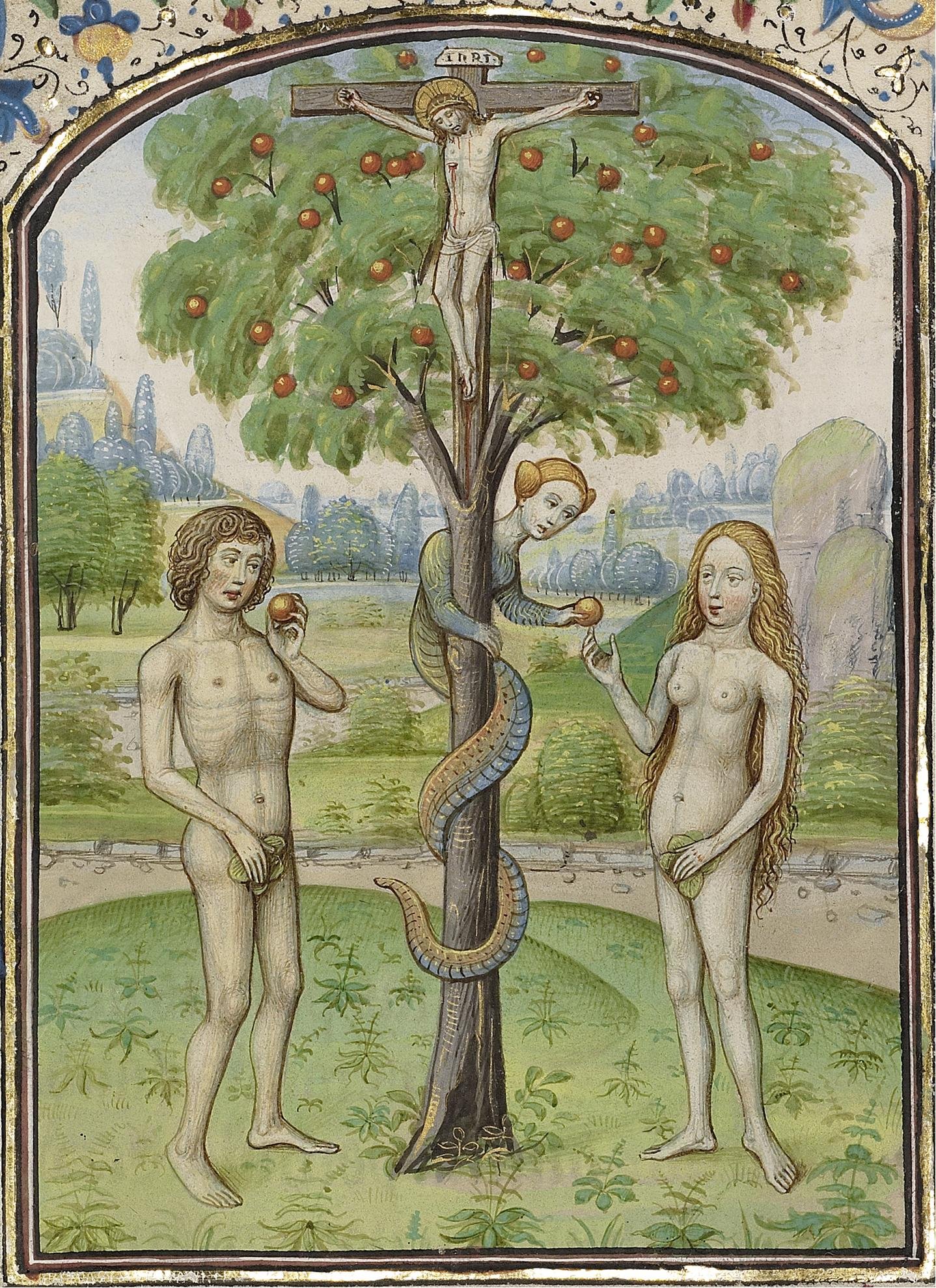
    And then we had a look at this picture (Willem Vrelant, 1460s illuminator Flemish, died 1481—Digital image courtesy of the Getty’s Open Content Program.)
    Adam and Eve

    And tried to answer these questions:

    • What strikes you about the picture?
    • What influence does this story have on you today?

    I’d be interested to hear any responses on here. (Why can’t we do bible study on a blog post?)

    And here is an extra question for those answering today:

    • What difference do you think it might make studying the story of Adam and Eve in an LGBT group to any other group?

    Don’t be shy…

52 responses to “Inclusive Language – again”

  1. ryan Avatar
    ryan

    Kelvin – that cracked me almost as much as your last tweet on the left of your blog ;-)!

  2. Jimmy Avatar

    Ryan, although you address your comment to Kelvin like I am not there. I assume you are referring to my poem, I can assure you that it does not crack me up watching you making any opinion you may have untenable.

    1. kelvin Avatar

      No Jimmy – I think Ryan was indeed referring to my last comment, above.

  3. Jimmy Avatar

    Thank you Kelvin and Sorry Ryan.

  4. ryan Avatar
    ryan

    No worries! Was indeed referring to the v.amusing coming out day tweets at the side.

    I’m not sure there’s ever existed anyone, anywhere,at any time, of whom it could be said that *all* their opinions are ‘untenable’, so such rhetoric is dehumanising at best. Apropos nothing, I was moved to google the poetic stylings of the great David Brent. Who needs Auden? 😉
    http://murfinsandburglars.com/2009/04/14/bad-poetry-for-tuesday-david-brent-edition/

  5. Peter Avatar
    Peter

    Kelvin; no, I think it distracts. It simp;ly reminds us that this is how your mind works: you make connections and delight in that sort of word-play. However, to sharpen up my point. Thank you for helping me to realise that, for some, ‘family’ is not a positive word in the way in which I experience it. For my part, this willl mean that I will be more careful about its use when others might feel excluded (and therefore hurt). Mutatis mutandi can you accept that I feel offended by what seems to be merely a casual linking between family and the f word? These are sensitive areas, but sensibilities are by no means confined to those who find family a painful or unhelpful concept.

  6. Simon Avatar
    Simon

    I am slightly nervous aboaut the alternatives to the 1982 Liturgy, not because I don’t share the inclusive sentiments expressed above (I do). I fear that, as so often in the history of the church, the steps we take to avoid one kind of mistake in the way we talk about God can lead us into another. The avoidance of pronouns as a measure to achieve inclusivity produces inelegant, strained and stilted English. How would it be if one were to use it in day-to-day speech? ‘I saw John this morning. I asked John’s how John’s health was. John said that John was over his flu, and hoped to be back at work on Monday’. This may not in itself seem to be a problem. But in fact, what very quickly happens when we adopt this idiom in addressing/expressing God, is that the very idea of a personal God begins to recede. My basic instinct is that the church’s language of pulbic prayer is properly anchored in that of the scriptures. There are dangers in departing from this. The perceived problem (rightly perceived) is perhaps better tackled by good teaching about the nature of God, than by linguistic contortions that produce stilted prayers, and possibly a less real and vivid idea of God.

  7. Melissa Avatar
    Melissa

    About the family imagery – another reason to drop it in church is for the sake ones who, like me, do actually have the signifying family relationships.

    There is too much pressure on day to day life with children when that life is forced to serve as some kind of example or testimony or witness to the world – or more likely one’s church friends – about the nature of God.

    I think it sours love because in that kind of scheme loving children is more fundamentally a means to an end.

Leave a Reply

Your email address will not be published. Required fields are marked *

Previous Posts

  • To the Theatre Royal, Tarantara!

    As if there were not enough camp Victoriana in my life already, I took myself off last night to the Theatre Royal for a splendid Pirates of Penzance by the Carl Rosa company. It would be fair to say, upon looking around at the audience, that the young people of Glasgow have not yet discovered…

  • I know a fount

    Quite like the new font that has been “cut” for the Times headlines. As the paper has gone compact, it needs a more compact font for headlines to get all the words in. Don’t like the sans font that is sprinkled through the paper looking like confetti dropped by a Guardian reader. How quaint of…