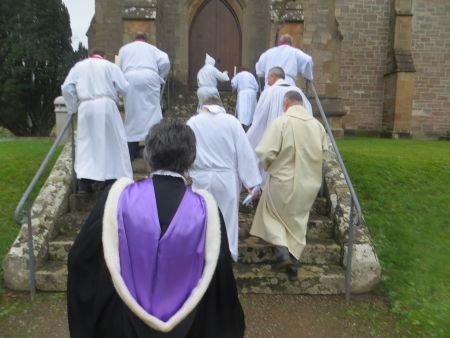
• Palm Sunday

    There’s no sermon from yesterday to upload. It is the only Sunday in the year when we have no preaching and simply let the story do the work. It is our custom on Palm Sunday to read the Passion story – that’s the story of the end of Jesus’s life from whichever gospel we have been reading through the year.

    Here at St Mary’s, the congregation, who are the body of Christ, read the words of Jesus whilst two people at the front narrate the rest of the story.

    Yesterday is probably the chilliest Palm Sunday on record. Here in this part of the world, we usually associate Holy Week with a growing sense of spring. New life is all around us. This year, it feels as though it hasn’t quite arrived.

    However, that’s a reminder that Holy Week is celebrated in all kinds of contexts. I struggle a bit working out how people could celebrate Easter in the autumn, but that, of course, is what happens in the southern hemisphere. There must be places where Palm Sunday is always held in the snow and it is hard to imagine what that is like.

    As it was yesterday, there was not much snow here. Much of the rest of the country was covered in it but it was a clear, if bracing day.

    I found myself taking to liturgical gloves.

    Brrr.

One response to “Eid, Pride and Abraham’s Sacrifice”

  1. Tim Avatar

    As one who grew up(?) in churches leaning toward the view “it’s a tough story for a tough world, how else would God be just?” in varying degrees, I agree the face-value-narrative understanding of the story is repellant.

    One thing stood out for the first time during Sunday’s reading: the plurality in Abraham’s line – “…and we will return to you”. I’ve been idly wondering about that since.
    It doesn’t make the story wholly acceptable as Abraham still ploughs on ever closer.
    But if one’s goal is to find a “by faith, Abraham” in there, better to say it’s the prior confidence that things will somehow work out well (which I thought was how Hebrews was trying to define it), than to locate the commendable quality in violence (which, by rabbiting on about resurrection, Hebrews does).

    In the absence of other clear & wholly mitigating contexts in which to place the story, certainly it’s simplest, easiest and probably best to file it under “that’s how they saw God back then” and move swiftly on.

    Oofft.

Leave a Reply

Your email address will not be published. Required fields are marked *

Previous Posts

  • Time for a song

    Now maybe there's a God above But all I ever learned from love Is how to shoot at someone who outdrew you It's not a complaint that you hear tonight It's not someone who's seen the light It's a cold and lonely HallelujahI did my best, it wasn't much I couldn't feel, so I learned…

  • Sexretary

    Deliciously, the latest statement on the usual topic from the bishops of the Scottish Episcopal Church has been sent out by someone claiming to be a sexretary.

  • Sermon – 5 June 2005

    The bible makes for poor history and worse law. As history it is inevitably a record of either those celebrating victory or those bearing a grievance. As law, it is hard to know whether to try to keep the detail or to try to extract precepts. The readings this morning give us much to think…